A real forecast is not the same thing as a good investment
In April 2026 the Quantum Economic Development Consortium published its annual survey of the industry. Buried in it is the number that has been quoted in almost every quantum article written since: global quantum computing revenue was US$1.4 billion in 2025, and is forecast to more than double to US$3 billion by 2028 — a compound growth rate of about 30 per cent a year.
That figure is not marketing. It comes from a consortium managed by the US National Institute of Standards and Technology, surveying 556 pure-play quantum companies and more than 7,400 organisations working with them. McKinsey, working from a different definition, is more bullish still: it puts the quantum computing market at US$43–71 billion by 2035.
So the premise holds. This is a real industry, growing fast, with a plausible path to being much larger.
And it still does not follow that quantum computing shares are a good thing to buy and hold for ten years. Those are two separate questions, and almost everything written about quantum stocks answers the first one and then quietly presents it as an answer to the second.
An industry growing 30 per cent a year and a share priced for 30 per cent a year are not the same object. You can be completely right about the first and lose money on the second.
This article does the second question. It sets out what quantum computing actually is, where the technology genuinely stands in September 2026, who the participants are, and then does the arithmetic that decides whether a long hold works — including the two things Australian investors face that American commentary never mentions: there is no ASX pure play, and the capital gains tax rules change on 1 July 2027.
- The 30% claim, and where it comes from
- What a quantum computer is, in plain English
- Where the technology actually stands
- The main participants, in five groups
- Australia's quantum industry, and who owns it
- The arithmetic that decides everything
- The dilution wedge
- The bear case
- The base case
- The bull case
- What would have to happen for the bull case
- How an Australian actually gets exposure
- The tax question nobody is asking
- How to hold a speculation for ten years
Data current to 6 September 2026. Sources: QED-C, State of the Global Quantum Industry 2026 (14 April 2026); McKinsey Quantum Technology Monitor 2026 (28 April 2026); company results for the quarter to 30 June 2026; market prices at the close of 4 September 2026; Gidney, arXiv:2505.15917 (21 May 2025); Quantinuum, 5 November 2025. Full source list at the end.
The 30% claim, and where it comes from
Growth forecasts for quantum computing vary wildly, because the people making them are not measuring the same thing. It is worth separating them before leaning on any of them.
QED-C, in its State of the Global Quantum Industry 2026 report of 14 April 2026, measures actual revenue reported by quantum companies. It found US$1.9 billion across the whole quantum industry in 2025, of which US$1.4 billion was quantum computing and US$470 million quantum sensing. It forecasts the computing segment to exceed US$3 billion by 2028, which is the 30 per cent a year figure. Sensing grows slightly faster, at 32 per cent.
McKinsey, in its Quantum Technology Monitor 2026 of 28 April 2026, forecasts further out and defines the market more broadly. It puts quantum computing at US$43–71 billion by 2035 and the whole quantum technology market at US$60–100 billion, with US$1.3–2.7 trillion of economic value at stake across end industries. Getting from roughly US$1 billion in 2025 to US$43–71 billion in 2035 implies growth of 45 to 53 per cent a year, not 30.
MarketsandMarkets, counting hardware, software and services together, has the market at US$3.52 billion in 2025 growing to US$20.2 billion by 2030 — 41.8 per cent a year. Its 2025 base is two and a half times QED-C's, which tells you how much of the disagreement is definitional rather than substantive.
Take the most conservative of these and extend it honestly. Grow US$1.4 billion at 30 per cent a year for ten years and you arrive at roughly US$19 billion of global quantum computing revenue in 2035. That is a real industry — about the size of the global pet food market today — built out of almost nothing in a decade. It is a genuine success story.
Hold that number. We will come back to it, because the listed quantum companies are already worth two and a half times it.
What a quantum computer is, in plain English
You do not need the physics to make an investment decision, but you do need enough of it to tell a milestone from a press release.
An ordinary computer stores information in bits, each of which is a nought or a one. A quantum computer uses qubits, which can hold a combination of both at once, and which can be linked to each other so that the state of one depends on the state of another. Run a calculation across a set of linked qubits and you are, loosely, exploring many possible answers at the same time rather than one after another.
That sounds like a machine that does everything faster. It is not. A quantum computer is not a faster computer. It is a different kind of machine that is dramatically better at a narrow set of problems — factoring very large numbers, simulating molecules and materials, some optimisation, some sampling — and no better, or worse, at almost everything else. Microsoft's own Matthias Troyer has described it as not a general-purpose technology but a niche technology that can only solve a few specific problems
.
The catch, and it is the whole industry in one sentence, is that qubits are extraordinarily fragile. A stray vibration, a photon, a fraction of a degree of warmth, and the state collapses. Errors accumulate faster than the calculation progresses. Which is why the entire field now revolves around one idea.
Because physical qubits are so error-prone, you gang many of them together and use the redundancy to detect and correct errors as the calculation runs. The result is one reliable logical qubit built out of many unreliable physical ones. Useful work needs logical qubits, and lots of them.
So whenever a company announces a qubit count, the first question is which kind. A headline about 6,100 physical qubits and a headline about 48 error-corrected logical qubits are not comparable, and the second is much harder. Caltech assembled a 6,100-qubit array in September 2025 that performed no entangling gates and no error correction at all. It was a real achievement and it computed nothing.
There are five main ways to build a qubit, and no consensus on which wins. Superconducting circuits chilled to near absolute zero (IBM, Google, Rigetti, IQM, D-Wave). Trapped ions held in electromagnetic fields (IonQ, Quantinuum). Neutral atoms held by lasers (QuEra, Pasqal, Atom Computing, Infleqtion). Photons of light (PsiQuantum, Xanadu). And silicon spin qubits made on semiconductor lines (Diraq, Silicon Quantum Computing, Quantum Motion) — the approach Australia is deepest in.
This matters for an investor because it is the clearest reason not to hold a single name. Four of those five approaches will end up as footnotes. Buying one company is a bet on the technology and on that company's execution and on its balance sheet surviving long enough to find out.
Where the technology actually stands in September 2026
The honest summary is that the science has gone better than sceptics expected and the commerce has gone worse than promoters implied. Both halves are true at once, and most coverage picks one.
On the science, three results genuinely moved the field.
Google's Willow chip, December 2024. Published in Nature. Google showed that as it scaled its error-correcting code from distance three to five to seven, the error rate halved at each step. That is the "below threshold" result the field had been chasing since 1995: proof that adding more physical qubits makes the logical qubit better rather than worse. Everything after it rests on this.
Quantinuum's Helios, November 2025. A 98-physical-qubit trapped-ion machine running 48 fully error-corrected logical qubits, at a roughly two-to-one physical-to-logical ratio, with two-qubit gate fidelity of 99.921 per cent. Eleven months earlier the record was one logical qubit on 105 physical ones. That is a steep curve.
Google's Quantum Echoes, October 2025. Also in Nature. A claimed 13,000-times speed-up over the best classical algorithm on a leading supercomputer, and — the important part — the first advantage claim that is verifiable, in that another quantum machine can repeat it. A challenge published in April 2026 concluded that the circuits are effectively incompressible by tensor-network methods, so the claim has survived its first serious test. It has not yet survived the second or the third.
| Result | Who | Date | Status |
|---|---|---|---|
| Below-threshold error correction | Google Willow | Dec 2024 | Peer-reviewed, Nature |
| Cat-qubit logical error rates | AWS Ocelot | Feb 2025 | Peer-reviewed, Nature |
| 96 logical qubits, magic-state distillation | QuEra with Harvard, MIT, Yale | 2025 | Peer-reviewed |
| Verifiable quantum advantage | Google Quantum Echoes | Oct 2025 | Peer-reviewed, contested but standing |
| 48 error-corrected logical qubits | Quantinuum Helios | Nov 2025 | Commercially launched |
| 120-qubit Nighthawk processor | IBM | Jan 2026 | Delivered, on the cloud |
| Topological qubit | Microsoft Majorana 1 and 2 | Feb 2025, Jun 2026 | Disputed; a retraction has been publicly called for |
| Fault-tolerant commercial machine | Nobody | — | Does not exist |
Sources: Google Quantum AI (Nature, 9 December 2024 and 22 October 2025); Amazon Science (27 February 2025); QuEra (December 2025); Quantinuum (5 November 2025); IBM (13 January 2026); Scientific American and Nature news (24 June and 3 June 2026).
Against that, the commercial record is thin. As at 6 September 2026 no quantum computer has demonstrated an advantage on a real commercial problem that has survived sustained classical challenge. The history here is unkind and worth knowing.
In 2018 a 19-year-old undergraduate, Ewin Tang, took what was considered one of the strongest candidates for an exponential quantum speed-up — a quantum recommendation algorithm — and wrote a classical algorithm that matched it to within a polynomial factor. The advantage evaporated.
In 2022 Chinese researchers reproduced Google's 2019 "quantum supremacy" result in about fifteen hours on GPUs. Google had said classical hardware would need ten thousand years.
In July 2026 a team from the Flatiron Institute and Boston University, publishing in Science, reproduced on a laptop the spin-glass dynamics that D-Wave's March 2025 Science paper had claimed exceeded the Frontier supercomputer. D-Wave disputes this, arguing the classical method fails on the hardest lattice geometries and higher-order observables, and maintains its result stands.
The pattern is not that quantum advantage is fake. It is that every claim gets attacked, and a good share of them fall. Treat any advantage headline as provisional for at least two years.
The other 2026 development an investor should know about runs the other way, and it is the strongest thing the bulls have. Three papers in ten months slashed the estimated hardware needed to break public-key encryption.
Craig Gidney of Google cut his own 2019 estimate for breaking RSA-2048 from 20 million noisy qubits to fewer than one million in May 2025. In February 2026 Iceberg Quantum — founded by three researchers who met doing PhDs at the University of Sydney — published an architecture claiming it could be done with fewer than 100,000.
Scott Aaronson, one of the field's most careful sceptics, called that work serious
and entirely plausible
while noting it assumes 99.9 per cent two-qubit gate fidelity at scale, which has not been demonstrated. Iceberg's own hardware partners put the timeline at three to five years. Aaronson himself, having spent years warning about hype, wrote in December 2025 that the year had updated me in favor of taking more seriously the aggressive pronouncements
of Google, Quantinuum, QuEra and PsiQuantum about 2028 and 2029.
That is the single most important thing to understand about the bear case: the most credible sceptics have moved, and they have moved toward the bulls on timing. What they have not done is say anything about which listed company captures the value. Those remain separate questions.
The main participants, in five groups
The word "quantum" is doing a lot of work in most stock lists. The companies sit in five quite different groups, with quite different risks, and only one of those groups is what people mean when they say quantum stocks.
1. The listed pure plays
These are the small number of companies whose business is quantum computing and whose shares you can buy today. There are nine of any size, and five of them have listed since February 2026 — a fact worth noticing on its own.
| Company | Ticker | Price | Market cap | Revenue (12mth) | Price/sales |
|---|---|---|---|---|---|
| IonQ | IONQ (NYSE) | US$39.52 | US$15.70bn | US$246.5m | 64× |
| Quantinuum | QNT (Nasdaq) | US$49.65 | US$13.07bn | US$23.0m | 569× |
| D-Wave Quantum | QBTS (Nasdaq) | US$16.58 | US$6.18bn | US$12.4m | 497× |
| Rigetti Computing | RGTI (Nasdaq) | US$15.20 | US$5.07bn | US$13.4m | 380× |
| Xanadu | XNDU (Nasdaq, TSX) | US$9.72 | US$2.95bn | US$7.2m | 410× |
| Infleqtion | INFQ (NYSE) | US$12.85 | US$2.90bn | US$42.4m | 68× |
| IQM Quantum Computers | IQMX (Nasdaq) | US$10.80 | US$2.06bn | US$39.0m | 53× |
| Quantum Computing Inc | QUBT (Nasdaq) | US$8.01 | US$1.81bn | US$9.8m | 185× |
| Arqit Quantum | ARQQ (Nasdaq) | US$21.37 | US$0.35bn | US$1.1m | 326× |
| Combined | US$50.1bn | US$394.8m | 127× |
Prices at the close of 4 September 2026. Revenue is the trailing twelve months to 30 June 2026, except Arqit (six-monthly reporter, to 31 March 2026). Arqit's share count is at 31 March 2026 and its at-the-market programme is active, so its market cap is understated. Xanadu's market cap applies the traded price across both share classes.
The three companies at the cheap end of that chart deserve an asterisk, because their revenue is not really quantum revenue. IonQ's jump to US$80.1 million in the June 2026 quarter, up 287 per cent, came substantially from its acquisition of SkyWater Technology, a semiconductor foundry, completed on 31 July 2026. Infleqtion and IQM both carry sensing, defence and systems revenue alongside their quantum computing work. Strip that out and the sector's revenue base is smaller than the table suggests.
IonQ is also the only one of the nine that gives revenue guidance at all — US$280–290 million for 2026. Rigetti, D-Wave, Quantum Computing Inc, Arqit and Xanadu all decline to forecast their own revenue. That is not a scandal; it is what companies do when they cannot see a year ahead. It is worth knowing before you build a ten-year thesis on their numbers.
2. The incumbents
The deepest quantum research in the world is being done inside companies whose share price barely notices it.
| Company | What it is actually doing | Quantum as a share of the business |
|---|---|---|
| IBM | The most detailed public roadmap in the field: Nighthawk delivered January 2026, Starling fault-tolerant target 2029. More than US$10bn committed over five years | Not a reported segment. CEO expects measurable revenue impact "in 2028 or 2029" |
| Alphabet (Google) | Willow, below-threshold error correction, Quantum Echoes. Arguably the best science in the field | Sells nothing. Willow is research-access only, by application |
| Microsoft | Topological qubits (Majorana 1 and 2), Azure Quantum reselling third-party hardware | Immaterial, and the core scientific claim is disputed |
| Amazon | Ocelot cat-qubit chip; Braket cloud brokerage; a 2028 target with QuEra | Immaterial and undisclosed |
| Nvidia | NVQLink, CUDA-Q and the Ising models — the classical control and error-decoding layer for everyone else's qubits | Sells no qubits at all. Monetises GPUs whichever hardware wins |
Nvidia's position is the one worth pausing on, because it is the closest thing in this sector to a way of being right without having to pick. It does not build qubits. It builds the classical machinery that calibrates them and decodes their errors, and it has signed up nineteen quantum hardware builders across every competing modality — including two Australian ones. If quantum computing works, Nvidia sells into it. If it does not, Nvidia loses nothing. That asymmetry is also why owning Nvidia is not really quantum exposure: the quantum part is a rounding error in a company valued on artificial intelligence.
Jensen Huang wiped roughly US$8 billion off the sector in a single session in January 2025 by saying useful quantum computers were fifteen to thirty years away. By June he was calling it an inflection point. Neither statement was information about any company's earnings.
3. The private leaders
Some of the strongest teams in the field cannot be bought at all, which structurally disadvantages the listed names.
PsiQuantum raised US$1 billion in September 2025 at a US$7 billion valuation, from BlackRock, Temasek, Baillie Gifford, Nvidia's venture arm and Macquarie Capital. QuEra raised over US$230 million in December 2025, led by Google's own quantum division and SoftBank. Atom Computing raised more than US$300 million in June 2026. Alice & Bob and Pasqal are backed by the French state; Pasqal is listing via a SPAC at about a US$2 billion valuation.
The pattern is that the best-funded and often best-regarded work sits outside the listed market, and when it does list — Quantinuum in June 2026, Infleqtion in February 2026, Xanadu in March 2026 — it lists at prices that already reflect years of private enthusiasm. Quantinuum's US$1.68 billion IPO priced at US$60 on 3 June 2026, closed flat on debut, and traded at US$49.65 three months later.
4. The security layer
A great deal of "quantum" spending over the next decade will not go to quantum computers at all. It will go to replacing the encryption that quantum computers would eventually break. NIST finalised three post-quantum cryptography standards on 13 August 2024 and added a fourth algorithm in March 2025; the US National Security Agency requires national security systems to complete the migration by 2035, and NIST proposes to deprecate RSA-2048 after 2030.
This is a large, well-funded, mandated migration. It is also a software and certificate project. Its beneficiaries are hardware security module makers, certificate authorities, cloud providers and systems integrators — none of whom need to own a quantum computer. The one listed pure play selling quantum-safe encryption, Arqit, has US$1.1 million of annual revenue and 16 per cent of its shares sold short.
5. Australia
Which brings us to the group Australian readers most need to understand, because the answer is uncomfortable.
Australia's quantum industry, and who owns it
Australia is genuinely good at this. Two of the eleven companies selected worldwide for Stage B of the US Defense Advanced Research Projects Agency's Quantum Benchmarking Initiative in November 2025 are Australian: Diraq and Silicon Quantum Computing, both in Sydney, both working on silicon spin qubits. Nvidia's NVQLink launch partners include both. Iceberg Quantum, whose February 2026 architecture cut the RSA-2048 qubit estimate by another order of magnitude, was founded by three University of Sydney PhDs.
And an Australian retail investor cannot buy any of it.
| Entity | What it is | Who owns it | Can you buy it? |
|---|---|---|---|
| PsiQuantum Brisbane | Photonic, targeting a utility-scale machine at Moreton Bay Central | Commonwealth and Queensland governments jointly committed A$940m in April 2024, as equity and loans; BlackRock, Temasek, Baillie Gifford, Nvidia at company level | No |
| Silicon Quantum Computing | Michelle Simmons' UNSW spin-out; atom-precision silicon qubits | ~A$110m raised; Commonwealth Bank, Telstra, UNSW, NSW Government; the federal government holds about a third; a further A$60m from the National Reconstruction Fund in 2026 | No |
| Diraq | Silicon spin qubits on standard semiconductor lines | A$20m from the National Reconstruction Fund (Feb 2026); a US$38m letter of intent with the US Department of Commerce (May 2026) that largely converts to equity | No |
| Q-CTRL | Quantum control software, now pivoting hard into GPS-free navigation | US$113m Series B (Oct 2024) — the largest quantum raise by an Australian company; Lockheed Martin Ventures, Salesforce Ventures, DCVC, Main Sequence | No |
| Quantum Brilliance | Room-temperature diamond quantum accelerators, Canberra and Stuttgart | ~A$59m; National Reconstruction Fund, Breakthrough Victoria, In-Q-Tel | No |
| Archer Materials (ASX: AXE) | The 12CQ carbon qubit chip, alongside a biochip medical diagnostics business | ASX-listed. A$53.9m market cap; A$7.95m raised at 27c in July–August 2026, now trading at 19c | Yes, with caveats |
Figures at 4 September 2026 where market data is quoted; funding figures as announced. Sources: Prime Minister's media release (30 April 2024); Treasury FOI 3641; DARPA Stage B selection (6 November 2025); company announcements; ASX and Google Finance.
Archer is the closest thing the ASX has, and it is not a pure play. Its recent announcements have been dominated by the biochip, not the qubit. As at its July 2026 quarterly it had achieved full-wafer manufacturing runs of its graphene qubit designs but had still not demonstrated a working qubit. Its July 2026 agreement with IonQ is frequently misreported as IonQ investing in Archer; it is the reverse — Archer is paying IonQ US$1.5 million over three years for cloud access to IonQ's machines.
AUSIEX's research desk put it plainly in February 2026: for investors wanting quantum exposure, there are no pure-play quantum companies listed on the ASX
.
The A$940 million PsiQuantum commitment is the largest single quantum investment either level of Australian government has made, and it has not gone smoothly. The original Brisbane Airport site was abandoned after two years of planning delays; a new site at Moreton Bay Central was announced on 20 May 2026 and construction began on 15 June 2026. The custom cryogenic plant is not scheduled for delivery until the second half of 2027, and commissioning follows delivery — so the machine cannot be operational in 2027 as originally promised. Reporting in December 2025 put the realistic date at around 2030.
On process: the Australian National Audit Office did not produce a report on the deal, contrary to a good deal of commentary. What happened was an internal post-implementation review by McGrathNicol, published 19 September 2025, which found the approach "appropriate" while noting that market-testing criteria were not formally documented at the outset and that the twenty-one competing firms could have been informed more explicitly. Separately, the department's legal costs on the transaction rose from A$282,300 to about A$3.3 million across nine contract variations.
None of this is a reason to be for or against quantum shares. It is a reason to be careful with the claim that Australia is "building the world's first useful quantum computer", which appears in a lot of promotional material and is at best a 2030 proposition.
The arithmetic that decides everything
Here is the calculation that no quantum stock article seems willing to do.
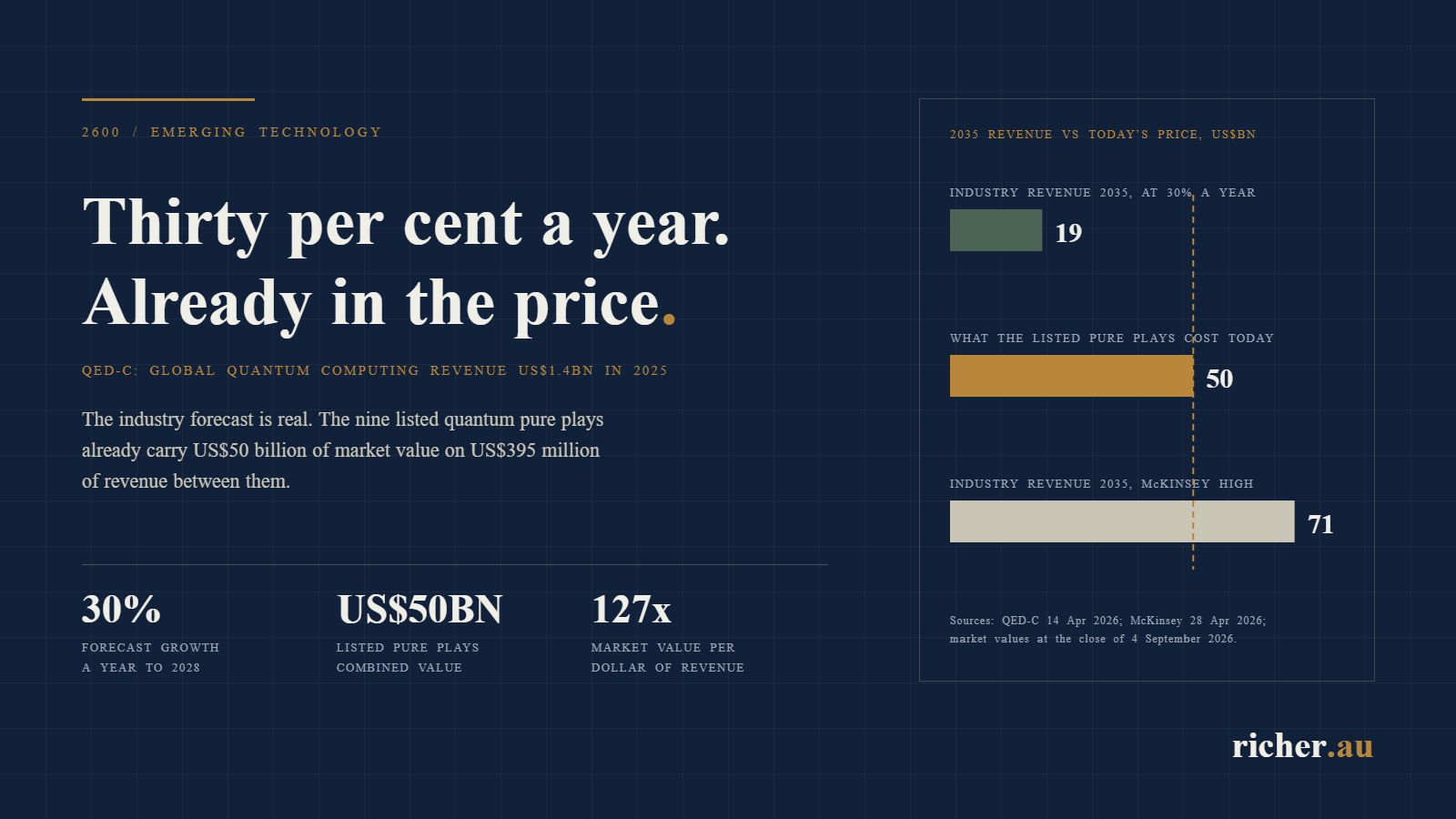
Global quantum computing revenue in 2025: US$1.4 billion. Grow it at the forecast 30 per cent a year for ten years and you get roughly US$19 billion in 2035.
Combined market value of the nine listed quantum pure plays today: US$50 billion.
So the market is currently asking investors to pay about two and a half times the entire global industry's projected 2035 revenue — not its profit, its revenue — for a group of companies that between them capture perhaps a quarter of today's market, and whose largest competitors are IBM, Google, Microsoft, Amazon and a dozen well-funded private firms.
Put the same thing another way. For the listed pure plays to be worth US$50 billion on a normal software multiple of, say, eight times revenue in 2035, they would need US$6.25 billion of revenue between them in that year. On the 30 per cent growth path that is a third of the entire global market. On McKinsey's much more bullish US$43–71 billion, it is nine to fifteen per cent — achievable, but it delivers you no gain at all after ten years of waiting, because you already paid for it.
This is what "priced for perfection" actually means, expressed in dollars rather than adjectives. The growth is not the question. Whose growth, and at what price, is the question.
None of that says the shares go down. It says the industry forecast, on its own, gives you no edge whatsoever, because that forecast is already public, widely quoted and reflected in every one of these prices. If you are buying quantum shares because you read that the sector will grow 30 per cent a year, you are buying on the most thoroughly priced-in fact in the sector.
The dilution wedge
There is a second piece of arithmetic that matters more to a long-term holder than almost anything else, and it gets almost no attention.
Every one of these companies loses money and funds itself by selling shares. Since late 2024 the four original US pure plays have raised roughly US$5.3 billion between them through at-the-market programmes and placements. IonQ alone raised US$372.6 million in March 2025, US$1 billion in July 2025 and US$2 billion in October 2025, the latter two to a single buyer and each accompanied by large seven-year warrants that represent a further claim on the company.
The effect on a shareholder who does nothing is straightforward.
Read that chart carefully, because it is the heart of the matter for anyone planning to hold for a decade. The industry can grow 30 per cent a year while your slice of it shrinks faster. A company that triples its share count over three years has to triple in value just to leave the existing owner where they started.
The counter-argument is fair and should be stated. The dilution bought genuine runway: IonQ finished June 2026 with about US$3.0 billion of cash and investments, D-Wave with US$546 million, Rigetti with US$541 million, Quantum Computing Inc with about US$1.3 billion, and none of them carries meaningful debt. In a field where the deciding factor may simply be who can fund a decade of research, having raised money into a strong share price is a competitive advantage, not a mistake. Rigetti's US$350 million programme was sold into strength, and D-Wave's June 2025 issue cleared at US$15.18 against US$6.10 five months earlier.
Both things are true. The companies raised well. The existing holders paid for it.
The bear case
The bear case is not that quantum computing does not work. Almost nobody serious argues that any more. It is that the listed pure plays are the wrong way to own it.
The valuation is the whole argument. Nine companies, US$50 billion of market value, US$395 million of revenue, and about US$1 billion of combined annual losses. Strip out IonQ, whose revenue is largely a semiconductor foundry, and it is US$34 billion against US$148 million — over 230 times sales. The three original US pure plays alone trade at roughly 367 times.
The revenue is not what the headlines say. Quantum Computing Inc's June 2026 revenue rose from US$61,000 to US$5.6 million, an increase of about 9,000 per cent. A jump like that says almost nothing about commercial traction and almost everything about how small the prior-year base was. D-Wave's revenue for the first half of 2026 was down 67 per cent, from US$18.1 million to US$5.9 million, because the prior year contained a one-off system sale. Revenue at this scale is lumpy, project-based and frequently government-funded.
Government money, not customer money, is underwriting the sector. QED-C counts US$56.7 billion of public funding commitments worldwide. IBM has a US$1 billion CHIPS Act letter of intent; Rigetti has one for up to US$100 million; Atom Computing for US$100 million; Diraq for US$38 million; Xanadu received C$195 million from the Canadian government in August 2026; PsiQuantum has A$940 million from Australia. That is a legitimate way to fund early infrastructure. It is not the same as customers choosing to buy something.
The short sellers have made specific, checkable allegations. Kerrisdale Capital argued in March 2025 that IonQ's photonic interconnects — essential to its scaling plan — were running four to five orders of magnitude below the required rate, and that two customers accounted for 77 per cent of 2024 revenue. Wolfpack Research alleged in February 2026 that a large share of IonQ's booked government revenue related to eliminated congressional earmarks; the shares fell 8 per cent. Capybara Research called Quantum Computing Inc a fraud in January 2025, and a securities class action covering that period is still before a New Jersey court. IonQ has rejected both reports as false and misleading.
Insiders have been net sellers on a very large scale. Over the five years to May 2026, net insider selling ran to about US$576 million at IonQ, US$295 million at D-Wave and US$60 million at Rigetti, against combined insider buying of roughly US$4 million. Much executive selling covers tax on vesting equity, which is the standard and fair caveat. The ratio is still striking.
And the shares behave like what they are.
Every one of these companies has fallen 69 to 79 per cent from its high inside the past twelve months. All four fell 36 to 45 per cent in one session in January 2025 because a chief executive who does not sell qubits gave a personal timeline estimate in a Q&A. Xanadu fell 67 per cent before the market opened one morning in May 2026 simply because it registered 293.6 million shares for resale.
That is not a criticism of the companies. It is a description of what you are agreeing to sit through if you plan to hold for ten years.
The base case
The base case is the least discussed and the most likely, and it looks like this.
The technology works. Error correction keeps improving on roughly the trajectory of the past two years. Somewhere between 2029 and 2033 a machine does something commercially valuable in chemistry, materials or optimisation that classical computing genuinely cannot match. The industry grows at about the forecast rate and is worth US$20–40 billion of annual revenue in the mid-2030s.
And most of that revenue accrues to IBM, Google, Microsoft, Amazon, Nvidia and the private specialists — because they have the balance sheets, the enterprise sales channels, the cloud distribution and, in Google's case, arguably the best science. The listed pure plays survive, several are acquired, one or two become real businesses, and their shares deliver returns roughly in line with the broad market from today's prices, with five times the volatility along the way.
In this scenario, everything the bulls say about the technology comes true, and buying the listed pure plays today still turns out to have been a poor use of capital compared with a global index fund. This is not a cynical scenario. It is what happened to most of the listed pure plays in the last three big technology build-outs — fibre optics, fuel cells and, closer to home, the first generation of listed solar manufacturers.
Between 1996 and 2000 the internet was exactly the transformative technology its promoters said it was. Global internet traffic grew even faster than the most aggressive forecasts. Cisco, the company selling the essential equipment, has never regained its March 2000 share price in real terms — twenty-six years later. Being right about the technology and right about the company was not enough. You also had to be right about the price.
The bull case
The bull case deserves to be put at full strength, because it is stronger than it was two years ago.
The timeline has genuinely compressed. Scott Aaronson, who spent a decade as the field's most quoted sceptic, wrote in December 2025 that the year had moved him toward taking the 2028–2029 predictions seriously, and in April 2026 that experts he trusts believe a cryptographically relevant quantum computer ought to be possible by around 2029
, adding: This post IS your warning.
The resource estimate for breaking RSA-2048 fell twentyfold in 2025 and another tenfold in early 2026. Quantinuum went from one logical qubit to 48 in under a year.
The buyers are arriving. McKinsey counts more than 300 companies now working with quantum vendors; a third of the large firms it analysed allocated more than US$10 million to quantum in 2025, and seven per cent more than US$50 million, with the largest single budget at US$200 million. Private investment into quantum startups hit US$12.6 billion in 2025, six times the prior year.
There is a floor under the sector that most speculative technology does not have. Quantum computing is now a declared strategic priority for the United States, China, the European Union, the United Kingdom, Japan, Canada and Australia. Government money will keep flowing whether or not commercial demand arrives on schedule, because no government can afford to be second at something that breaks encryption.
And if it works, the winners are enormous. McKinsey puts the economic value at stake at US$1.3–2.7 trillion by 2035. A company that ends up owning the dominant architecture in a genuinely fault-tolerant era is not a US$15 billion company; it is a US$300 billion company. That is the shape of the payoff, and it is why position sizing matters more here than stock selection.
| Bear | Base | Bull | |
|---|---|---|---|
| Technology | Error correction plateaus; logical qubit counts stall in the low hundreds | Steady progress; useful fault tolerance around 2030–2033 | Cryptographically relevant machine by 2029–2031 |
| Industry revenue 2035 | ~US$8bn | ~US$19bn | US$43–71bn |
| Who captures it | Governments and research labs; almost no commercial market | IBM, Google, Amazon, Nvidia and private specialists | Two or three architectures win outright, at least one of them listed |
| Listed pure plays | Repeated dilution, consolidation, several fail or are absorbed cheaply | Survive, some acquired, returns roughly market-like from here | The winner is a 10 to 20 times return; the losers still go to nothing |
| What tells you early | Logical qubit records stop falling; government programmes wind back | Revenue grows but stays project-based and lumpy | A paying commercial customer publishes a result classical computing cannot match |
Scenarios constructed by richer.au from the sources cited. They are illustrations of how the range of outcomes is shaped, not forecasts, and no probability is assigned to any of them.
What would have to happen for the bull case
If you are going to hold this for a decade, it is worth writing down in advance what would confirm you were right, so that you are not reacting to price.
- Logical qubit counts keep compounding. The record went from 1 to 48 between December 2024 and November 2025. It needs to reach the hundreds, then the thousands, at similar encoding ratios. If the record sits still for two years, the thesis is in trouble.
- Someone demonstrates a commercially valuable result that survives classical attack for two years. Not a benchmark, not a sampling task, not a physics simulation of academic interest. A customer problem, with a customer paying for it, that a laptop cannot reproduce eighteen months later.
- Revenue becomes recurring rather than project-based. Watch for a listed pure play reporting the same revenue twice in consecutive years without a one-off system sale, and reporting commercial rather than government customers.
- Share counts stabilise. The moment these companies can fund themselves from operations, or at least stop issuing 30 to 70 per cent more stock a year, the compounding starts working for holders instead of against them.
- The winning architecture becomes apparent. Five approaches cannot all win. When capital and customers concentrate on one or two, the survivors re-rate and the rest do not.
How an Australian actually gets exposure
There are four routes, and they are not equivalent.
| Route | Cost | Domicile | W-8BEN | US estate tax | What you actually own |
|---|---|---|---|---|---|
| VanEck Quantum ETF (ASX: QNTM) | 0.65% p.a. | Australia | No | No | 62 global names; heavily weighted to incumbents, with the pure plays included |
| Defiance Quantum ETF (QTUM) | 0.40% p.a. | United States | Yes | Yes | About 90 quantum and machine-learning names; US$5.5bn fund, listed since 2018 |
| Direct US shares | Brokerage + FX | United States | Yes | Yes | One company's execution, balance sheet and dilution schedule |
| Incumbents (IBM, Alphabet, Nvidia) | Brokerage + FX | United States | Yes | Yes | Large diversified businesses in which quantum is immaterial today |
Fees and fund data as at 3–5 September 2026. QNTM: VanEck Investments Limited, inception 4 August 2026, listed 6 August 2026, 62 holdings, net assets A$4.91 million, NAV A$19.24. QTUM: Defiance ETFs, inception 5 September 2018, expense ratio 0.40 per cent, about US$5.55 billion of assets, around 90 holdings.
Australia finally has a listed option. The VanEck Quantum ETF (ASX: QNTM) listed on 6 August 2026 — the first quantum computing ETF on the ASX. Being Australian-domiciled, it removes the W-8BEN paperwork and the US estate tax question entirely, because you own units in an Australian trust rather than shares in US companies.
Three things to weigh before assuming that settles it. First, it is tiny — A$4.91 million of net assets at 3 September 2026. Small funds carry wider bid-offer spreads and, in the worst case, closure risk. Second, the fee is 0.65 per cent against QTUM's 0.40 per cent. Third, and most important, look at what is in it: the largest holdings are Infleqtion at 3.23 per cent, then Microsoft, NEC, Dell and Fujitsu. That is a sensible way to build a quantum index and it is not what most buyers picture. If you want concentrated exposure to the pure plays, this is not it; if you want diversified exposure to the ecosystem without picking a winner, it is a reasonable instrument.
There is a second fund with the same ticker. VanEck also runs a VanEck Quantum Computing UCITS ETF, Ireland-domiciled, also trading as QNTM in Europe. It is a different product with different holdings. Check the exchange before you place an order.
US estate tax is a real issue with a treaty solution, not a cliff. Shares in a US company are US-situs assets wherever you hold them. A non-US individual gets a unified credit equivalent to only about US$60,000 of exemption, against rates to 40 per cent. But there is an Australia–US estate tax treaty, under which an Australian domiciliary can claim a pro-rata share of the much larger US credit, in proportion to their US assets against their worldwide estate. It is not automatic: it requires filing and a treaty position. Do not treat US$60,000 as a hard threshold, and do not ignore it either.
And the foreign exchange cost is the one most people miss entirely. On a A$100,000 conversion the gap between the cheapest and dearest Australian platform runs to hundreds of dollars — far more than the advertised brokerage. That is covered in detail in our piece on investing in overseas shares from Australia.
The tax question nobody is asking
If you are buying a speculative growth asset today with the explicit intention of holding it for ten years, Australian tax law changed underneath that plan four months ago.
The Treasury Laws Amendment (Tax Reform No. 1) Act 2026 received royal assent on 26 June 2026. From 1 July 2027, the 50 per cent capital gains tax discount for individuals, trusts and partnerships is replaced by cost base indexation to CPI, plus a 30 per cent minimum tax on the real gain. It applies to all CGT assets held at least twelve months — not just property, which is the single most common error in current commentary. Shares are squarely inside it.
| Gain accruing to 30 June 2027 | Gain accruing from 1 July 2027 | |
|---|---|---|
| Treatment | 50% discount after 12 months | Cost base indexed to CPI |
| Minimum tax | None — taxed at your marginal rate on half the gain | 30% floor on the real gain |
| Effect on a stock that triples | Half the gain is taxed | CPI barely moves the cost base, so nearly all of it is taxed |
| Deferring a sale into a low-income year | Works | Capped by the 30% floor |
| How the split is measured | Market value at 1 July 2027, or a time-apportionment method by election | |
Read the third row again, because it is why this matters here more than almost anywhere else. Indexation is generous to an asset that grows slowly over decades. It is close to worthless on an asset that multiplies. If a quantum holding does what the bull case says it does, the change costs you far more than it would on a term deposit or a blue chip. Speculative long-hold growth assets are the biggest losers under the new regime.
The practical consequence: gains accruing between now and 30 June 2027 keep the old, better treatment, provided the twelve-month rule is met. It is worth recording a defensible market value for any speculative holding at 1 July 2027, because that valuation determines how much of an eventual gain is quarantined into the old rules. Talk to a registered tax agent — this is a general description of the law, not advice about your position.
How to hold a speculation for ten years
Everything above is the analysis. This is the part that decides the outcome.
The single largest cause of losses in speculative technology is not being wrong about the technology. It is being forced to sell at the bottom — by a margin call, by a life event, by a position size that stopped letting you sleep. Quantum stocks fall 70 per cent as a matter of routine. Anyone who holds them at a size that makes a 70 per cent fall intolerable will not be holding them when the thesis pays off.
Being right and being sold out are not mutually exclusive. The whole point of position sizing is to make sure that the second one cannot happen to you.
Three principles follow from that, and none of them is about quantum computing.
Size it so that zero is survivable. Not painful — survivable, and boring. If the position going to nothing would change your plans, it is too big. For most people that number is low single digits of the portfolio, and there is nothing wrong with one per cent.
Never gear into it. A margin loan turns a 70 per cent drawdown into a forced sale at the exact moment the thesis is cheapest. Every one of these companies has delivered a drawdown large enough to trigger one.
Own the ecosystem rather than the lottery ticket, unless you can genuinely afford the lottery ticket. Four of the five qubit architectures will lose. An index of sixty names, or a position in the incumbents who profit either way, gets you the industry's 30 per cent without needing to identify which company survives to collect it.
That is the honest answer to the question this article started with. Quantum computing is a real industry growing at a real 30 per cent a year, and the technology has been going better than its critics expected. Whether the listed quantum stocks are a good ten-year hold depends almost entirely on price and position size — on the things you control — and almost not at all on the forecast everybody is quoting. Think Richer, and the growth story stops being the reason to buy and becomes just one input among several.
More on the sizing question, and on why a strong balance sheet beats a good forecast, in our piece on money management for Australians.
Frequently asked questions
Are quantum computing stocks a good long-term investment?
The industry forecast supports the sector, not the share prices. Global quantum computing revenue was US$1.4 billion in 2025 and is forecast to grow about 30 per cent a year, which would take it to roughly US$19 billion by 2035. The nine listed quantum pure plays are already worth about US$50 billion — two and a half times that projected 2035 revenue for the entire world market. So a long hold can work, but it requires the companies to capture an unusually large share of the market and to stop diluting existing holders, not merely for the industry forecast to come true. Past returns do not guarantee future returns, and this is general information rather than a recommendation.
Is the quantum computing industry really going to grow 30% a year?
Thirty per cent is the figure from QED-C's State of the Global Quantum Industry 2026 report of 14 April 2026, covering the quantum computing segment through to 2028. It is a credible, survey-based number. Other forecasters are more bullish on different definitions: McKinsey implies 45 to 53 per cent a year to 2035 and MarketsandMarkets 41.8 per cent to 2030, but both start from a larger 2025 base. The disagreement is mostly about what counts as quantum revenue rather than about the direction.
Can I buy quantum computing shares on the ASX?
There is no genuine quantum computing pure play listed on the ASX. Archer Materials (ASX: AXE) is the closest, and it is a two-business company whose recent progress has been in medical biochips rather than its 12CQ qubit chip, which had not demonstrated a working qubit as at its July 2026 quarterly. Australia's strongest quantum companies — Silicon Quantum Computing, Diraq, Q-CTRL, Quantum Brilliance and PsiQuantum's Brisbane project — are all privately held, largely by governments and venture funds. Retail investors cannot buy any of them.
What is the best quantum computing ETF for Australian investors?
There are two obvious candidates and neither is objectively best. The VanEck Quantum ETF (ASX: QNTM) listed on 6 August 2026, is Australian-domiciled, holds 62 names and charges 0.65 per cent a year; it avoids W-8BEN paperwork and US estate tax exposure but had only A$4.91 million of net assets at 3 September 2026. The Defiance Quantum ETF (QTUM) is US-listed, has been running since 2018, holds about 90 names, charges 0.40 per cent and manages about US$5.55 billion, but requires an international brokerage account and brings US tax paperwork. Both are dominated by large technology incumbents rather than the pure plays.
Which company is leading in quantum computing?
It depends what you mean by leading. On demonstrated error correction, Quantinuum ran 48 fully error-corrected logical qubits on a 98-qubit machine in November 2025 — the best result anyone has published. On underlying science, Google's below-threshold result of December 2024 and its Quantum Echoes advantage claim of October 2025 are the most significant. On published roadmap and capital committed, IBM is targeting a fault-tolerant machine in 2029 and has pledged more than US$10 billion over five years. On revenue among the listed pure plays, IonQ is far ahead, though much of that comes from an acquired semiconductor foundry.
Will quantum computers break Bitcoin and bank encryption?
Eventually, on current estimates, though not soon and not with any machine that exists. A May 2025 paper by Craig Gidney put the requirement for breaking RSA-2048 at fewer than one million noisy physical qubits, down from 20 million in 2019, and a February 2026 architecture from Iceberg Quantum claims under 100,000. The best error-corrected machine in existence has 98 physical qubits. Meanwhile the defence is already standardised: NIST finalised its first three post-quantum cryptography standards on 13 August 2024, and the US National Security Agency requires national security systems to complete migration by 2035. Note that this migration is a software and certificate project, so it does not require anyone to own a quantum computer — which is why it is a poor reason to buy quantum hardware shares.
How much of a portfolio should go into quantum computing stocks?
Richer Online Pty Ltd does not hold an AFSL and cannot tell you a percentage. What can be said factually is that every listed quantum pure play has fallen between 69 and 79 per cent from its high within the past twelve months, and that all four of the original US names fell 36 to 45 per cent in a single session in January 2025 on one comment from Nvidia's chief executive. Any position needs to be sized so that outcome is survivable and does not force a sale. Gearing into an asset with that drawdown profile is how investors get sold out at the bottom.
What happens to my capital gains tax if I hold a quantum stock past 1 July 2027?
The 50 per cent CGT discount is replaced from 1 July 2027 by cost base indexation to CPI plus a 30 per cent minimum tax on the real gain, under the Treasury Laws Amendment (Tax Reform No. 1) Act 2026. It applies to all CGT assets held at least twelve months, including shares. Gains that accrued up to 30 June 2027 keep the old treatment, with the split measured by market value at that date or by an elected time-apportionment method. Because indexation is close to worthless on an asset that multiplies, speculative growth holdings are the worst affected. Confirm your own position with a registered tax agent.
Sources
- QED-C, State of the Global Quantum Industry 2026, 14 April 2026 — 2025 revenue of US$1.9bn total and US$1.4bn for quantum computing; 30 per cent forecast growth to 2028; US$56.7bn of public funding commitments; 556 pure-play companies.
- McKinsey & Company, Quantum Technology Monitor 2026: A commercial tipping point, 28 April 2026 — US$43–71bn quantum computing market by 2035; US$1.3–2.7tn value at stake; US$12.6bn of private investment in 2025; corporate budget survey.
- MarketsandMarkets, Quantum Computing Market, 2025–2030 — US$3.52bn in 2025 to US$20.2bn in 2030, 41.8 per cent CAGR.
- IonQ, second quarter 2026 results, 5 August 2026 — revenue US$80.1m, guidance US$280–290m, US$3.0bn cash and investments, adjusted EBITDA loss US$120.3m, GAAP loss driven by a US$1.649bn non-cash warrant revaluation.
- Rigetti Computing, second quarter 2026 results, 6 August 2026; D-Wave Quantum, second quarter 2026 results, 6 August 2026; Quantum Computing Inc, second quarter 2026 results, 10 August 2026; Xanadu, second quarter 2026 results, 5 August 2026; Arqit Quantum, first half FY2026 results, 21 May 2026.
- Market prices, market capitalisations, 52-week ranges and share counts via stockanalysis.com, at the close of 4 September 2026.
- Google Quantum AI, Nature, 9 December 2024 (Willow, below-threshold error correction) and 22 October 2025 (Quantum Echoes); Bermejo et al., arXiv:2604.15427, 16 April 2026 (classical simulability challenge).
- Quantinuum, Helios commercial launch, 5 November 2025 — 98 physical qubits, 48 error-corrected logical qubits, 99.921 per cent two-qubit gate fidelity.
- IBM, quantum roadmap, 10 June 2025; Nighthawk availability, 13 January 2026; Arvind Krishna's letter to investors, 14 July 2026.
- Craig Gidney, How to factor 2048 bit RSA integers with less than a million noisy qubits, arXiv:2505.15917, 21 May 2025; Iceberg Quantum, arXiv:2602.11457, 13 February 2026; Scott Aaronson, scottaaronson.blog, 15 February 2026 and 21 December 2025.
- Ewin Tang, arXiv:1807.04271, 10 July 2018; Pan Zhang et al., 4 August 2022 (classical simulation of Sycamore); Tindall et al., Science vol. 392, July 2026 (laptop reproduction of D-Wave's spin-glass result) and D-Wave's response of 26 May 2026.
- CNBC, 8 January 2025 (Jensen Huang's CES remarks and the sector selloff) and 11 June 2025 (his reversal at GTC Paris); Nvidia, NVQLink launch, 28 October 2025.
- Kerrisdale Capital, IonQ short report, 13 March 2025; Wolfpack Research on IonQ, 4 February 2026; Capybara Research on Quantum Computing Inc, 16 January 2025; company responses as reported by Fortune and DataCenterDynamics.
- NIST, FIPS 203, 204 and 205, 13 August 2024; HQC selection, 11 March 2025; NIST IR 8547 draft, November 2024; NSA CNSA 2.0 advisory, September 2022, reposted May 2025.
- Prime Minister of Australia, media release, 30 April 2024 (A$940m PsiQuantum commitment); Treasury FOI 3641; PsiQuantum, Moreton Bay Central site announcement, 20 May 2026; Department of Industry, Science and Resources, PsiQuantum post-implementation review, 19 September 2025.
- DARPA, Quantum Benchmarking Initiative Stage B selections, 6 November 2025; Silicon Quantum Computing and Diraq company announcements, 2026; Q-CTRL Series B, 8 October 2024; National Reconstruction Fund Corporation investment announcements.
- CSIRO, Growing Australia's Quantum Technology Industry Roadmap, 19 October 2022 — A$2.2bn of annual revenue and 8,700 jobs projected by 2030.
- VanEck Australia, VanEck Quantum ETF (ASX: QNTM) fund snapshot, 3–4 September 2026; Defiance ETFs, QTUM holdings and fund data, September 2026; AUSIEX AXIS, 12 February 2026.
- Archer Materials, quarterly activities reports, 29 January 2026 and 9 July 2026; share purchase plan completion, 10 August 2026; IonQ quantum compute agreement, 1 July 2026.
- Australian Taxation Office, new legislation guidance on the Treasury Laws Amendment (Tax Reform No. 1) Act 2026 (assent 26 June 2026); Treasurer's second reading speech, 28 May 2026; Baker McKenzie budget analysis, 12 May 2026.
Keep reading
James Zhang is an Australian investor and business owner, and the founder of richer.au. He holds a Bachelor of Economics from the University of Sydney and an MBA majoring in Finance from the University of Technology Sydney, and has spent over twenty years investing in more than twenty properties across six Australian states and territories, alongside shares, ETFs, commodities and private businesses. More about James.
General information only. This article is general information and does not take account of your objectives, financial situation or needs. It is not a recommendation to buy or sell any security, fund or product. Past returns do not guarantee future returns, and quantum computing companies are speculative: several of those named have fallen more than 70 per cent within the past year and may fall further or fail entirely. Richer Online Pty Ltd (ABN 62 159 604 949) does not hold an AFSL, has no commercial, referral or affiliate relationship with any broker, platform, fund or company named in this article, and received no payment or consideration from any of them. Figures are as at the dates stated and will change. Speak to a licensed financial adviser and a registered tax agent about your own circumstances.