A record high is not the same thing as a bull market
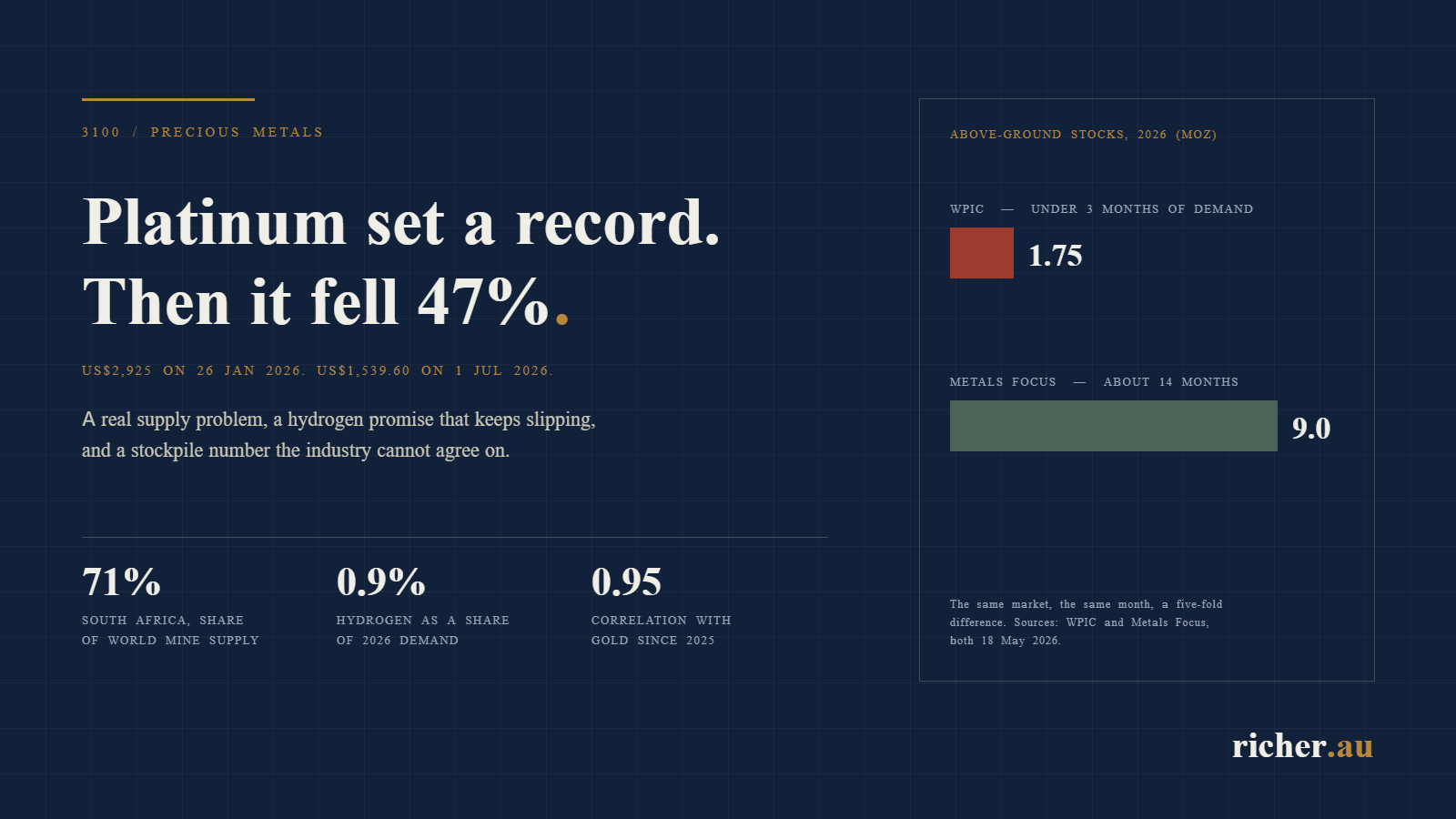
On 26 January 2026 platinum traded at about US$2,925 an ounce. That was a nominal all-time high, beating a record that had stood since March 2008. It capped a seven-month run in which the metal had risen roughly 118 per cent from about US$1,343 at the end of June 2025 — and a calendar year, 2025, in which it gained around 120 per cent, its best since 1987.
Five months later, on 1 July 2026, it traded at US$1,539.60. That is a fall of 47.4 per cent from the January peak, in about twenty-two weeks.
It has since recovered to US$1,826, or about A$2,533 an ounce, as at the close of 4 September 2026 — still 37.6 per cent below the record.
That sequence is the honest starting point for anyone asking whether platinum is a good investment. Not the deficit story, not the hydrogen story, not the gold-is-expensive-so-buy-platinum story. Just the fact that this metal moved 118 per cent up and 47 per cent down inside thirteen months, and that both moves happened while the underlying supply and demand picture barely changed.
An asset that can halve in five months is not a savings account with a nicer story. Whatever the case for platinum turns out to be, it has to survive being held through that.
There is a real case for platinum, and this article makes it properly. There is also a set of problems that most platinum commentary does not mention, including one — the size of the world's above-ground stockpile — where two respected research houses disagree by a factor of five. That disagreement decides whether the deficit everyone quotes actually matters.
- What actually happened to the price
- What platinum is actually for
- Rarer than gold, and why that matters less than it sounds
- Where platinum comes from, and why supply cannot answer
- Where it goes, and what is shrinking
- Four deficits, and what they actually mean
- The stockpile fight: 1.7 million ounces, or nine?
- The hydrogen bet, priced honestly
- The uses nobody has thought of yet
- Why platinum is currently trading as a gold proxy
- Is 47% below the high a good entry point?
- The bull case
- The bear case
- What an Australian can actually buy
- What it costs to own
- GST, CGT, and the 1 July 2027 change
- How to size a position in something this volatile
Data current to 6 September 2026. Sources: World Platinum Investment Council, Platinum Quarterly Q1 2026 (18 May 2026) and Perspectives (25 August 2026); Metals Focus via Kitco (18 May 2026); Johnson Matthey PGM Market Report (14 May 2026); Trading Economics and Kitco spot prices at the close of 4 September 2026; RBA daily exchange rates; Global X fund data at 3 September 2026. Full source list at the end. Note: the WPIC's Platinum Quarterly for Q2 2026 is due on 9 September 2026 and will revise several figures below.
What actually happened to the price
Platinum has three price histories, and which one you look at changes the conclusion entirely.
The last eighteen months look like a triumph. From about US$1,343 at the end of June 2025 to US$2,925 on 26 January 2026 is a gain of 117.8 per cent. Calendar 2025 delivered roughly 120 per cent, the metal's best year since 1987, and the outturn beat every single forecast in the LBMA's annual analyst survey — the most bullish of which had called an average of US$1,100 against an actual average of US$1,275.
The last eight months look like a warning. Down 47.4 per cent from the peak by 1 July, then up about 19 per cent off that low. Year to date, platinum is somewhere between 10 and 15 per cent lower, depending which end-2025 closing price you start from.
The last eighteen years look like a caution. Platinum's previous record was set on 4 March 2008 at roughly US$2,270 to US$2,290 an ounce. It took until late December 2025 to beat that in nominal terms — almost eighteen years. Adjusted for inflation, the 2008 peak is worth about US$3,400 in today's money. On that basis platinum has never recovered its 2008 high, and today's US$1,826 is roughly 46 per cent below it.
None of that makes platinum a bad investment. Assets that move like this can be excellent investments, bought at the right price and held at the right size. But it disposes of the framing you will see most often — that platinum is the cheap, sensible alternative to an expensive gold price. It is not sensible. It is a small, illiquid, industrially driven market that happens to be shiny.
What platinum is actually for
Gold is bought because people want to own gold. Roughly nine-tenths of platinum is bought because a factory needs it for something.
That single difference explains most of platinum's behaviour. It is an industrial metal with a precious-metal ticker, and when industry stops needing it, no amount of scarcity narrative holds the price up.
The four things it is used for:
Autocatalysts. The largest use, at about 39 per cent of demand. Platinum sits in the catalytic converter of petrol, diesel and hybrid vehicles, converting exhaust gases into less harmful ones. Battery electric vehicles contain no platinum at all.
Jewellery. About a quarter of demand, concentrated in China, Japan, India and the United States. Highly price-sensitive, because it competes directly with white gold.
Industrial. Another quarter or so: glass manufacturing (platinum crucibles for LCD and fibreglass production), chemical catalysts, petroleum refining, electrical components and medical devices. The glass line is the most volatile item in the whole market — it swung from 692 thousand ounces in 2024 to 206 in 2025 and back to a forecast 377 in 2026, purely on the timing of factory build-outs.
Investment. Bars, coins, exchange-traded funds and exchange stocks. Usually the smallest slice, and always the most volatile: it was negative 518 thousand ounces in 2022, when investors were net sellers, and 1,136 thousand ounces in 2025.
Carmakers can swap platinum for palladium in petrol catalytic converters, within limits. When palladium was expensive they switched toward platinum, which added roughly 700 thousand ounces a year of platinum demand by 2024 — a genuinely large tailwind.
That switch is now done, and the condition for it reversing has arrived: Johnson Matthey forecasts palladium's first surplus since 2011 in 2026, and Metals Focus reported in October 2025 that converter makers were already shifting back to more cost-effective palladium
. Vehicle platform cycles run about seven years, so nothing happens quickly. But treat that 700 thousand ounces as a level already in the base, not a growth driver — and possibly as a headwind from here.
Rarer than gold, and why that matters less than it sounds
Platinum is rarer than gold. On the measure that matters most to a market — how much of it comes out of the ground each year — it is not close.
| Measure | Gold | Platinum | Verdict |
|---|---|---|---|
| World mine production, 2025 | 3,300 t | 170 t | Platinum is about 19× rarer |
| Total ever mined | 222,600 t | No published figure | Almost certainly platinum, by a wide margin |
| Crustal abundance, modern geochemistry | 1.5 ppb | 0.5 ppb | Platinum is about 3× rarer |
| Crustal abundance, older handbooks | 4 ppb | 5–10 ppb | The opposite — gold is rarer |
| Price, 4 September 2026 | US$4,433 | US$1,826 | Gold costs 2.4× as much |
Sources: US Geological Survey, Mineral Commodity Summaries 2026 (both metals on the same basis); World Gold Council, total gold mined at end-Q2 2026; Rudnick and Gao, Composition of the Continental Crust, and Peucker-Ehrenbrink and Jahn (2001) for the modern crustal figures; CRC Handbook of Chemistry and Physics, 97th edition, for the older ones. Prices via Trading Economics at the close of 4 September 2026.
Take that table row by row, because each line has a catch.
Annual production is the solid one. The USGS puts world gold mine production at about 3,300 tonnes in 2025 and platinum at 170 tonnes — a ratio of roughly 19 to 1. Using the World Gold Council's larger gold figure of 3,672 tonnes instead gives about 22 to 1. Either way, the world digs up somewhere between nineteen and twenty-two times more gold than platinum every year. That part of the claim is real and well sourced.
You will see "platinum is thirty times rarer than gold" almost everywhere, usually on a dealer's website. It traces back to an archived commodity-exchange page from around 2009 — and the same source's own numbers, roughly 160 tonnes of platinum against 2,600 tonnes of gold, work out to 16 times, not 30. The claim contradicts its own arithmetic.
The defensible number today is 19 to 22 times, on current production. That is still a striking ratio. It just is not thirty, and a figure that has been repeated for seventeen years without anyone checking it is worth treating carefully.
Total ever mined is where the story gets thinner. The World Gold Council publishes a careful figure for gold: 222,600 tonnes mined in all of human history, as at the end of June 2026. Nobody publishes an equivalent for platinum. Not the USGS, not the World Platinum Investment Council, not Johnson Matthey. So the familiar line that all the platinum ever mined would fit in an average living room is an illustration, not a sourced fact, and this article will not pretend otherwise.
One warning while we are here. The WPIC's "above-ground stocks" number — 1.75 million ounces, about 54 tonnes — is sometimes quoted as though it were the total ever mined. It is not. It is working market inventory, as the earlier section explains.
Crustal abundance is genuinely contested. How much platinum is in the Earth's crust depends entirely on which source you open. Purpose-built geochemical determinations from the past twenty-five years put platinum at about 0.5 parts per billion against gold at 1.5, making platinum roughly three times rarer. Older handbook compilations put platinum at 5 to 10 parts per billion against gold at 4 — the exact opposite. Gold's figure is stable across every source; platinum's varies by an order of magnitude, and the geochemists themselves say so.
And one common qualifier is simply wrong. Platinum is often described as a by-product of nickel mining. About 85 per cent of world supply comes from South Africa's Bushveld Complex and Zimbabwe's Great Dyke, where platinum-group metals are the primary product and nickel and copper are the by-products. Only Russia's Norilsk operations and the Canadian mines — roughly 12 to 15 per cent of supply — fit the by-product description.
That said, there is a real version of the point. Even at a platinum-primary mine, the metal is one line in a basket of six: platinum, palladium, rhodium, gold, nickel and copper. Mine economics respond to the value of the whole basket, not to the platinum price alone. That is why supply barely moves when platinum moves — which is a supply-rigidity argument, and a good one.
Rarity sets a floor under nothing. Rhodium, iridium, osmium and ruthenium are all rarer than platinum, and nobody builds a retirement plan around osmium. What matters is whether anyone wants the metal at the price.
Which is the honest conclusion of this whole section. Scarcity is a supply fact, and price is a demand question. Gold is nineteen times more plentiful than platinum and trades at 2.4 times the price, and it has done so every day for more than eleven years. If rarity determined value, that could not happen. Platinum's problem for the past decade has not been that too much of it is being produced. It is that its largest customer — the internal combustion engine — is being legislated out of existence, and nothing has yet replaced it.
Rarity is a reason platinum can re-rate violently when demand does arrive, because there is no spare supply to absorb it. That is a genuine and important part of the bull case. It is not, on its own, a reason to expect demand.
Where platinum comes from, and why supply cannot answer
This is the strongest part of the bull case, and it is genuinely strong.
Total mine supply was 5,561 thousand ounces in 2025, forecast at 5,551 for 2026 — effectively flat, and around 10 per cent below the pre-COVID five-year average. Metals Focus describes 2026 mine supply as a twelve-year low outside the COVID year.
South African production peaked in 2006. The Western Limb orebodies are now, in the words of one industry assessment, too deep and geologically complex to mine profitably at current electricity and labour costs. Impala Platinum has cut Rustenburg from eleven shafts to six in two years. More than twenty thousand South African platinum-group-metal jobs have gone since 2024. Paul Dunne, chief executive of Northam Platinum, said in March 2026 that the industry has entered a phase of terminal decline
.
Supply also cannot respond quickly to price, because deep-level mine development takes many years and enormous capital, and the producers have spent a decade learning not to spend it. Implats rejected a R12 billion Waterberg commitment; Anglo American Platinum deferred US$1.5 billion at Mogalakwena. Industry commentary suggests a sustained US$2,500 an ounce would be needed to justify new deep-level development — a level platinum has touched for a matter of weeks in eighteen years.
Supply is not perfectly inelastic and 2026 has been proving it. First-quarter mine supply was up 22 per cent year on year at 1,320 thousand ounces, producing a 268 thousand ounce quarterly surplus — the first in six quarters. Recycling, which is genuinely price-elastic, is forecast up almost 9 per cent to 1,826 thousand ounces in 2026 and is the only growing source of supply.
And the producers are not cutting. Valterra Platinum — the renamed Anglo American Platinum, demerged on 2 June 2025 — left its 2026 guidance unchanged at 3.0 to 3.4 million ounces. Northam produced a record 939 thousand ounces in its 2026 financial year and is expanding. Impala refined 3.56 million ounces, up 5 per cent, and lifted reserves 9.4 per cent. Sibanye-Stillwater's earnings more than doubled and it announced no new closures. High prices did what high prices do.
Where it goes, and what is shrinking
| Demand, thousand ounces | 2023 | 2024 | 2025 | 2026f | 2026 share |
|---|---|---|---|---|---|
| Automotive | 3,204 | 3,108 | 3,031 | 2,959 | 38.6% |
| Industrial | 2,491 | 2,526 | 2,049 | 2,238 | 29.2% |
| Jewellery | 1,849 | 2,008 | 2,214 | 1,958 | 25.5% |
| Investment | 388 | 713 | 1,136 | 519 | 6.8% |
| of which hydrogen (in industrial) | 22 | 40 | 65 | 69 | 0.9% |
| Total demand | 7,933 | 8,355 | 8,431 | 7,674 |
Source: World Platinum Investment Council, Platinum Quarterly Q1 2026, published 18 May 2026. Figures for 2026 are forecasts and were revised again in August. The Q2 2026 report is due 9 September 2026.
Two demand lines are in structural decline and one is in structural doubt.
Automotive is grinding down — 3,204 to 2,959 thousand ounces across four years — and the reason is not cyclical. The International Energy Agency's Global EV Outlook 2026 puts electric cars at more than 20 million sales in 2025, about 25 per cent of the global market, rising to a forecast 28 per cent in 2026 and around 50 per cent by 2035 on stated policies. China is already at roughly 55 per cent and is projected above 90 per cent by 2035. Battery electric vehicles use no platinum.
The WPIC's own sensitivity is the number to hold onto: every 1 per cent shift in market share from combustion to battery-electric removes about 25 thousand ounces of annual platinum demand. The genuine counterweight is hybrids, which do use platinum-bearing catalysts and have been growing faster than pure battery vehicles; Europe's tighter Euro 7 standard is also expected to raise loadings per vehicle. That slows the decline. It does not reverse it.
Jewellery is a long story of decline punctuated by rallies. Global platinum jewellery peaked around 3.0 million ounces in 2014. Chinese demand alone fell from about 2.0 million ounces in 2014 to 594 thousand in 2025 — a 70 per cent collapse over eleven years, and that was after a 44 per cent rebound year, driven by gold becoming so expensive that white gold cost more than platinum. That arbitrage lasted four quarters. Chinese platinum jewellery fabrication fell 42 per cent year on year in the first quarter of 2026 and the WPIC forecasts minus 43 per cent for the full year.
Investment demand is the swing factor, and it swings both ways. It was minus 518 thousand ounces in 2022. It was plus 1,136 thousand in 2025. It is forecast at 519 thousand in 2026, down 54 per cent. Hold that thought — it matters more than it looks.
Four deficits, and what they actually mean
The headline every platinum article uses is that the market has been in deficit for four consecutive years. That is true, and it is worth understanding precisely what it means — because it is doing less work than it appears to.
| Thousand ounces | 2023 | 2024 | 2025 | 2026f |
|---|---|---|---|---|
| Mine supply | 5,620 | 5,787 | 5,561 | 5,551 |
| Recycling | 1,515 | 1,536 | 1,679 | 1,826 |
| Total supply | 7,135 | 7,323 | 7,240 | 7,377 |
| Total demand | 7,933 | 8,355 | 8,431 | 7,674 |
| Market balance | −799 | −1,033 | −1,191 | −297 |
| Above-ground stocks, year end | 4,268 | 3,235 | 2,044 | 1,747 |
Source: World Platinum Investment Council, Platinum Quarterly Q1 2026, 18 May 2026. Note the arithmetic: each year's stock figure is the prior year less that year's deficit. The deficit and the fall in stocks are the same fact, stated twice.
Three things about that table deserve attention before anyone treats it as a reason to buy.
First, the WPIC counts investment inflows as demand. When an exchange-traded fund buys metal and puts it in a vault, or when metal is shipped into a New York warehouse, the WPIC records that as demand. In 2025, of the 1,191 thousand ounce deficit, 569 thousand ounces — 48 per cent — was exchange-traded fund inflows (185) plus exchange stock builds (384). That is metal moving between vaults, not metal being consumed. Strip it out and the 2025 "real" deficit is closer to 620 thousand ounces.
Second, a large part of that warehouse build was a tariff artefact. American exchange stocks rose 460 thousand ounces, or 225 per cent, between mid-December 2024 and late March 2025, as traders positioned for a possible US tariff on platinum-group metals under a Section 232 critical minerals investigation. That investigation reported in October 2025 and the January 2026 proclamation imposed no tariffs on processed critical minerals. CME warehouse stocks, which had risen from 270 thousand ounces at the start of 2025 to 624 thousand by June 2026, are now expected to unwind back toward where they started. Roughly 350 thousand ounces of what was counted as demand was a trade-policy hedge.
Third, and most importantly, the industry's own council has already reversed its 2026 call. On 18 May 2026 the WPIC forecast a 297 thousand ounce deficit. On 25 August 2026 it published a note projecting a modest surplus for 2026, citing roughly 750 thousand ounces of combined year-to-date fund outflows and exchange stock reductions. Its own wording adds that any such surplus would be too small to meaningfully rebuild depleted above ground stocks
.
The World Platinum Investment Council is the source of almost every platinum supply and demand figure in circulation, including most of the ones in this article. It is also funded by the platinum producers — Valterra, Impala, Northam, Sibanye-Stillwater — and exists to develop investment demand for the metal. That does not make its data wrong; it is the most detailed public dataset available and it is compiled by Metals Focus. It does mean its forecasts should be read alongside others, and its track record checked.
That record is mixed. Its 2025 deficit forecast went 848 thousand ounces in March 2025, up to 966 in May, down to 850 in September, down to 692 in November — and was then restated to about 1,191 the following year. Its 2026 forecast went from a 20 thousand ounce surplus in November 2025, to a 240 thousand ounce deficit in March 2026, to a 297 thousand ounce deficit in May, back to a surplus in August. Those are not small revisions to a number the whole investment case rests on.
The stockpile fight: 1.7 million ounces, or nine?
Here is the part of the platinum story that almost nobody writes about, and it decides everything.
A deficit only matters if the world is running out. So: how much platinum is sitting above ground, already mined, available to be sold?
The two most respected sources in the market disagree by a factor of five.
The difference is definitional, not factual. The WPIC's 1.75 million ounce figure explicitly excludes metal held in exchange-traded funds, metal held in exchange warehouses, and working inventories at producers, refiners and fabricators. Exchange-traded funds alone held 3,540 thousand ounces at the end of 2025. CME warehouses held 624 thousand in June 2026. Add those to the WPIC's number and you are already near 5.9 million ounces before counting a single ounce of industrial working stock.
"Three months of demand cover" is a definitional choice, not a physical measurement. Quoted without that caveat — as it almost always is — it is a marketing figure.
There is a second problem with the stocks number, which is that the WPIC restated it heavily. Between its Q4 2025 report and its Q1 2026 report, ten weeks apart, it cut its own end-2026 stock estimate by about 866 thousand ounces while widening the deficit by only 57 thousand. The entire historical series moved: end-2022 stocks went from 5,543 to 5,067 thousand ounces, end-2025 from 2,853 to 2,044.
And there is a third, which is the most damaging to the thesis. Low stocks have not historically forced the price up. On the WPIC's own series, above-ground stocks at the end of 2020 were 2,691 thousand ounces — comparable to, or lower than, the 2025 figure. Platinum averaged under US$900 an ounce in 2020. In May 2015 the WPIC's then chief executive forecast stocks would fall to a record-low 2.6 million ounces by year end; platinum promptly fell to a six-and-a-half-year low. His own caveat at the time was that stocks certainly don't need to reach zero for sentiment to change
— which is an admission that the mechanism is sentiment rather than physical scarcity.
| 2026 forecast | WPIC | Johnson Matthey | Metals Focus |
|---|---|---|---|
| Market balance | −297 koz, revised to a small surplus in Aug | −371 koz | −312 koz |
| Above-ground stocks | 1.75 Moz | Not published | ~9 Moz |
| Average price | No public forecast | No public forecast | US$2,190/oz |
| Funded by | Platinum producers | Chemicals and PGM refining group | Independent, subscription |
| Published | 18 May 2026 / 25 Aug 2026 | 14 May 2026 | 18 May 2026 |
The three agree on direction and disagree on almost everything that would tell you what to pay. Metals Focus, which is the most bullish on price at US$2,190, is also the one publishing the largest stockpile estimate. That is not a contradiction — but it does mean the price case does not rest on physical scarcity.
The hydrogen bet, priced honestly
Every bullish platinum article eventually arrives at hydrogen. It deserves a proper hearing, and then a proper measurement.
The case: proton-exchange-membrane electrolysers, which split water into hydrogen using electricity, need platinum on the cathode. Hydrogen fuel-cell vehicles need considerably more — roughly 30 grams for a Toyota Mirai-sized car, 45 to 50 grams for a bus, 65 to 75 grams for a heavy truck. The WPIC has said hydrogen could be potentially the largest demand segment for platinum by 2040
, and has forecast around 900 thousand ounces by 2030.
Now the measurement.
Hydrogen-related platinum demand is forecast at 69 thousand ounces in 2026. Total demand is 7,674 thousand. That is 0.9 per cent of the market. Add fuel-cell vehicles, which sit inside the automotive line: 16,011 hydrogen vehicles were sold worldwide in 2025, which at 30 to 70 grams each is somewhere between 15 and 35 thousand ounces. Total hydrogen platinum demand today is plausibly under 110 thousand ounces — call it 1.4 per cent.
Against that, in August 2024 the WPIC forecast hydrogen-linked platinum demand of 476 thousand ounces by 2028. Two years into that four-year path, demand has gone from 40 to 69. It is not close to the trajectory.
The reasons are documented and they are not going away quickly:
The hydrogen build-out is being cancelled, not delayed. The International Energy Agency cut its 2030 low-emissions hydrogen capacity outlook from 49 million tonnes a year to 37 million in a single year, a 24 per cent reduction, and reported that more than half of potential electrolyser capacity is now set to slip past its target dates. Only about 4 million tonnes is actually under construction or past final investment decision. Fatih Birol's own framing was that hydrogen growth is under pressure due to economic headwinds and policy uncertainty
.
Australia has been at the centre of that. BP walked away from a 26 gigawatt green hydrogen plan in Australia in July 2025. Fortescue cancelled its flagship hydrogen projects the same month. Those were two of the largest proposed sources of future electrolyser demand anywhere.
Fuel-cell vehicles are going backwards in most markets. 2025 sales grew globally only because of Korea and China: Europe fell 23 per cent, Japan 37 per cent, North America 38 per cent. Toyota's own fuel-cell sales fell 39 per cent.
And loadings are engineered downward as fast as capacity is built. Fuel-cell platinum loading has gone from about 1.0 gram per kilowatt in 2005 to 0.25–0.30 today, with a US Department of Energy 2030 target of 0.125 — a further halving as stated policy. Every gigawatt built in 2035 will use materially less platinum than one built today.
Valterra Platinum's own chief executive, Craig Miller, said in March 2026 that hydrogen would not be a meaningful offset
until the early 2030s. When the producer selling the metal says that, it is worth believing.
None of the above says hydrogen will not matter. It says hydrogen does not matter yet, and that the timeline has slipped by years rather than months. If you are buying platinum for the hydrogen thesis, you are buying a call option on the 2030s with a premium paid today, and the sensible way to hold it is at a size that survives being wrong about the decade.
The uses nobody has thought of yet
It is a fair question, and it is the most common reason people give for holding platinum through a bad decade: the metal is extraordinarily useful, so surely something new will come along.
The honest answer has three parts, and they do not all point the same way.
What is genuinely emerging right now
Several things, and they are real rather than speculative.
Artificial intelligence has quietly become a platinum story. Hard disk drives use a platinum alloy as the magnetic recording layer, and the newest heat-assisted drives use an iron-platinum layer specifically. Johnson Matthey reported in May 2026 that platinum-group use in electrical and electronics rose about 8 per cent in 2025, driven by "a boom in hard disk demand, associated with the construction of data centres". Existing drive capacity is already committed through 2026. Platinum's electrical demand is forecast up 20 per cent to 119 thousand ounces in 2026, and glass demand up 83 per cent to 377 thousand ounces as platinum-rhodium bushings draw the fibreglass used in printed circuit boards and data-centre cabling.
Medical demand grows every year. 308, then 320, then a forecast 332 thousand ounces — about 4 per cent of the market. Most of that is devices rather than drugs: catheters, stents, pacemakers, cochlear implants, chosen because platinum shows up on an X-ray and does not corrode inside a body.
And there is genuine laboratory work. In 2026 alone: platinum films enabling magnetic memory to switch without an external magnet, published in Physical Review X; platinum-substituted catalysts pushing lithium-air batteries past 550 cycles; sustainable aviation fuel, where the WPIC forecasts platinum demand rising ninefold to over 260 thousand ounces a year — by 2050.
The problem of scale
Now hold those numbers against the market. Total platinum demand is 7,674 thousand ounces. The AI-related electrical line is 119. Medical is 332. The entire sustainable aviation fuel forecast, twenty-four years out, is 260 — roughly the size of today's medical segment.
Which points at the uncomfortable fact:
No new industrial use has reached a million ounces of durable annual demand since the catalytic converter in the 1970s. Half a century, and nothing has replaced it.
The largest genuinely new source of platinum demand since 1990 was not a technology at all. It was Chinese jewellery, which went from almost nothing to 1.75 million ounces by 2009 — and has since fallen back to 594 thousand. The biggest new industrial use, glass, reached 692 thousand ounces in 2024 and then fell 70 per cent in a single year.
Edward Sterck, the WPIC's own director of research, conceded the point in May 2026: no single technology has emerged as a 'silver bullet'
to replace declining autocatalyst demand. On the AI story specifically, the WPIC's published position in May 2026 was that it is too soon to quantify global demand growth potential
. When the producer-funded body whose job is to grow investment demand says that, it is worth hearing.
The part that decides it: every new use gets engineered smaller
This is the argument that most "future uses" reasoning misses entirely, and it is very well documented.
Platinum is expensive, so the moment an application becomes commercially serious, engineers begin designing the platinum out of it. The clearest record is fuel cells. The US Department of Energy's own history has loadings falling from 35 milligrams per square centimetre in the 1960s Gemini programme to around 0.15 by the 2010s — a reduction, in its words, of two orders of magnitude since the 1960s and one since the mid-1980s. The stated 2030 target is lower again.
It has not stopped. In April 2026 a Shanghai team reported a platinum catalyst with 86 times the mass activity of the commercial standard at a loading of six micrograms per square centimetre. In August 2026 a Madrid institute matched pure platinum's performance in hydrogen catalysis using 75 per cent less platinum. Johnson Matthey targets an 80 per cent reduction in precious metal per gigawatt of electrolyser by 2030.
And much industrial platinum is never consumed at all. Recycling rates exceed 95 per cent in some applications; Johnson Matthey estimates that almost 60 per cent of the platinum-group metal going into new products each year is already recycled metal. A nitric acid plant may hold more than a tonne of platinum gauze and replace only a few per cent of it per cycle.
New technology does not only create platinum demand. It also removes it, and 2026 supplied several examples. Ammonia cracking, one of the more plausible hydrogen-transport routes, runs on nickel and ruthenium catalysts, not platinum. The dominant supplier of fuel cells to data centres, Bloom Energy, uses solid oxide cells and states plainly that the technology does not require the expensive, precious metals associated with PEM fuel cells
. The most publicised carbon-dioxide-to-methanol catalyst of 2026, from ETH Zurich, used indium. Spark plug demand is shifting to iridium and ruthenium electrodes. And the WPIC expects about two-thirds of platinum's recent gains from palladium substitution to reverse by 2030.
Meanwhile a well-funded international research programme has spent a decade trying to build fuel cells with no platinum at all, using iron-nitrogen-carbon catalysts. It has not succeeded commercially. It has not stopped either.
So how should an investor hold the thought?
Carefully, and at the right size. An undiscovered application is a genuine possibility — platinum is a remarkable catalyst and the laboratory work is real. But as an investment argument it has two weaknesses that are worth naming.
The first is that it is unfalsifiable. "There might be a use we have not found yet" can be said about every element on the periodic table, cannot be tested, and cannot be sized. It is a reason to keep an open mind, not a reason to pay a particular price.
The second is that the same laboratories discovering new uses are the ones cutting the loadings. Both of the 2026 catalysis results above are simultaneously a new application and a large reduction in platinum per unit of that application. Historically, thrifting has usually won that race.
The version of this argument that does hold up is narrower and better: in a market this small, with supply this rigid, any genuinely new use of a million ounces or more would move the price violently, because there is no spare metal to absorb it. That is a real asymmetry. It is also why the sensible way to own it is a position small enough that you never have to be right about the decade in which it arrives.
Why platinum is currently trading as a gold proxy
Everything above concerns fundamentals. In practice, over the past twenty months, fundamentals have not been what moved the price.
The WPIC's own August 2026 note put it plainly: the platinum-gold correlation has been 0.95 since the start of 2025, and that relationship, not fundamentals
, is likely to dominate the near-term investment case. Platinum's record high in January 2026 came while gold was making its own run above US$5,500; platinum's collapse from that high was triggered in part by sharp losses in gold and silver spilling over into platinum amid thin liquidity
, with speculative positions that had pushed prices far ahead of near term physical demand
.
Wilma Swarts, director of platinum-group metals at Metals Focus — a house that is bullish on platinum — said in May 2026: What has changed markedly is the investor story. Platinum's re-rating last year was driven as much by strategic accumulation and correlation with gold, as by physical fundamentals and tighter available stock levels.
The clinching detail: in the first quarter of 2026, platinum demand fell 31 per cent year on year and the market posted a surplus — while the price was at record highs.
That chart is the relative-value argument in one picture, and it cuts both ways. Platinum traded at a large premium to gold for most of the period before 2015. It has traded at a discount every single day since — more than eleven years, the longest such run on record. Bulls read that as a spring under tension. Bears read it as the market correctly repricing a metal whose largest end use is being legislated out of existence. Nothing forces the ratio back.
Is 47 per cent below the high a good entry point?
This is the question the price chart invites, and it deserves a proper answer rather than a slogan. Two things are true at the same time, and the second one is the one almost nobody says out loud.
The first is straightforward. Platinum is 37.6 per cent below the record it set on 26 January 2026, and it fell 47.4 per cent from that peak to its July low. Buying an asset a long way below its high is, all else equal, better than buying it at the high.
The second is this. Platinum today is roughly double what it was worth, on average, in every year from 2016 to 2024.
Read that chart before deciding what "cheap" means. Platinum averaged US$988 in 2016, US$868 in 2019, US$956 in 2024. It has spent most of the last decade between US$860 and US$1,090. At US$1,826 it is not near the bottom of its range. It is about 92 per cent above its 2016 to 2024 average and near the top of everything it traded at before 2025.
Both statements are true. Platinum is 38 per cent below its high, and platinum is nearly double its decade-long average price. The high was three weeks old when it was set, and it was the first time in almost eighteen years that the March 2008 record had been beaten. Measuring cheapness against a level that existed for a fortnight, once, in twenty years, tells you very little.
A drawdown tells you the price fell. It does not tell you the price is low. Those are different facts and they need different evidence.
What has actually happened after big falls
Platinum has had three completed peak-to-trough falls of 40 per cent or more since 2000. Here is what buying at the exact bottom of each would have delivered.
| Drawdown | Peak | Trough | Fall | +1 year | +3 years | +5 years |
|---|---|---|---|---|---|---|
| Global financial crisis | Mar 2008, US$2,248 | Oct 2008, US$787 | −65.0% | +67.3% | +108.2% | +84.8% |
| Post-2011 bear market | Aug 2011, US$1,906 | Jan 2016, US$819 | −57.0% | +19.3% | −2.7% | +37.9% |
| 2016 peak to COVID | Aug 2016, US$1,177 | Mar 2020, US$596 | −49.3% | +100.8% | +63.9% | +68.3% |
| Current, unresolved | Jan 2026, US$2,925 | Jul 2026, US$1,540 | −47.4% | Too recent to know | ||
Peak and trough levels from a single consistent daily London price series; the January 2026 record and July low are on a spot basis and differ slightly by source. Returns are measured from the exact trough, which nobody achieves in practice.
At first glance that table is encouraging: two of the three troughs produced enormous one-year rebounds. Read it more carefully and three things temper it badly.
Every one of those returns is measured from the exact low. Nobody buys the exact low. The three-year outcomes give a better sense of what a real investor faced, and one of the three was negative: buying the January 2016 bottom left you slightly under water three years later.
Two of those drawdowns are really one drawdown. The August 2016 peak of US$1,177 never came close to the August 2011 peak of US$1,906. Counting them as two separate falls with two separate recoveries flatters the record considerably. Measured honestly as one continuous decline, platinum fell from US$1,906 in August 2011 to US$596 in March 2020 — a fall of 68.7 per cent over eight years and seven months. That is deeper than the crash of 2008 and vastly slower, and anyone who bought during it on the grounds that the metal was already well off its high spent most of a decade being wrong.
And the recovery time has been extraordinary. Platinum's March 2008 high was not exceeded until January 2026 — a wait of nearly eighteen years. Adjusted for inflation it has still never been beaten.
So what would actually make this an entry point?
Not the distance from the high. That is the least informative number on the page. The things that would matter are the ones the rest of this article has been testing.
If the deficit is real and physical rather than an accounting artefact of fund flows; if above-ground stocks are closer to the World Platinum Investment Council's 1.75 million ounces than to Metals Focus's nine million; if hydrogen or artificial intelligence adds a million ounces of durable annual demand; if the palladium substitution does not reverse; and if the price stops taking its instructions from gold — then US$1,826 for a metal whose supply cannot respond will look like a bargain in hindsight.
If instead the deficit keeps shrinking as fund flows unwind, the 2026 surplus the WPIC now forecasts turns into several more, and the internal combustion engine keeps losing share at 25 thousand ounces of platinum per percentage point, then US$1,826 is simply a price on the way back to the range it occupied for the previous nine years.
Neither outcome is knowable now. What is knowable is that the metal has spent a decade in a range far below today's price, that it can fall 47 per cent in five months, and that it once took nearly eighteen years to reclaim a high. That is not an argument against buying it. It is an argument for buying it in a size that lets you be early — because in platinum, being early has historically meant being early by years.
The bull case
Put at full strength, it is this.
Supply is genuinely, structurally constrained. Mine output is at a twelve-year low outside COVID, roughly 10 per cent below the pre-pandemic average, from a country that has been in decline for twenty years and cannot easily reverse it. No amount of price fixes a mine that is four kilometres deep and short of power. Three independent houses — the WPIC, Johnson Matthey and Metals Focus — all forecast a fourth consecutive deficit in 2026, differing on magnitude but not direction.
The physical market showed real stress. One-month platinum lease rates reached 15 per cent in the third quarter of 2025 and spiked to 22.7 per cent in June 2025. Sustained backwardation in London is a physical signal, not a paper one. Bruce Ikemizu of the Japan Bullion Market Association said in June 2025 that lease rates at all-time highs indicated a severe shortage
in London and Zurich.
It is cheap against gold and against its own history. Platinum trades at less than half gold's price, having spent the pre-2015 era at a premium. In real terms it sits roughly 46 per cent below its 2008 peak. Bar and coin demand is forecast at a six-year high of 718 thousand ounces in 2026, so physical buyers are showing up at these levels.
Strategic demand is a new and real bid. Platinum-group metals are on the United States' fifty-mineral critical list. Whatever happens with tariffs, governments that treat a metal as strategic tend to stockpile it, and 71 per cent of supply sitting in one country is exactly the sort of fact that motivates them.
And the hydrogen option is genuinely free at this price. Almost none of the 2030s hydrogen demand is in the current price — the market is valuing hydrogen at roughly 1 per cent of demand, which is what it is today. If the build-out arrives even half as fast as forecast, that is several hundred thousand ounces of demand nobody is paying for.
The bear case
Also at full strength.
The largest use is being legislated away. Automotive is 39 per cent of demand and battery electric vehicles use none. On the IEA's stated-policies path, electric vehicles reach about half of global car sales by 2035 and above 90 per cent in China. At 25 thousand ounces of platinum per percentage point of market share, that is a demand headwind measured in millions of ounces over a decade. Hybrids slow it; nothing reverses it.
The deficit is an accounting artefact as much as a physical one. Half of 2025's deficit was metal moving into funds and warehouses; roughly 350 thousand ounces of it was a hedge against a tariff that was never imposed. Those flows have reversed — about 750 thousand ounces out year to date — and the WPIC now expects 2026 to be in surplus.
The scarcity number does not survive scrutiny. "Under three months of cover" excludes funds, warehouses and industrial working stock. Include them and you are at six to nine million ounces. And when stocks were genuinely this low in 2020, platinum averaged US$883.
The price is being set by gold, not by platinum. A 0.95 correlation means an investor buying platinum for its supply story is, in practice, buying a leveraged and less liquid position in the gold trade. If gold falls, the platinum deficit will not save it — that is precisely what happened between January and July 2026.
And the record is long and unkind. Platinum spent almost eighteen years below its 2008 nominal high. It has never recovered it in real terms. Diesel's collapse after the 2015 Volkswagen scandal took a decade to work through — platinum only regained its pre-scandal euro price in June 2025. Jewellery demand has never returned to its 2014 peak and is forecast 35 per cent below it.
| What moved the price in 2025–26 | Evidence for fundamentals | Evidence for flows |
|---|---|---|
| Physical tightness | Lease rates 15–22.7%; London backwardation | — |
| Supply | Mine output at a 12-year low ex-COVID | Q1 2026 mine supply +22% y/y |
| Demand | Bar and coin at a six-year high | Q1 2026 total demand −31% y/y |
| The deficit itself | Four consecutive years | 48% of 2025's was fund and warehouse inflows |
| Warehouse stocks | — | 270 to 624 koz on a tariff that never came |
| Price behaviour | — | 0.95 correlation with gold; record high while the market ran a surplus |
| Forecasts | Three houses agree on direction | 2025 outturn beat every LBMA analyst forecast |
Read that table honestly and the conclusion is not "platinum is a bad investment". It is that the reason most often given for buying platinum is not the reason the price moved. Somebody who bought in mid-2025 on the deficit story made a great deal of money for reasons that had more to do with gold and with tariff positioning than with South African mine depth. Being right for the wrong reason is fine once. It is not a process.
What an Australian can actually buy
Unlike some commodity stories, this one has real, accessible Australian options — and one notable absence.
| Route | Cost | Domicile | US tax paperwork | What you own |
|---|---|---|---|---|
| Global X Physical Platinum (ASX: ETPMPT) | 0.49% p.a. | Australia | No | Allocated, segregated Good Delivery bars in London, JPMorgan custodian |
| abrdn Physical Platinum (PPLT) | 0.60% p.a. | United States | Yes | Grantor trust, 1.13 Moz of metal, ICBC Standard Bank London vaults |
| GraniteShares Platinum (PLTM) | 0.50% p.a. | United States | Yes | Grantor trust, 108 koz, much smaller and thinner |
| Physical bars and coins | Dealer spread | Australia | No | Metal you can hold, plus storage or the risk of storing it yourself |
| ASX PGM explorers | Brokerage | Australia | No | Pre-production exploration risk, mostly palladium rather than platinum |
| Offshore producers (e.g. NYSE: SBSW) | Brokerage + FX | Offshore | Yes | An operating miner, with mine, country and cost risk on top of the metal |
Fund data as at 3–4 September 2026. ETPMPT: Global X Metal Securities Australia Limited, inception 2 January 2009, fund size A$80.68m, NAV A$230.07, 350,680 units on issue. PPLT: abrdn, inception 8 January 2010, net assets about US$2.19bn, 1,131,546 oz held at 30 June 2026. PLTM: GraniteShares, inception 22 January 2018, about US$187m.
The ASX option is real. Global X Physical Platinum trades as ETPMPT, has been listed since January 2009, charges 0.49 per cent a year, and holds A$80.7 million of physically allocated, individually identified bars with JPMorgan in London. Being Australian-domiciled, it avoids the W-8BEN paperwork and the United States estate tax question entirely.
Two things to know about it. First, it is small — A$80.7 million and 350,680 units — so expect wider bid-offer spreads than you would get on a large gold fund. Second, it is not structured as an ordinary ETF: it is issued under a prospectus, not a product disclosure statement, and each security is a redeemable preference share plus a beneficial interest in a trust holding the metal. Ordinary holders can redeem for physical metal or cash. That structure is fine, but it is worth reading rather than assuming.
Chalice Mining (ASX: CHN) is the largest ASX platinum-group name, at about A$1.33 and A$518 million as at 4 September 2026. Its Gonneville deposit near Julimar in Western Australia holds 17 million ounces of three-element PGM resource — but the split is 13 million ounces palladium against 2.9 million ounces platinum. Chalice itself calls it the Gonneville Palladium-Nickel-Copper Project. Its December 2025 pre-feasibility study describes a 23-year mine life and a post-tax net present value of about A$1.0 billion, with a final investment decision targeted for the first half of 2028 and first production around 2030. It has a memorandum of understanding with Mitsubishi and both state and federal project status, but no binding offtake and no development funding secured.
Podium Minerals (ASX: POD) holds 7.6 million ounces of five-element PGM resource at Parks Reef, and is more platinum-weighted, but is a A$40 million company with less than a year of cash on current burn. Galileo Mining (ASX: GAL) has 585 thousand ounces at Callisto and a similar funding position. Future Metals (ASX: FME) holds Panton in the Kimberley, reportedly the most platinum-led of the ASX resources.
None of them produces an ounce of platinum today, and none is expected to before about 2030. Owning them is owning exploration and financing risk, correlated to the platinum price but not equivalent to it. If you want listed platinum production, you have to go offshore — and in practice only Sibanye-Stillwater (NYSE: SBSW, about US$9.2 billion) is straightforwardly buyable through a mainstream international brokerage account. Valterra, Impala and Northam are Johannesburg-listed, with a London secondary listing in Valterra's case.
What it costs to own
This is where platinum differs most sharply from gold in practice, and where the honest numbers are least flattering.
Platinum is a much smaller market than gold, and smaller markets cost more to trade. On the ABC Bullion board on 6 September 2026, a one-ounce pool-allocated platinum holding was priced at A$2,659.70 to buy and A$2,295.00 to sell back. That is a round trip of about 13.7 per cent. The equivalent gold product at the same moment was about 4.7 per cent, and silver about 19.5 per cent. Minted platinum tablets were wider again at about 17.6 per cent.
They were captured on a Sunday with the global metal markets closed, and the same A$2,295.00 buyback appeared against three structurally different one-ounce platinum products, which is characteristic of a closed-market floor bid rather than a live two-way price. Expect narrower quotes during Australian trading hours. The ranking is the durable point: platinum's round trip is roughly three times gold's, and the gap is real.
The other practical asymmetry is worth stating plainly. The Perth Mint will make you a platinum coin, but it will not store platinum for you. Its depository offers allocated, pool-allocated and unallocated storage for gold and silver only; platinum appears in none of the storage categories. ABC Bullion does store platinum — pool allocated at no annual fee, secure storage at 0.55 per cent a year for its own product, 1.25 per cent for third-party bullion — but the choice of custodian is narrower than for gold.
| Holding platinum | Annual cost | Round-trip spread | Note |
|---|---|---|---|
| ETPMPT (ASX) | 0.49% | Market bid-offer | Small fund; check the spread before you deal |
| PPLT (US) | 0.60% | Market bid-offer | Much larger and more liquid; brings US paperwork |
| Pool allocated (ABC) | Nil | ~13.7% | No storage fee; you own an entitlement, not a specific bar |
| Minted bars, stored | 0.55–1.25% | ~17.6% | Fabrication premium on the way in |
| Perth Mint storage | Not available | — | Gold and silver only |
Fees as published at 6 September 2026. Spreads as quoted on the ABC Bullion buy and sell boards on 6 September 2026 with global markets closed; treat them as indicative of the ranking rather than the exact level.
The arithmetic that follows is simple and under-appreciated. If it costs roughly 14 per cent to get in and out of physical platinum, the metal has to rise 14 per cent before a physical buyer breaks even. On a metal that has moved 118 per cent up and 47 per cent down inside thirteen months, that is survivable. On a metal you expect to compound gently, it is not. Physical platinum is a position for someone who intends to hold it for years, or an expensive way to be wrong quickly.
GST, CGT, and the 1 July 2027 change
Two Australian tax points matter here, and one of them is a genuine advantage that platinum shares with gold and silver.
GST. Under section 195-1 of the GST Act, "precious metal" means gold of at least 99.5 per cent fineness, silver of at least 99.9 per cent, or platinum of at least 99.0 per cent — in each case in investment form. The ATO's ruling GSTR 2003/10 defines investment form as a bar, wafer or coin, bearing an accepted mark guaranteeing fineness, and usually traded at a price referable to the spot price of the metal it contains.
Platinum's threshold is the lowest of the three, and standard investment platinum is 99.95 per cent, so it clears comfortably. Investment-grade platinum bullion is GST-free; platinum jewellery is not. The ruling is explicit that items such as jewellery made of platinum are not platinum for the purposes of the definition, because they have the character of jewellery made from gold, silver or platinum
rather than the character of the metal. Buying a platinum ring is not buying platinum, for tax or for investment.
Capital gains tax, and the change coming on 1 July 2027. The Treasury Laws Amendment (Tax Reform No. 1) Act 2026 received royal assent on 26 June 2026. From 1 July 2027 the 50 per cent CGT discount for individuals, trusts and partnerships is replaced by cost base indexation to CPI plus a 30 per cent minimum tax on the real gain. In the Treasurer's own words in his second reading speech, it applies to all CGT assets, including pre-1985 CGT assets, held by individuals, partnerships and trusts for at least 12 months
.
That includes bullion and it includes exchange-traded platinum. Gains that accrued up to 30 June 2027 keep the old treatment; the split is measured by market value at that date, or by an elected time-apportionment method.
| Gain accruing to 30 June 2027 | Gain accruing from 1 July 2027 | |
|---|---|---|
| Treatment | 50% discount after 12 months | Cost base indexed to CPI |
| Minimum tax | None | 30% floor on the real gain |
| Effect on a metal that doubles | Half the gain is taxed | CPI barely moves the cost base, so almost all of it is |
| Applies to platinum bullion? | Yes. Bullion is a CGT asset and the personal-use exemption does not apply to metal bought as an investment | |
The ATO lists coins or medallions
among collectables. Collectables acquired for $500 or less are exempt from CGT, and capital losses on collectables can only be offset against capital gains on collectables — not against gains on shares or property. A one-ounce platinum Kangaroo at roughly A$2,950 is well above the threshold, and whether a bullion coin traded at spot-linked prices is a "collectable" or simply an investment asset is fact-dependent.
The practical consequence is that bars and pool-allocated holdings avoid the question that coins raise. There is no ATO ruling dealing specifically with platinum bullion and CGT; the conclusion follows from the general definition of a CGT asset. If you are buying a meaningful amount, this is a question for a registered tax agent, not for an article.
How to size a position in something this volatile
Everything above is analysis. This is the part that decides whether it works for you.
Platinum is not gold. Gold is the thing people buy when they want an asset that does not depend on anyone's earnings. Platinum depends very much on somebody's earnings — specifically, on carmakers, glass manufacturers and jewellers — while carrying the volatility of a small market and the trading costs of an illiquid one. It is closer in character to a commodity equity than to a store of value.
The metal moved 118 per cent up and 47 per cent down inside thirteen months. Any position sized as though that will not happen again is sized wrong.
Three things follow, and none of them is a prediction about the platinum price.
Size it against the drawdown, not against the thesis. A 47 per cent fall is not the worst case; it is what happened this year. Whatever number you hold has to be one you would be comfortable seeing halve without changing anything else in your life. For most people that is a low single-digit percentage of a portfolio.
Decide in advance whether you are buying the metal or the story. If the reason is the hydrogen thesis, you are buying an option on the 2030s and you should expect to wait through years of it not working. If the reason is the deficit, be aware the industry's own council has just revised that call to a surplus. If the reason is that platinum is cheap against gold, then you are making a relative-value trade and should say so — and know that the ratio has been "cheap" for eleven straight years.
Count the friction before you start. A 14 per cent round trip on physical metal, or a 0.49 per cent annual fee plus the bid-offer spread on a small ASX fund, is a real cost that compounds against you while you wait for a thesis measured in decades. It is the strongest argument for choosing the cheapest sensible wrapper and then leaving it alone.
The honest summary is that platinum is a legitimate diversifier with a genuine supply problem, trading in a market where the price is currently being set by gold, where the scarcity headline rests on a definition two respected houses disagree about, and where the transformative demand story is running years behind its own forecasts. That is not a reason to avoid it. It is a reason to hold it as a position rather than as a plan. Think Richer, and the size of the bet gets decided before the story does.
The companion piece on silver as an investment in Australia works through the same questions for a metal with a similar industrial-versus-precious split, and the piece on money management covers the sizing question properly.
Frequently asked questions
Is platinum a good investment in 2026?
It depends entirely on price and position size. Platinum has a genuine structural supply problem — mine output is at a twelve-year low outside COVID and 71 per cent of it comes from South Africa, where production peaked in 2006. But it hit an all-time high of about US$2,925 an ounce on 26 January 2026 and fell 47 per cent to US$1,539.60 by 1 July, and its price has been 0.95 correlated with gold since the start of 2025, meaning fundamentals are not currently what moves it. Past returns do not guarantee future returns and this is general information, not a recommendation.
Why is platinum cheaper than gold?
Because most platinum is bought by industry rather than by investors. About 39 per cent of demand is autocatalysts for petrol, diesel and hybrid vehicles, 25 per cent is jewellery and 29 per cent is other industrial uses. Gold is bought overwhelmingly to be held. Platinum traded at a premium to gold for most of the period before 2015 and has traded at a discount every day since — the longest such run on record — largely because the market has repriced the outlook for internal combustion engines. At the close of 4 September 2026 one ounce of gold bought 2.43 ounces of platinum.
How can I buy platinum in Australia?
There are four routes. Global X Physical Platinum trades on the ASX as ETPMPT, is Australian-domiciled, charges 0.49 per cent a year and holds allocated bars in London. US-listed funds PPLT and PLTM are larger and cheaper to hold in the case of PLTM, but require an international brokerage account, a W-8BEN and attention to US estate tax. Physical bars and coins are available from ABC Bullion and dealers, with the Perth Mint producing a one-ounce Platinum Kangaroo. And ASX-listed explorers such as Chalice, Podium, Galileo and Future Metals give exploration exposure rather than metal exposure.
Is platinum bullion GST-free in Australia?
Yes, if it meets the definition. Section 195-1 of the GST Act defines precious metal as including platinum of at least 99.0 per cent fineness in investment form, and ATO ruling GSTR 2003/10 defines investment form as a bar, wafer or coin bearing an accepted mark and traded at a price referable to spot. Standard investment platinum is 99.95 per cent, so it qualifies. Platinum jewellery does not — the ruling is explicit that jewellery made of platinum is not platinum for this purpose, and GST applies.
Will hydrogen save platinum demand?
Not soon, on the current evidence. Platinum demand from hydrogen electrolysers and stationary fuel cells is forecast at 69 thousand ounces in 2026, about 0.9 per cent of total demand of 7,674 thousand ounces. Adding fuel-cell vehicles takes it to perhaps 110 thousand ounces. Against that, the World Platinum Investment Council forecast 476 thousand ounces by 2028 back in August 2024, and 900 thousand by 2030. The International Energy Agency cut its 2030 low-emissions hydrogen capacity outlook by 24 per cent in a single year, BP abandoned a 26 gigawatt Australian project in July 2025 and Fortescue cancelled its flagship hydrogen projects the same month. Valterra Platinum's chief executive said in March 2026 that hydrogen would not be a meaningful offset until the early 2030s.
Is there an ASX-listed platinum miner?
There is no ASX-listed platinum producer. The largest ASX platinum-group name is Chalice Mining, whose Gonneville deposit holds 17 million ounces of three-element resource but is 13 million ounces palladium against only 2.9 million ounces platinum, with a final investment decision targeted for the first half of 2028 and first production around 2030. Podium Minerals, Galileo Mining and Future Metals are smaller explorers, several with less than a year of cash on current burn. For listed platinum production an Australian has to buy offshore, and in practice only Sibanye-Stillwater is readily accessible through a mainstream international broker.
How volatile is platinum compared with gold?
Considerably more so, in both price and trading cost. Platinum rose about 118 per cent between the end of June 2025 and 26 January 2026, then fell 47.4 per cent by 1 July 2026. On the dealer side, a one-ounce pool-allocated platinum round trip was quoted at about 13.7 per cent on 6 September 2026 against roughly 4.7 per cent for the equivalent gold product at the same moment — about three times the friction. Platinum is a much smaller market than gold and behaves like one.
What happens to my capital gains tax on platinum after 1 July 2027?
The 50 per cent CGT discount is replaced from 1 July 2027 by cost base indexation to CPI plus a 30 per cent minimum tax on the real gain, under the Treasury Laws Amendment (Tax Reform No. 1) Act 2026, which received royal assent on 26 June 2026. It applies to all CGT assets held at least twelve months, which includes bullion and exchange-traded platinum. Gains accruing up to 30 June 2027 keep the old treatment. Note separately that the ATO lists coins and medallions among collectables, where losses can only be offset against collectable gains — a reason to prefer bars or pool-allocated holdings. Confirm your own position with a registered tax agent.
Is platinum rarer than gold?
Yes, on the measure that matters most. The US Geological Survey put world gold mine production at about 3,300 tonnes in 2025 against 170 tonnes of platinum — platinum is roughly 19 times rarer in annual supply, or about 22 times using the World Gold Council's larger gold figure. The widely repeated claim that platinum is "30 times rarer" traces to an archived exchange page from around 2009 whose own numbers imply 16 times, not 30. Crustal abundance is genuinely contested: modern geochemistry puts platinum at about 0.5 parts per billion against gold at 1.5, but older handbook figures reverse it. Note that rarity does not set the price — gold is far more plentiful and has traded above platinum every day since January 2015.
Is platinum a good entry point now that it is well below its high?
The distance from the high is the least informative number available. Platinum is 37.6 per cent below its January 2026 record, but at US$1,826 it is also about 92 per cent above its 2016 to 2024 average of roughly US$950, and above almost everything it traded at before 2025. Both facts are true. Its three completed drawdowns of 40 per cent or more since 2000 produced one-year rebounds of 67, 19 and 101 per cent from the exact trough, but two of those falls were really one continuous decline of 68.7 per cent from August 2011 to March 2020, and the March 2008 high was not exceeded until January 2026. Richer Online Pty Ltd does not hold an AFSL and this is general information, not advice.
Could new uses for platinum be discovered?
Possibly, and there is real laboratory work: platinum films for magnetic memory and platinum-substituted catalysts for lithium-air batteries were both published in 2026, and platinum demand from artificial intelligence hardware is already visible in hard disk drives and fibreglass. But no new industrial use has reached a million ounces of durable annual demand since the catalytic converter in the 1970s, and each new application tends to be engineered smaller: fuel cell platinum loadings have fallen roughly two orders of magnitude since the 1960s, and 2026 results have matched platinum's performance using 75 per cent less of it. The World Platinum Investment Council's own position on the AI story in May 2026 was that "it is too soon to quantify global demand growth potential".
Sources
- World Platinum Investment Council, Platinum Quarterly Q1 2026, 18 May 2026 — supply, demand, market balance and above-ground stocks for 2023 to 2026f; the 2026 deficit forecast of 297 koz and end-2026 stocks of 1,747 koz.
- World Platinum Investment Council, Perspectives, 25 August 2026 — the revision to a modest 2026 surplus, roughly 750 koz of year-to-date fund and exchange stock outflows to 7 August 2026, and the 0.95 platinum-gold correlation since the start of 2025.
- World Platinum Investment Council, Platinum Quarterly Q4 2025 (March 2026) — the prior above-ground stocks series, since restated. The Q2 2026 report is due 9 September 2026.
- World Platinum Investment Council, hydrogen demand page and Platinum Perspectives, 15 August 2024 — the 476 koz by 2028 and roughly 900 koz by 2030 hydrogen forecasts; and 2 May 2024 for the sensitivity of 25 koz of platinum demand per 1% of light-vehicle market share.
- World Platinum Investment Council, Perspectives, 4 December 2025 and 28 March 2025 — the Section 232 tariff-driven build in American exchange stocks from 270 koz to 624 koz and the expectation that it unwinds.
- Johnson Matthey, PGM Market Report, 14 May 2026 — platinum deficits of 559 koz (2024), 951 koz (2025) and 371 koz (2026e); palladium's first surplus since 2011.
- Metals Focus via Kitco, 18 May 2026 — 2026 deficit of 312 koz, above-ground stocks of about 9 Moz, 2026 average price forecast of US$2,190/oz, and the Wilma Swarts quotation on the investor story.
- US Geological Survey, Mineral Commodity Summaries 2026, February 2026 — independent mine production estimates and country split.
- Trading Economics and Kitco — platinum at US$1,826/oz and gold at US$4,432.56/oz at the close of 4 September 2026; the January 2026 record of US$2,923.70 on NYMEX.
- Reserve Bank of Australia, daily exchange rates — AUD/USD 0.7210 at 4 September 2026, used for all Australian dollar conversions.
- LBMA annual analyst forecast survey and Metal.com, January 2026 — platinum's 2025 average of US$1,274.73 against a highest forecast of US$1,100.
- International Energy Agency, Global EV Outlook 2026 — electric vehicles at about 25% of global car sales in 2025, a forecast 28% in 2026 and around 50% by 2035 on stated policies.
- International Energy Agency, Global Hydrogen Review 2025, 12 September 2025 — the cut in 2030 low-emissions hydrogen capacity from 49 to 37 Mtpa and the observation that more than half of potential electrolyser capacity will slip past target dates.
- pv-magazine, 28 July 2025 and CleanTechnica, 24 July 2025 — BP's withdrawal from a 26 GW Australian green hydrogen plan and Fortescue's cancellation of its flagship hydrogen projects.
- electrive, 23 February 2026 — 16,011 hydrogen vehicles sold globally in 2025, with Europe down 23%, Japan 37% and North America 38%.
- Valterra Platinum, Impala Platinum, Northam Platinum and Sibanye-Stillwater 2026 production and results announcements; Anglo American, 2 June 2025, on the completion of the Anglo American Platinum demerger and renaming to Valterra Platinum.
- Mining Weekly and MarketMinute, March and August 2026 — South African production commentary, the Paul Dunne "terminal decline" quotation and Heraeus's independent production estimates.
- Global X Metal Securities Australia, ETPMPT fund page and Supplementary Prospectus dated 24 December 2025; abrdn and GraniteShares fund pages for PPLT and PLTM, all as at 3–4 September 2026.
- ABC Bullion buy and sell boards and storage fee schedule, and the Perth Mint depository fee schedule, captured 6 September 2026.
- Chalice Mining ASX announcements (Mineral Resource, 23 April 2024; pre-feasibility study, 8 December 2025); Podium Minerals, Galileo Mining and Future Metals project disclosures; market data via Simply Wall St and Stockopedia at 4–6 September 2026.
- A New Tax System (Goods and Services Tax) Act 1999, section 195-1, and ATO ruling GSTR 2003/10 — the definition of precious metal and investment form, and the exclusion of jewellery.
- Treasury Laws Amendment (Tax Reform No. 1) Act 2026 (Act No. 49 of 2026, assent 26 June 2026); the Treasurer's second reading speech, 28 May 2026; ATO new legislation guidance; ATO list of CGT assets and exemptions on collectables.
- US Geological Survey, Mineral Commodity Summaries 2026, January 2026 — world gold mine production of about 3,300 tonnes and platinum of 170 tonnes in 2025, both on the same basis; World Gold Council, Gold Demand Trends full year 2025 (29 January 2026) for the larger 3,672-tonne gold figure, and total gold ever mined of 222,600 tonnes at end-June 2026.
- Rudnick and Gao, Composition of the Continental Crust (Treatise on Geochemistry), and Peucker-Ehrenbrink and Jahn (2001) — upper continental crust at about 0.5 ppb platinum against 1.5 ppb gold; CRC Handbook of Chemistry and Physics, 97th edition, for the older 5 ppb and 4 ppb figures.
- SFA (Oxford), platinum-group metal mining — the Bushveld Complex and Great Dyke as platinum-primary rather than by-product operations.
- LBMA published annual averages for 2023 (US$964.98), 2024 (US$955.73) and 2025 (US$1,274.73); a consistent daily London price series for 2016 to 2022, validated against the LBMA figures where they overlap; 2026 year-to-date average calculated from 175 daily prices to 2 September 2026.
- Daily London platinum price history for the drawdown analysis: peaks and troughs of March 2008, October 2008, August 2011, January 2016, August 2016 and March 2020, with the March 2020 low independently corroborated by the WPIC Platinum Quarterly Q2 2020.
- Johnson Matthey, PGM Market Report (14 May 2026) — platinum-group use in electrical and electronics up about 8% in 2025 on hard disk demand for AI data centres; and Johnson Matthey on circularity, with recycling above 95% in some applications and almost 60% of PGM entering new products already recycled.
- International Platinum Group Metals Association on platinum in AI hardware, including iron-platinum layers in heat-assisted magnetic recording; WPIC, 27 May 2026, "it is too soon to quantify global demand growth potential".
- US Department of Energy, "Platinum Loading in PEMFC" — fuel cell loadings falling from 35 mg/cm² in the 1960s by two orders of magnitude; IMDEA Materials Institute (August 2026) matching platinum with 75% less of it; Nature Communications (7 April 2026) reporting 86 times the mass activity of commercial platinum catalyst at 6 µg/cm².
- WPIC Platinum Essentials, 6 November 2025, on sustainable aviation fuel reaching over 260 koz a year by 2050; Edward Sterck, WPIC, via Kitco, 22 May 2026, on hydrogen demand of about 90 koz today and no "silver bullet" replacement for autocatalyst demand.
- Bloom Energy on solid oxide fuel cells not requiring precious metals; Johnson Matthey ammonia cracking catalysts (nickel and ruthenium); ETH Zurich indium-based CO2-to-methanol catalyst, Nature Nanotechnology, 20 March 2026; CME Group on the history of platinum-palladium substitution.
Keep reading
James Zhang is an Australian investor and business owner, and the founder of richer.au. He holds a Bachelor of Economics from the University of Sydney and an MBA majoring in Finance from the University of Technology Sydney, and has spent over twenty years investing in more than twenty properties across six Australian states and territories, alongside shares, ETFs, commodities and private businesses. More about James.
General information only. This article is general information and does not take account of your objectives, financial situation or needs. It is not a recommendation to buy or sell any metal, security, fund or product. Past returns do not guarantee future returns, and platinum is volatile: it fell 47 per cent in under six months during 2026 and may fall further. Richer Online Pty Ltd (ABN 62 159 604 949) does not hold an AFSL, has no commercial, referral or affiliate relationship with any dealer, mint, platform, fund or company named in this article, and received no payment or consideration from any of them. Figures are as at the dates stated and will change; several of the supply and demand forecasts quoted are due to be revised on 9 September 2026. Speak to a licensed financial adviser and a registered tax agent about your own circumstances.