4100 · Asset allocation
An asset pays you. A liability doesn’t.
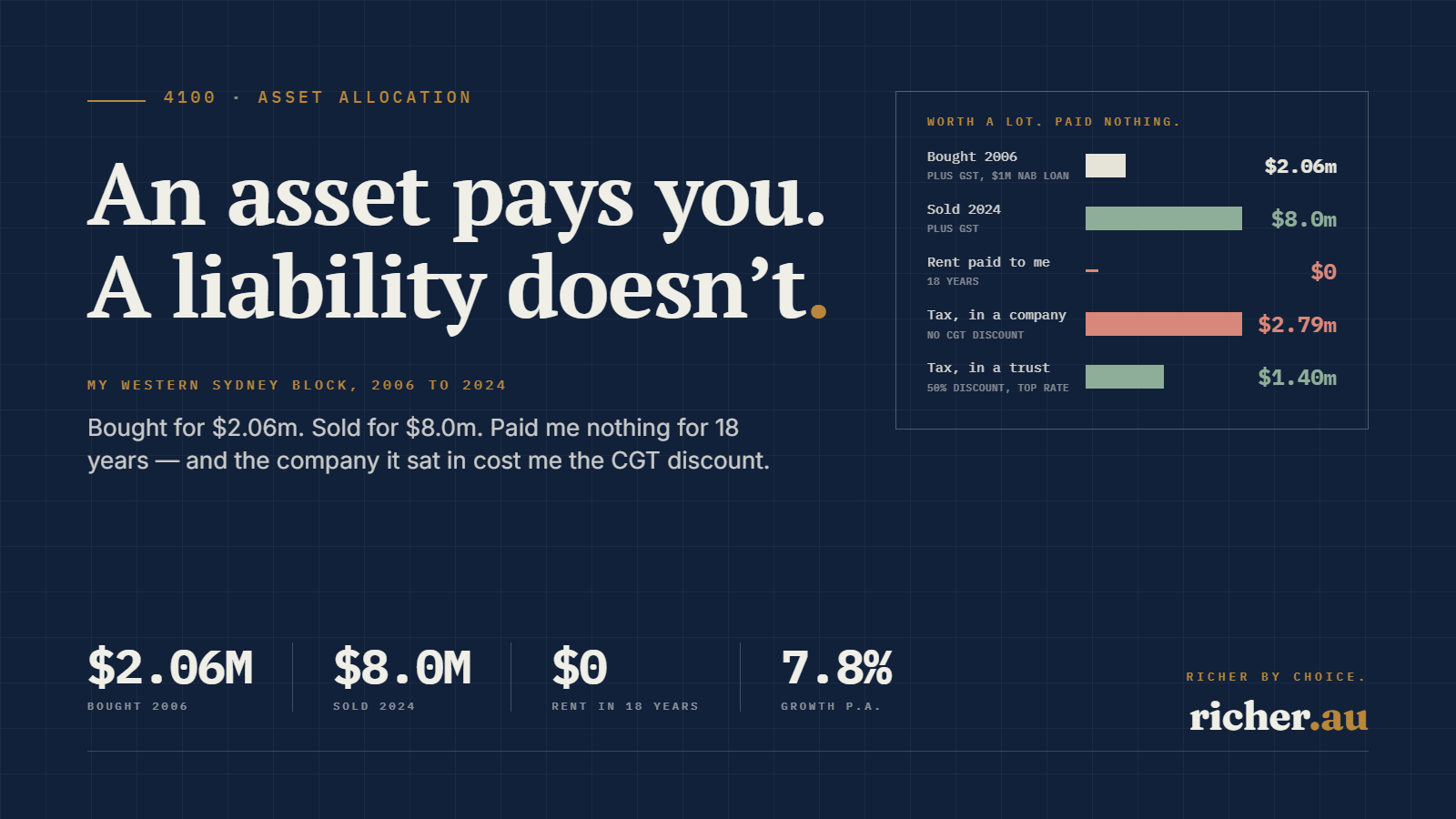
Robert Kiyosaki’s assets vs liabilities test asks one question: does it put money in your pocket, or take money out? I bought a Western Sydney block for $2.06m in 2006 and sold it for $8.0m in 2024 — and by that test it was a liability for all 18 years. Here is what it cost, and the structure mistake that cost more.
Sources: author’s own transaction; ATO; Revenue NSW; Vanguard
The test that has nothing to do with what something is worth
Most people sort what they own into two piles by looking at a valuation. The house is worth $900,000, so it goes in the "asset" column. The car is worth $30,000, so it goes there too. Robert Kiyosaki's Rich Dad Poor Dad throws that sorting method out entirely. His assets vs liabilities test has nothing to do with value, and everything to do with direction: does the thing put money into your pocket every month, or does it take money out?
"An asset puts money in your pocket. A liability takes money out of your pocket." That is the whole rule, stated as plainly as Kiyosaki ever states anything. It is deliberately not the accountant's definition, and that is the point of it — a balance sheet will happily call something an asset while it quietly drains your bank account every year it sits there. I know, because I owned one for 18 years: a block of commercial land in Western Sydney that I bought in 2006 for $2.06 million plus GST and sold in 2024 for $8.0 million plus GST. It nearly quadrupled in value. By Kiyosaki's test it was a liability every single day I held it, and the way I bought it cost me a second time on the way out.
- Assets vs liabilities: the rule Kiyosaki actually uses
- Why a balance sheet can lie to you
- The land I held for 18 years: $2.06m in, $8.0m out, $0 in between
- The second mistake: buying it in a company, not a trust
- What actually pays you in Australia
- The rule I invest by now: as many cash-flow-positive assets as possible
- The end goal: passive income that replaces your job
Assets vs liabilities: the rule Kiyosaki actually uses
Kiyosaki's framework comes from Rich Dad Poor Dad, and its most provocative line is the claim that your own home is not an asset — because for as long as you live in it, it takes money out of your pocket every month (rates, insurance, maintenance, interest) and puts nothing back in. An accountant will still list it as an asset on a personal balance sheet, because accounting defines an asset as anything of value that you own. Kiyosaki isn't arguing with the accounting definition; he's arguing that it's the wrong question to be asking when you're deciding what to buy.
Under his rule, four things commonly bought as "investments" fail the test outright: a car bought on finance, a holiday house that sits empty most of the year, jewellery and collectables that pay no income, and — the one this article is really about — land bought and held with no tenant, no crop, no lease and no development on it. Every one of those can be worth more later. None of them puts a dollar in your pocket while you hold it.
Why a balance sheet can lie to you
The reason this distinction matters is that a rising valuation and a rising bank balance are two completely different things, and only one of them can be spent, borrowed against without new debt, or relied on if your income stops. A block of land that quadruples in value over 18 years has, on paper, "made" its owner a great deal of money. In practice, that owner has not received a single dollar from it in those 18 years — and has paid council rates, land tax and interest the entire time. The gain is real, but it is locked up until the day the land is sold, and it can just as easily go the other way before that day arrives.
Capital growth is a bet on a future buyer. Cash flow is money that has already arrived. A genuine asset, on Kiyosaki's test, gives you both a present income and a claim on future value — it doesn't ask you to wait for one to get the other.
The land I held for 18 years: $2.06m in, $8.0m out, $0 in between
Here are my actual numbers, because a rule like this only means something when you see it applied to a real purchase. In 2006 I bought a block of commercial land in Western Sydney for $2.06 million plus GST. I borrowed $1 million of that from NAB and put the rest in as cash. There was no tenant, no lease and no building on it — just a block sitting there while the suburbs grew around it. I held it for 18 years and sold it in 2024 for $8.0 million plus GST.
On paper that is a very good result: a gross gain of $5.94 million, or roughly 7.8% a year compounded. It is also, by Kiyosaki's test, 18 years of liability. In all that time the land paid me nothing. What it did every year, without fail, was send me bills — council rates, NSW land tax, and interest on the NAB loan — and every one of those was paid out of income from my business, not from the land itself.
The block never once paid me anything. Whatever it was worth on paper, it behaved exactly like a liability the entire time I held it — money going out, nothing coming back.
James ZhangHere is the part that actually stings in hindsight. Australian shares returned 9.0% a year over the 30 years to 30 June 2026 with income reinvested, according to the Vanguard 2026 Index Chart; Australian listed property returned 7.8% a year over the same period. My land's 7.8% a year is the same headline number as listed property — except listed property paid its distributions along the way, and my block paid nothing and charged me rates, land tax and interest for the privilege. The money tied up in that block could have been in dividend-paying shares, or a leased commercial property, or a rental that covered its own costs — any of which would have put cash in my pocket every year I waited, on top of whatever they were worth at the end.
The cost of holding an income-free asset isn't just the rates, land tax and interest you pay directly. It's every year of dividends, rent or interest you didn't collect from whatever else that money could have bought instead — the return you gave up by tying capital to something that pays nothing while you wait for a buyer. On a $2.06 million outlay held for 18 years, that forgone income is a very large number, and none of it shows up on the contract of sale.
The second mistake: buying it in a company, not a trust
The first mistake was buying something that paid nothing. The second was how I bought it. I purchased the block in a company name. That felt tidy at the time — one entity, one set of accounts — and it turned out to be the more expensive decision of the two, because of a single rule in Australian tax law: companies cannot use the 50% capital gains tax discount. Individuals and trusts that hold an asset for more than 12 months pay tax on only half the gain. A company pays on all of it (ATO, CGT discount, updated 29 June 2026).
Had I bought the land through a discretionary trust instead, the trust could have distributed the capital gain to individual beneficiaries, each of whom would have paid tax on half of their share. In a company, the gain is taxed at the company rate — 30%, or 25% for a small trading company that passes the ATO's passive-income test, which a company whose income that year is mostly a capital gain generally doesn't — and then, when the after-tax proceeds are paid out as dividends, the shareholders are topped up to their own marginal rate through the franking system. For a shareholder on the top rate, that means the whole gain ends up taxed at up to 47% (45% plus the 2% Medicare levy) with no discount anywhere in the chain.
On the raw numbers, at the top rates, that is the difference between roughly $2.8 million of tax and roughly $1.4 million of tax on the same $5.94 million gain — about $1.4 million that a different piece of paper, signed in 2006, would have kept. My actual bill was different, because stamp duty, legal and selling costs reduce the gain, and the rates that applied in the year of sale were what they were. But the shape of it is exactly this, and it is the second lesson of the block: the structure you buy in is decided on day one and cannot be changed later without triggering the very tax you are trying to avoid.
The honest case for the company — and why it still loses
A discretionary trust isn't free of downsides, and anyone telling you it is hasn't held land in New South Wales. Revenue NSW does not give a special (discretionary) trust the land tax tax-free threshold: a trust pays from the first dollar of land value, where a company or an individual only pays above the threshold ($1,075,000 for the 2026 tax year, at $100 plus 1.6% of the value above it). At today's thresholds, a trust holding land valued at $2.06 million would pay about $33,000 a year in land tax against about $15,900 for a company — roughly $17,000 a year more, every year (Revenue NSW, 2026 land tax year). And since 1 July 2019, individuals, SMSFs and most trusts have been unable to deduct the holding costs of vacant land — interest, rates, land tax — at all, while companies still can (ATO, deductions for vacant land, updated 22 June 2026).
Both of those points are real, and both are dwarfed by the CGT outcome. Eighteen years of an extra $17,000 in land tax is a little over $300,000; the discount forgone on a $5.94 million gain is more than four times that. And the vacant-land deduction rule only matters because the block was vacant — which is to say, the two mistakes fed each other. A block with a tenant on it is not "vacant land" for that rule, pays its own land tax out of the rent, and would have been a straightforward trust asset from the start.
Decide the structure before the contract, not after. For a long-hold growth asset that will eventually be sold at a large gain, a discretionary trust with individual beneficiaries keeps the 50% discount available; a company throws it away. Then price in the trust's own costs — no land tax threshold in NSW, no vacant-land deductions — and let a tenant pay them. Get advice on your own position: the right answer depends on who the beneficiaries are, where the land is, and whether the entity does anything else.
What actually pays you in Australia
Applying the test honestly means looking at what different asset classes are actually paying right now, not what they might be worth in a decade. As at the second half of 2026, the picture across a few common Australian options looks like this:
| Holding | Typical cash flow | Kiyosaki's call |
|---|---|---|
| Dividend-paying ASX shares | Positive — ~4.57% gross yield, ASX 200 average | Asset |
| Positively-geared rental property | Positive — rent exceeds holding costs | Asset |
| Leased commercial property | Positive — tenant pays rent and, usually, outgoings | Asset |
| Cash / term deposit | Positive — ~4.35% at the RBA cash rate | Asset |
| Negatively-geared rental property | Negative — rent falls short of holding costs | Liability, subsidised by a tax offset |
| Owner-occupied home | Negative — rates, insurance, maintenance, interest | Liability, by Kiyosaki's own famous example |
| Car bought on finance | Negative — repayments, insurance, depreciation | Liability |
| My Western Sydney block, 2006–2024 | Negative — rates, land tax and NAB interest, $0 rent | Liability for 18 years, however the deed read |
Yields are gross, point-in-time figures as at the dates shown and will move. They illustrate the comparison, not a forecast for any one property or portfolio.
The rule I invest by now: as many cash-flow-positive assets as possible
Kiyosaki's test is blunt on purpose, and it isn't a complete investment philosophy on its own — plenty of genuine assets pay little or nothing for a stretch (a development site being rezoned, a growth share that reinvests every dollar of profit) and still turn out to be excellent decisions. The test isn't a ban on capital growth. It's a discipline for the moment you're deciding whether to buy something: ask what it will pay you while you own it, not only what you hope it will be worth when you eventually sell it.
My own rule, after the block, is simpler and stricter than Kiyosaki's: buy as many cash-flow-positive assets as possible, and let the growth come with them. The logic is not that growth doesn't matter — my land grew 7.8% a year — it is that income compounds and growth only promises to. An asset that pays you can fund the next asset. A leased commercial property pays its own land tax and interest and leaves something over. A dividend portfolio drops cash into the account every six months whether the market is up or down. Each of those buys the next one, and none of them can force you to sell at the wrong time, because none of them is asking you to fund it. A block of vacant land can only ever be paid for out of something else — and the something else, for 18 years, was me.
Before the next purchase, three questions do most of the work:
- What does this pay me, in cash, while I hold it? If the honest answer is "nothing," that isn't automatically a reason to walk away — but it is a reason to know exactly what you're choosing, and how long you're prepared to fund it for. I would have said "a few years" in 2006. It was 18.
- What am I giving up by tying my money up here instead? A block of land competes for your capital with dividend shares, leased property and even a bank deposit — all of which were paying somewhere between 4.35% and 4.94% through 2026 while you waited, and all of which would have paid something every year since 2006.
- Who is actually paying my holding costs, and in what name? Rates, land tax, interest and insurance don't pause because the asset isn't earning. If nothing else is covering them, you are — and if you bought in the wrong entity, the tax office will take a larger share of the eventual gain as well.
None of this means never buy land, never hold a growth asset, or never accept a stretch with no income. It means going in with your eyes open about which pile — asset or liability — the thing actually belongs in while you own it, deciding the structure before you sign, and preferring, wherever you can, the assets that pay you to wait.
The end goal: passive income that replaces your job
All of this points at one destination, and it is worth saying plainly because most people never do. The final strategy is to build as much passive income as possible until the passive income replaces your job. Not "supplements" it — replaces it. Every asset that pays you is a small piece of your wage that no longer has to come from your time.
The arithmetic is simpler than it sounds. Say you earn $30 an hour. Then every extra $30 of passive income a year is one hour a year you no longer have to work. It doesn't feel like much at $30 — it isn't — but the same rule holds at every scale, and it compounds in the one direction that matters: each asset you buy takes a permanent slice off the number of hours your life depends on.
| Hours you could stop working | Passive income needed at $30/hour | Capital at 4.57% gross yield | Capital at 4.94% gross yield |
|---|---|---|---|
| 1 hour a week (52 a year) | $1,560 a year | ~$34,000 | ~$32,000 |
| One 7.6-hour day a week | $11,856 a year | ~$259,000 | ~$240,000 |
| Half a 38-hour week | $29,640 a year | ~$649,000 | ~$600,000 |
| A full 38-hour week — the whole job | $59,280 a year | ~$1.30 million | ~$1.20 million |
Illustration only. $30 an hour is an assumed wage; 38 hours is the National Employment Standards maximum ordinary week (Fair Work Ombudsman); 52 weeks, no leave. Yields are the ASX 200 gross dividend yield (4.57%, half-year to June 2025) and the national gross rental yield (4.94%, Q3 2026) from the Sources below, before tax and costs. Compare after-tax wage with after-tax income when you do this for real.
Two things fall out of that table. The first is that the finish line is a number, not a feeling — at $30 an hour it is roughly $59,000 a year of passive income, or something like $1.2–1.3 million of income-producing assets at today's gross yields, less if the yields are higher or the wage is lower. You can work out your own line in a minute. The second is that the finish line is reached one hour at a time. Nobody buys the whole $1.3 million in one go; you buy the first $34,000 of it, it hands you $1,560 a year, and that $1,560 goes into the next one.
My block put $5.94 million on paper over 18 years and took zero hours off my working week — in fact it added hours, because I had to earn its rates, land tax and interest on top of everything else. A $2.06 million portfolio of income-producing assets at the yields above would have thrown off roughly $94,000–$102,000 a year gross, every year, from the day it was bought. At $30 an hour that is more than a full-time job, replaced on day one, before any capital growth at all. That is the whole difference between Kiyosaki's two columns, expressed in hours of your life.
Frequently asked questions
Is my own home an asset or a liability under Kiyosaki's rule?
Under his cash-flow test, a liability — for as long as you live in it, it costs you rates, insurance, maintenance and (if there's a mortgage) interest, and pays you nothing back. That doesn't make buying a home a bad decision; it means the reasons to buy one (stability, forced saving, no rent to a landlord) are different from the reasons Kiyosaki calls something an asset.
What did the Western Sydney land actually return?
Bought in 2006 for $2.06 million plus GST with a $1 million NAB loan, sold in 2024 for $8.0 million plus GST: a gross gain of $5.94 million, or about 7.8% a year compounded, before rates, land tax, interest, stamp duty, selling costs and tax. It paid no rent in 18 years. Australian shares returned 9.0% a year over the 30 years to 30 June 2026 with income reinvested (Vanguard 2026 Index Chart) — and paid that income along the way.
Why does it matter whether you buy investment land in a company or a trust?
Because a company can't use the 50% CGT discount and a trust's individual beneficiaries can (ATO). On a large gain held for more than 12 months, that is the difference between tax on the whole gain and tax on half of it. The trade-off is that in NSW a discretionary trust gets no land tax threshold and, since 1 July 2019, can't deduct the holding costs of vacant land, so a trust works best when the land has a tenant paying those costs.
Does negative gearing break the cash-flow test?
No — a negatively-geared rental property fails the test in the plainest sense: the rent doesn't cover the costs, so cash goes out every year you hold it. The tax offset reduces how much that costs you at tax time; it doesn't turn the property into something that pays you. The bet with a negatively-geared property is entirely on future capital growth and eventual rent increases, not on present cash flow.
Is land ever an asset by this test?
Yes, once it's producing something — a lease to a farmer, a tenant in a shed on it, a share of crop or grazing income, or rent from something built on it. The test isn't "is it land," it's "does it pay me." Vacant, unleased, undeveloped land almost never does, which is exactly why it's such a common example of a liability sitting in the asset column — and why my block was one for 18 years.
Isn't capital growth also a return, even with no income?
Yes — this is the test's real limitation, and my land is the proof: 7.8% a year of growth is genuine wealth. But it was unrealised and uncertain until the day I sold, it could have reversed first, and it had to be funded from other income the entire time. Kiyosaki's test simply refuses to count it as the same kind of return as cash that has already landed in your account, because one you can spend today and the other you can't.
How much passive income do I need to stop working?
Enough to replace your after-tax wage. The quick way to size it: take your hourly rate and multiply by the hours you work a year — at $30 an hour and a 38-hour week that is about $59,000 a year — then divide by a realistic gross yield to get the capital required, roughly $1.2–1.3 million at 2025–26 share and rental yields. Every extra $30 a year of passive income is one hour a year you no longer have to work, so the target is reached one asset at a time.
How do I actually apply this before buying something?
Ask what it will pay you in cash while you hold it, work out what your money would earn somewhere else in the meantime (through 2026, roughly 4.35–4.94% in cash, shares or a well-let rental), decide which entity should own it before you sign, and be honest about who covers the holding costs if the answer is "nothing." None of that rules a purchase out — it just makes sure you're choosing it with your eyes open.
Sources
Figures are gross, point-in-time and dated individually below. They will move — check the primary source for a current number before relying on it. The land figures are the author's own purchase and sale prices, excluding GST.
- Rich Dad, "Is Your House an Asset?" — Kiyosaki's asset/liability definition, Rich Dad Poor Dad — richdad.com
- Australian Taxation Office, "CGT discount" — 50% for individuals and trusts after 12 months; "Companies can't use the CGT discount", updated 29 June 2026 — ato.gov.au
- Australian Taxation Office, "Tax rates 2024–25" (companies) — 25% base rate entities, 30% all other companies, updated 16 May 2025; and "Changes to company tax rates" — the $50 million turnover and 80% passive-income tests, net capital gains counted as passive income, updated 4 September 2026 — ato.gov.au
- Australian Taxation Office, "Tax rates – Australian residents" — 45% above $190,000 for 2024–25 and 2025–26, plus the 2% Medicare levy, updated 13 August 2026 — ato.gov.au
- Revenue NSW, "How land tax is calculated" — 2026 tax year: threshold $1,075,000, $100 plus 1.6% above it, premium threshold $6,571,000 at 2%; no threshold for special (discretionary) trusts — revenue.nsw.gov.au
- Australian Taxation Office, "Deductions for vacant land after 1 July 2019" — holding costs not deductible for individuals, SMSFs and most trusts; corporate tax entities excluded from the rule, updated 22 June 2026 — ato.gov.au
- Vanguard, "2026 Vanguard Index Chart" — 30-year returns to 30 June 2026, income reinvested, no costs or taxes: Australian shares 9.0% p.a., Australian listed property 7.8% p.a., cash 4.0% p.a. — vanguard.com.au
- Fair Work Ombudsman, "Hours of work" — maximum ordinary hours for a full-time employee, 38 a week, under the National Employment Standards — fairwork.gov.au
- Trading Economics, ASX dividend yield, 4.57% for the half-year to June 2025 — tradingeconomics.com
- Global Property Guide, Australia gross rental yields, national average 4.94% Q3 2026 (up from 4.69% Q1 2026) — globalpropertyguide.com
- Reserve Bank of Australia, Statement by the Monetary Policy Board, cash rate held at 4.35% — rba.gov.au
Keep reading
James Zhang writes richer.au's Wealth coverage. The land figures in this article are from his own purchase in 2006 and sale in 2024 of a commercial block in Western Sydney, held in a company for 18 years without a tenant.
General information only. This article is general information, not personal financial, investment, taxation or legal advice, and doesn't account for your objectives, financial situation or needs. The tax comparison is an illustration at published rates, not the author's actual tax outcome. Figures are sourced and dated as shown and can change. Richer Online Pty Ltd (ABN 62 159 604 949) does not hold an Australian Financial Services Licence. Consider seeking advice from a licensed financial adviser, accountant or lawyer before acting. See our Terms of Use or get in touch.
Get richer, one decision at a time
New articles as they land.
Property, shares, commodities and tax strategy — worked examples with real Australian figures and no product spruiking. One email when something new goes live.
No spam · unsubscribe any time