The most talked-about strategy in Australian property
For decades negative gearing was the most talked-about strategy in Australian property — a way to carry the cost of an investment property against your salary while you waited for the value to grow. After the 2026 Federal Budget it is no longer a talking point. The rules for established residential property have changed, and they are now law.
The headlines were blunter than the legislation. Most owners are untouched, new builds are carved out entirely, and nothing at all happens until 1 July 2027. Here is what actually shifted, who it hits, and how to think about the next purchase.
What negative gearing actually is
Negative gearing happens when the cost of owning an investment property — loan interest, rates, insurance, maintenance, management — runs ahead of the rent it earns. The property makes a loss on paper and in the bank account.
Under the rules as they stand, that $10,000 loss can generally be deducted against other income — most often salary — reducing the tax bill for the year. The strategy has always rested on one assumption: that rents and values rise enough over time to more than repay the annual loss.
What changed in the 2026 Budget
The 2026–27 Federal Budget, handed down on 12 May 2026, legislated the biggest change to property tax in a generation. Four points carry all of it.
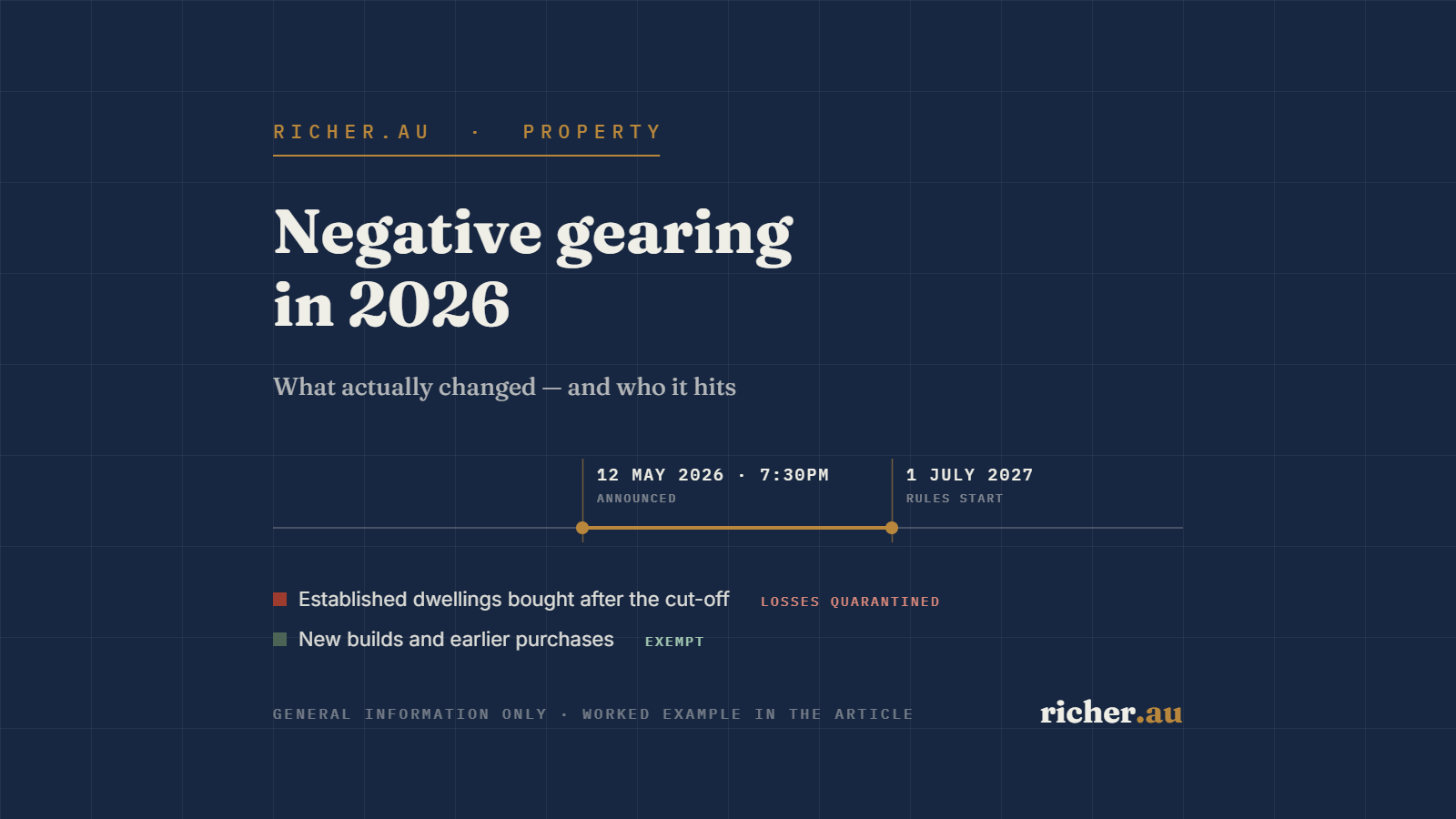
Negative gearing is being withdrawn for established residential property, but only where the property is purchased after 7:30pm AEST on Budget night. The change itself starts on 1 July 2027: from that date, rental losses on an affected property can no longer be offset against salary or other personal income. Those losses are not lost — they can still be offset against rental income or against capital gains on residential property, and anything unused carries forward indefinitely. Separately, the 50% capital gains tax discount is replaced from the same date with cost-base indexation and a 30% minimum tax on net capital gains, and that one reaches well beyond property.
| Situation | Negative gearing | CGT treatment |
|---|---|---|
| Established home owned before 7:30pm 12 May 2026 | Unchanged — salary offset kept | New CGT rules from 1 Jul 2027 |
| Established home bought after the cut-off | Losses quarantined from 1 Jul 2027 | Indexation + 30% min tax |
| New build, bought at any time | Full negative gearing | Choice of 50% or new rules |
| Property held in a complying super fund | Excluded from the changes | One-third discount unchanged |
| Shares and other CGT assets | Not applicable | Indexation + 30% min tax |
The two reforms are grandfathered differently, and this is where most summaries go wrong. Negative gearing is locked to when you bought — own an established property from before Budget night and the salary offset stays with it for as long as you hold it. The CGT change is locked to when the gain accrued. Assets are treated as disposed of and reacquired at market value on 1 July 2027, so growth up to that date keeps the 50% discount and growth after it falls under indexation and the 30% minimum. Buying before the cut-off protects your deductions; it does not freeze your CGT treatment.
Summarised from the 2026–27 Budget papers, Treasury fact sheets and ATO guidance current at August 2026. Legislation and guidance can change — check the current position before acting.
Who is exempt
The reform is narrower than the coverage suggested. Four carve-outs do most of the work.
Existing owners. Anyone who already owned an established property before 7:30pm on 12 May 2026 — including a contract signed but not yet settled — keeps the current negative gearing rules on that property until they sell it. The CGT change is separate and is not tied to when you bought.
New builds. A newly built dwelling can still be negatively geared and can still elect the existing 50% CGT discount instead of the new arrangements, whenever it is bought. This is the one place the 2026 rules actively favour an investor.
Super funds and companies. Excluded from the CGT changes altogether — a complying super fund keeps its one-third discount, and companies never had a discount to lose. The new treatment applies to individuals, partnerships and trusts.
Build-to-rent and government housing programs. Targeted exemptions apply to build-to-rent developments and to private investors supporting government housing initiatives.
In plain English: if you already own an investment property, nothing changes for you today. The new treatment only bites on established properties bought after Budget night, and even then not until 1 July 2027.
Why it is contentious
Views split along predictable lines, and reasonable people land in different places.
Investors holding established stock bought after the cut-off face a weaker after-tax return on the next purchase, and some expect flow-on effects for values — which is roughly what the market has done since, as we cover in capital city house prices are falling in 2026. Renters and housing advocates welcomed the change, arguing the tax treatment had been bidding established homes away from owner-occupiers and first-home buyers. Some economists counter that trimming the incentive to buy established rentals could tighten rental supply over time even as it cools competition for owner-occupier homes. New-build advocates point out that the exemption is the entire design intent: push investment toward new supply rather than existing stock.
Whichever side of that argument you sit on, the practical question for an investor is unchanged: does this property stand up without the tax break?
How investors can adapt
1. Judge the property, not the tax break
A good investment stacks up before tax. Population growth, constrained supply, infrastructure spending and real employment growth are what carry a property; tax treatment is a bonus, never the reason to buy. Our framework for that sits in buying a residential investment property in Australia.
2. Weigh new builds on their merits
New builds keep negative gearing and the current CGT discount, which is now a genuine structural advantage. Construction costs are still high, though, so test the rental yield and the build quality first and treat the tax treatment as the tiebreaker.
3. Keep debt serviceable, not maximised
Leverage cuts both ways. A $500,000 property growing at 7% builds $35,000 of equity in a year; the same gearing magnifies a fall just as neatly. Keep enough buffer that you are never forced to sell at the wrong point in the cycle.
4. Diversify beyond residential property
Australian households are heavily indexed to housing. Shares and ETFs, commercial property — which sits outside the negative gearing changes, though the new CGT treatment still reaches it — bonds and commodities all behave differently across a cycle. Spreading the risk is the least glamorous way to end up Richer, and the most reliable.
5. Model after-tax returns, not headline returns
With the CGT discount changing from 1 July 2027 as well, run deals on after-tax outcomes rather than assuming today's settings will still be in place when you sell. A property that only works because of a deduction is a tax position, not an investment.
Tax outcomes depend on your own circumstances, structure and timing, and the rules described here start on 1 July 2027. Model your position with a registered tax agent before committing to a purchase, and read the current ATO guidance rather than a headline.
The reform does not end property investing in Australia. It ends the version of it that only worked because of the deduction. Think Richer, and the next purchase is decided by the numbers on the property itself.
Frequently asked questions
Is negative gearing being abolished in Australia?
Not entirely. It is being withdrawn for established residential properties purchased after 7:30pm AEST on 12 May 2026, effective from 1 July 2027. Properties owned before that moment, and new builds bought at any time, are unaffected.
Does this affect investment properties I already own?
No. If you owned the property, or had signed an unconditional contract, before 7:30pm on 12 May 2026, the current negative gearing rules keep applying to that property until you sell it.
Can I still negative gear a new build?
Yes. Newly built residential dwellings are exempt and keep access to both negative gearing and the existing 50% CGT discount.
What happens to my losses if I buy an established property after the cut-off?
From 1 July 2027 those losses can no longer reduce your salary. They can be offset against rental income or against capital gains on residential property, and anything unused is carried forward to future years.
Does the CGT discount change too?
Yes. From 1 July 2027 the 50% discount is replaced by cost-base indexation plus a 30% minimum tax on net capital gains, and that change applies across shares and other CGT assets, not just residential property. Complying super funds keep the one-third discount.
Should I rush to buy before 1 July 2027?
The cut-off that matters has already passed — it was Budget night, 12 May 2026, not the 2027 start date. Buying an established property now does not restore the salary offset. What a purchase before 1 July 2027 does give you is the current treatment for the intervening period only.
Sources
- Australian Government, 2026–27 Federal Budget papers and Treasury fact sheets, 12 May 2026 — negative gearing and CGT discount measures.
- Australian Taxation Office guidance on rental property deductions and capital gains tax, current at August 2026.
- Cotality Home Value Index, July 2026, for market response since the Budget.
Keep reading
James Zhang is an Australian investor and business owner, and the founder of richer.au. He holds a Bachelor of Economics from the University of Sydney and an MBA majoring in Finance from the University of Technology Sydney, and has spent over twenty years investing in more than twenty properties across six Australian states and territories, alongside shares, ETFs, commodities and private businesses. More about James.
About these figures. Tax rules are summarised from the 2026–27 Budget papers, Treasury fact sheets and ATO guidance current at August 2026, and the worked example is deliberately simplified. Rules and thresholds change; check the current position with a registered tax agent before acting.