Two markets moving in opposite directions
Since the May 2026 Federal Budget rewrote negative gearing and the capital gains tax discount, every major capital city has rolled over — and the monthly falls are getting bigger, not smaller. Meanwhile a handful of small regional towns sitting in the path of billion-dollar infrastructure are quietly doing the opposite.
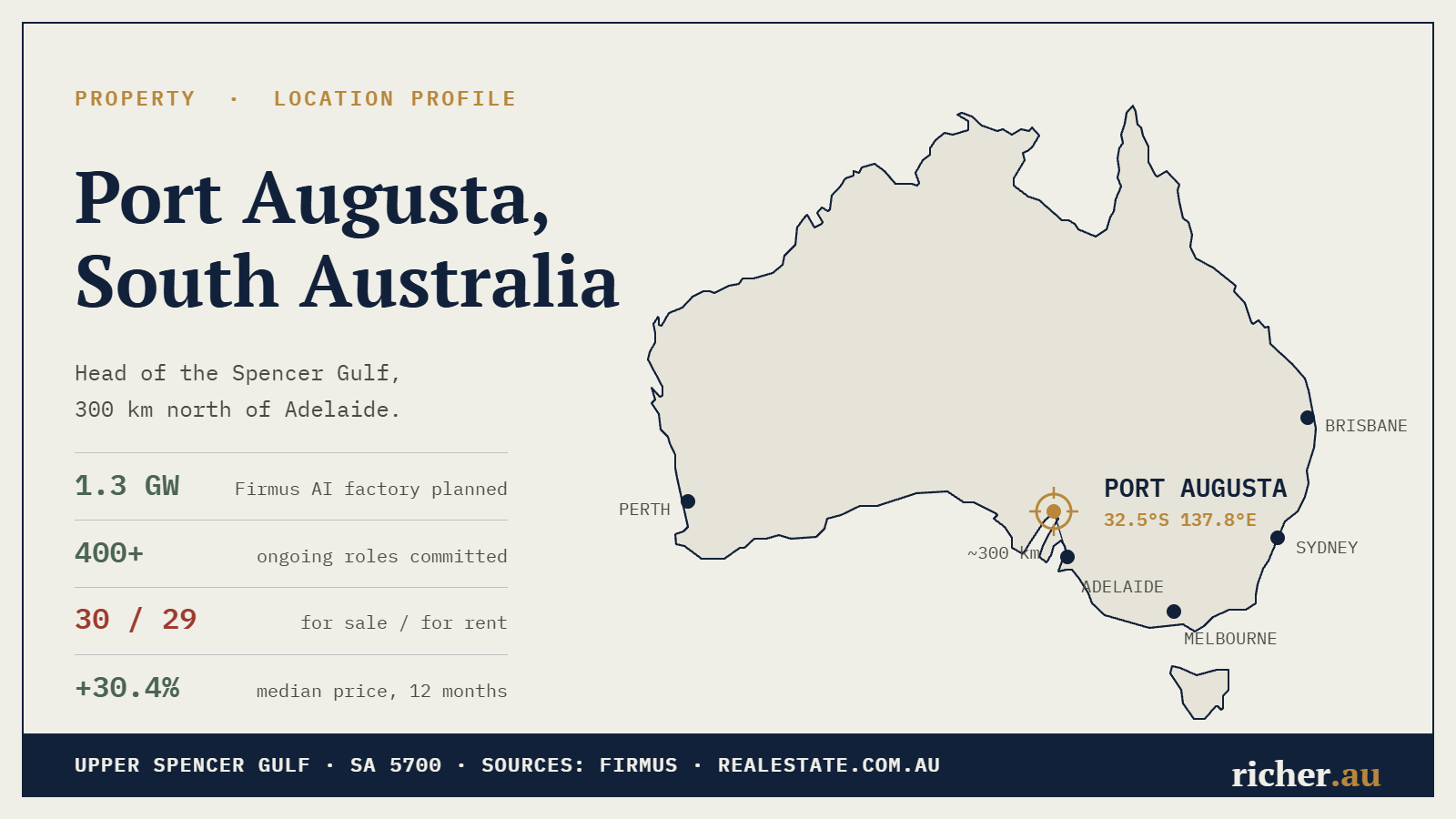
Port Augusta in South Australia is the clearest case study in the country: a town of roughly 13,800 people with 30 homes for sale and 29 rentals available, where Firmus Technologies is planning a gigawatt-scale AI factory that has already committed to a minimum of 400 ongoing jobs. This is what that mismatch looks like in the data, and what could still go wrong with it.
What actually changed: the May 2026 tax reset
The trigger for this downturn was not interest rates alone. On Budget night — 7:30pm, 12 May 2026 — the Federal Government removed negative gearing for established investment properties purchased after that moment. Rental losses on those properties are quarantined from 1 July 2027: they can offset rental income and future property gains, but not salary. Brand-new builds keep full negative gearing. On top of that, the 50% capital gains tax discount is being replaced with an inflation-indexation model from 1 July 2027.
We covered the mechanics in detail in Negative gearing in Australia, 2026: what actually changed. The short version for investors: the after-tax return on an established dwelling — especially a highly geared, low-yield one in Sydney or Melbourne — fell materially overnight. Investor demand responded exactly the way you would expect.
The data: every major capital is now falling — and still falling
Cotality's (formerly CoreLogic) national Home Value Index peaked in March 2026. It has fallen every month since: a −0.4% drop in June was the largest since December 2022, then July went further with −0.7%. The national index now sits roughly 1.4% below its March peak, with a national median dwelling value of about $928,000. The direction of each monthly print matters more than its size: the falls are accelerating, not fading.
Look at where the damage is concentrated. In July, Sydney fell 1.4% and Melbourne 1.2% in a single month. Over the June quarter, Cotality had Sydney down 3.2% and Melbourne down 2.6%, with combined capital city values falling 1.3%. Domain's June Quarter House Price Report told the same story from a different dataset: combined capital city house prices fell 1.4% — about $17,489 off the median — with Sydney down 3.3% to $1.73 million and Melbourne down 3.1% to $1.04 million.
Critically, July confirmed this is no longer just a Sydney–Melbourne story. Brisbane (−0.6%) and Adelaide (−0.2%) recorded their second consecutive monthly declines, ending the growth runs that had made them the most resilient large capitals of the cycle. Perth managed only +0.1% after a revised 0.5% fall in June. Five of eight capitals fell in July, and the combined regional index dipped 0.2% — its first decline since January 2023 — dragged down by regional NSW (−0.4%), Victoria and Queensland (−0.3% each). The exceptions: regional SA (+1.4%) and regional WA (+0.9%), still rising while everything else falls. Hold that thought.
SQM Research confirms it from the seller's side
SQM Research's Weekly Asking Prices Index for the week ending 30 June 2026 showed national house asking prices fell 1.4% in a month (units −0.7%), with Sydney's combined asking prices down 2.8% — the largest monthly decline of any capital. Distressed listings jumped 10.8% nationally in a month. Cotality's transaction data lines up: auction clearance rates across the combined capitals have held below 50% since late May, sales are running about 16.2% below a year ago, and advertised stock is roughly 11% above last year's level — not because sellers are flooding in, but because homes are sitting unsold.
“Such low clearance rates indicate a mismatch between buyer and seller pricing expectations. Buyers now have more stock to choose from and less urgency in their decision-making.” — Tim Lawless, Research Director, Cotality (June 2026 HVI)
Here is the twist that matters for investors: while prices fall, rents keep rising. SQM's national vacancy rate was 1.3% in June 2026 (1.2% in May, with just 37,844 vacant rentals nationally) — every capital below the 3% level considered balanced. National rents rose 0.5% in June and are up 5.9% over the year. Louis Christopher of SQM Research expects gross yields to climb from roughly 3.8% towards 5.5% over two to three years as this price-down, rent-up scissor keeps closing. Falling prices plus rising rents is precisely the setup that rewards patient, yield-focused buyers — just not necessarily in the capitals where the tax changes bite hardest.
Where the new rules point: regional towns with a structural catalyst
The tax reset did not just cut prices — it changed which properties make sense. With rental losses on established purchases quarantined from July 2027, the old strategy of wearing big early losses in a low-yield capital for long-run capital growth is doubly broken: the growth is not there near-term, and the losses no longer reduce salary tax. The market logic now favours affordable, high-yield locations where the property pays for itself — and new builds, which keep full negative gearing.
That points squarely at a specific type of regional market: cheap entry price, tight rental supply, and — the crucial part — a major external demand shock arriving that the local housing stock physically cannot absorb. Not every regional town qualifies. Regional NSW, Victoria and Queensland all fell in July. The ones still rising are the ones with a catalyst. Regional SA, up 1.4% in a falling national market, has the biggest catalyst in the country.
Case study: Port Augusta, SA — a gigawatt of demand meets a few dozen listings
Port Augusta, about 300 km north of Adelaide at the head of the Spencer Gulf, spent a decade being written off after its coal-fired power stations closed. In 2026 it finds itself at the centre of one of the largest private infrastructure programs in Australian history.
The Firmus AI factory: the headline catalyst
In May 2026, Nvidia-backed AI infrastructure company Firmus Technologies — valued at US$5.5 billion as of April — purchased land near Port Augusta and Tailem Bend for its national “Project Southgate” build-out of sovereign AI data centres, describing the plans as AI computing infrastructure worth “many billions of dollars”. The numbers attached to the Port Augusta site — the Stirling North AI Factory — are extraordinary for a town of roughly 13,800 people.
~1.3 GW of critical IT load at full build-out, supported by ~1.5 GW of planned power connection capacity — roughly four times the size of Firmus' Tasmanian project. A 12-year electricity supply agreement signed in June 2026 covers the first 600 MW of load, linked to 1.2 GW of new renewable generation and battery storage.
Firmus has promised a minimum of 400 direct full-time roles at each of its two South Australian sites, before counting the far larger construction workforce. The two facilities combined would draw about 2.7 GW — around 20 times the output of the existing Tailem Bend solar farm and battery. The Premier has called it a “generational economic opportunity”, and the state has announced a Data Centre and AI Infrastructure Act to streamline approvals, with Firmus seeking Crown Sponsorship for the approval pathway.
And it is not the only project
Port Augusta was already a renewable-energy construction hub before Firmus arrived. The $500 million, 317 MW Port Augusta Renewable Energy Park (Iberdrola/DP Energy) supported around 200 construction jobs, with a further 500 MW Stage 2 solar park planned nearby. Vast Solar's $200 million-plus concentrated solar thermal plant is slated for up to 450 construction jobs and about 70 ongoing roles. Add the state's new Technical College built in partnership with BHP, plus the Lincoln Gap wind farm, Bungama solar and Playford big battery projects in the surrounding region, and you have overlapping workforces competing for the same beds.
And Firmus is now no longer the only AI-infrastructure play on Port Augusta's doorstep. ASX-listed 1414 Degrees (ASX: 14D) is progressing the Aurora Energy Precinct, a roughly 16 km² master-planned energy and industrial site near Port Augusta anchored by an approved 140 MW / 280 MWh battery. In July 2026 the company signed a heads of agreement with an Australian data centre operator to develop up to 1 GW of AI data centre infrastructure at Aurora — starting with a 17 MW campus, expanding to an approximately 200 MW anchor campus once a new 275 kV transmission connection is built, and a longer-term pathway to gigawatt scale. A second gigawatt-scale AI build competing for the same regional workforce only sharpens the housing mismatch below.
Now look at the housing supply
This is where the arithmetic gets stark. We ran the live search on realestate.com.au in August 2026 across both Port Augusta (SA 5700) and Port Augusta West, houses and townhouses, excluding properties already under contract. The result: 30 properties for sale. A matching rental search, excluding listings where a deposit had been taken, returned 29 properties available to rent. That is 59 dwellings in total, for sale or lease, across an entire regional city.
The formal data backs the shortage: HtAG Analytics puts stock on market at just 0.16% of the LGA's ~8,859 dwellings with 1.67 months of inventory — anything under three months is considered supply-constrained. Rental vacancy sits around 1.18%. And the state government's own Regional Key Worker Housing Scheme is delivering exactly four new homes in Port Augusta.
What the live listings actually show
realestate.com.au's own suburb profile puts numbers on the pressure building behind those 59 dwellings. Its median house price for Port Augusta is $339,000 for the 12 months to July 2026 — up 30.4% on the prior year. Against that, only 32 houses were available in the past month while 157 sold over the past 12 months, and the portal counts 550 buyers actively interested in the suburb.
Those last two numbers are the ones worth sitting with. 550 interested buyers against 32 available houses is roughly 17 buyers competing for every home on the market. At 157 sales a year — about 13 a month — the current 30 listings represent barely 2.3 months of supply. Median days on market is 50 days and the portal's indicative rental yield is 5.5%. This is what a supply-constrained market looks like before a gigawatt-scale construction workforce arrives.
Look at the price trend too. While the national index peaked in March 2026 and has fallen every month since, Port Augusta's five-year median price line runs in the opposite direction — from roughly $150,000 in August 2021 to $339,000 today, an increase of about 126% in five years, with the steepest part of the curve in the last twelve months as the AI and renewables pipeline became public.
Two independent datasets tell the same story with slightly different numbers, which is worth being upfront about. CoreLogic data (via Your Investment Property) puts Port Augusta's median house price at $318,000, up 24.1% over the 12 months to May 2026, on 125 house sales, with a 6.19% gross yield and 38 days on market. realestate.com.au, measuring the 12 months to July 2026, has the median at $339,000, up 30.4%, on 157 sales, with a 5.5% yield and 50 days on market. The gap comes down to different measurement windows and methodologies — but both agree on direction and magnitude: a market rising 24–30% a year while the capitals fall. Even after that run, the entry price is barely a fifth of Sydney's median house price, and the yield is roughly double the ~3.5% gross yield of the combined capitals.
| Metric (houses) | Port Augusta | Combined capitals |
|---|---|---|
| Median value | $339,000 | $1,010,814 |
| 12-month price change | +30.4% | falling since March peak |
| Monthly trend (July 2026) | Regional SA +1.4% | −0.8% |
| Gross rental yield | 5.5–6.2% | ~3.5% |
| Homes for sale right now | 30 | stock ~11% above last year |
| Rentals available right now | 29 | vacancy 1.3% (SQM) |
| Interested buyers per listing | ~17 | clearance below 50% |
| Sales in past 12 months | 157 | volumes −16.2% y/y |
| Days on market | 50 | lengthening |
| Rental vacancy | ~1.18% | 1.3% national (SQM) |
Sources: realestate.com.au Port Augusta 5700 suburb profile and live listing searches, August 2026; CoreLogic via Your Investment Property (12 months to May 2026); HtAG Analytics; Cotality HVI July 2026; SQM Research June 2026. Portal listing counts move daily.
How an investor might read this — and the risks
The bull case writes itself: a sub-$350,000 entry price, 5.5–6.2% gross yields, near-zero vacancy, almost no supply pipeline, and a multi-billion-dollar, decade-long demand catalyst backed by Nvidia and championed by the state government. Put the two sides of the ledger next to each other: Firmus has committed to a minimum of 400 ongoing roles at this site alone, against 29 rentals currently available — roughly 14 incoming permanent workers for every vacant rental, before a single construction crew arrives, in a market where a busy year is 157 house sales. New builds in the area also keep full negative gearing under the post-Budget rules — one of the few ways the 2026 tax changes actively favour a market like this.
But single-catalyst towns carry single-catalyst risk, and honesty about that is what separates investing from speculating.
Approval risk. The Firmus project is still subject to planning approval under the PDI Act. It is not yet built, and local consultation concerns have already been reported.
Execution risk. Firmus' only operational facility is a far smaller site in Tasmania; critics note its roots in crypto-mining and question whether the full build-out will be funded and delivered on schedule. Its August 2026 US$2 billion equity raise helps, but gigawatt-scale projects slip.
Workforce housing risk. Large projects often house construction crews in purpose-built camps — as the Whyalla hydrogen workforce was, in caravan-park cabins — which would blunt the flow-through to the local market.
Small-market risk. With ~157 sales a year and 50 days median time on market, prices can move violently in both directions, exits are slower if sentiment turns, and a 30% annual gain means a good deal of the opportunity is already priced in. The 550-buyer figure cuts both ways: you are bidding against a crowd, not picking up a bargain.
Local factors. Port Augusta records well-above-average crime rates for South Australia and an economy still concentrated in a handful of sectors. Insurance, tenant selection and street-level due diligence matter more here, not less.
Macro risk. If the RBA hikes again or the national downturn deepens beyond an orderly repricing, regional markets will not be immune — regional NSW, Victoria and Queensland are already falling.
A sensible way to think about position sizing: this is a high-yield, high-variance satellite play, not a portfolio core. Run the numbers on the new tax settings (established purchases after 12 May 2026 lose the salary offset; new builds do not), model cash flow at current rates with a buffer, and treat the Firmus approval milestones — the PDI Act pathway, Crown Sponsorship, first construction contracts — as your go/no-go signals. For the broader framework on buying well, see our guide to buying a residential investment property in Australia, the Tax & SMSF hub for the 2027 CGT changeover, and the rest of our Property hub.
The target: what a bull-case outcome could look like
To put a concrete shape on the opportunity — and to be explicit that these are forecasts, not facts — here is the kind of outcome the bull case implies if the infrastructure pipeline lands and the supply squeeze plays out. Residential property currently changing hands in the $300,000 to $400,000 range could re-rate toward $600,000 to $800,000 within roughly five years, with weekly rents potentially doubling over a similar horizon as thousands of construction and permanent workers compete for a few dozen dwellings.
The target — forecast, not a promise
Prices: $300,000–$400,000 today → $600,000–$800,000 within ~5 years (roughly a doubling).
Rents: current asking rents doubling over a similar period as demand outruns supply.
These are projections only, contingent on the Firmus and 1414 Degrees / Aurora projects reaching approval and construction, and on the rental-supply shortage persisting. They are not guaranteed, could take longer or fail to materialise, and are not financial advice. Single-catalyst regional markets can fall as fast as they rise — see the risks above.
Frequently asked questions
Are Australian capital city house prices still falling in 2026?
Yes. Cotality's national Home Value Index fell 0.4% in June and 0.7% in July 2026 — the two largest monthly falls since December 2022 — and sits about 1.4% below its March 2026 peak. In July, Sydney fell 1.4%, Melbourne 1.2%, Brisbane 0.6% and Adelaide 0.2%, with five of eight capitals declining. Auction clearance rates have been below 50% since late May and sales volumes are about 16% below a year ago, so the momentum is still pointing down.
Why did the 2026 tax changes push prices down?
From 7:30pm on 12 May 2026, negative gearing was removed for established investment properties bought after that time: the losses are quarantined from 1 July 2027 and can no longer offset wages. The 50% CGT discount is also being replaced by inflation indexation from 1 July 2027. Together they cut the after-tax return on the low-yield, highly geared established properties that dominate Sydney and Melbourne, pulling investor demand out of exactly those markets.
Why is Port Augusta considered a property opportunity?
It combines a low entry price (median house $339,000 on realestate.com.au), a 5.5–6.2% gross yield, roughly 1.2% rental vacancy and just 30 homes for sale plus 29 rentals available across Port Augusta and Port Augusta West, with a large incoming demand catalyst: Firmus Technologies' planned 1.3 GW AI factory, promising a minimum of 400 ongoing jobs plus large construction workforces, alongside existing renewable energy projects. realestate.com.au counts 550 interested buyers against 32 available houses — about 17 buyers per listing. Regional SA was the strongest market in Australia in July 2026, up 1.4% while the capitals fell.
How many properties are actually available in Port Augusta?
As at August 2026, a realestate.com.au search across Port Augusta (SA 5700) and Port Augusta West returned 30 houses and townhouses for sale excluding those under contract, and 29 rental properties available excluding those with a deposit taken — 59 dwellings in total. The suburb profile separately reports 32 houses available in the past month against 550 interested buyers, and 157 sales over the past 12 months. Portal counts move daily.
What are the main risks of buying in Port Augusta?
The Firmus project is not yet approved or built; construction workers may be housed in camps rather than local rentals; the market is small (157 sales a year) so prices and liquidity can swing hard; prices have already risen about 30% in a year; and the town has elevated crime rates and a concentrated economy. Treat it as a higher-risk satellite investment, not a core holding, and take independent professional advice.
Do the 2026 negative gearing changes apply to a new build in a regional town?
No. Newly built dwellings keep full negative gearing under the post-Budget rules, which is one of the few places the 2026 changes actively favour an investor. Established properties bought after 7:30pm on 12 May 2026 lose the ability to offset rental losses against salary from 1 July 2027. The detail is in our negative gearing explainer.
Data sources
- Cotality Home Value Index, June and July 2026 releases — national, capital city and regional splits, clearance rates, sales and listings data.
- SQM Research — Weekly Asking Prices Index (week ending 30 June 2026) and National Vacancy Rate reports (May–June 2026); yield outlook comments by Louis Christopher.
- Domain House Price Report, June quarter 2026.
- Australian Government 2026–27 Federal Budget — negative gearing and CGT discount reforms, and subsequent ATO guidance.
- Firmus Technologies SA Community Hub (Stirling North AI Factory specifications, June 2026 energy agreement); InDaily, W.Media, Murray Bridge News and TechCrunch reporting on Project Southgate, May–August 2026.
- realestate.com.au — live buy and rent searches for Port Augusta SA 5700 and Port Augusta West (August 2026) and the Port Augusta 5700 suburb profile.
- CoreLogic suburb data via Your Investment Property (12 months to May 2026); HtAG Analytics, Port Augusta City Council LGA (August 2026).
- ARENA (Vast Solar Port Augusta CSP); DP Energy / Iberdrola (Port Augusta Renewable Energy Park); Government of South Australia (Regional Key Worker Housing Scheme, Technical College).
Keep reading
James Zhang is an Australian investor and business owner, and the founder of richer.au. He holds a Bachelor of Economics from the University of Sydney and an MBA majoring in Finance from the University of Technology Sydney, and has spent over twenty years investing in more than twenty properties across six Australian states and territories, alongside shares, ETFs, commodities and private businesses. More about James.
About these figures. Market data was drawn from the sources listed above between May and August 2026 and can change without notice; portal listing counts change daily.