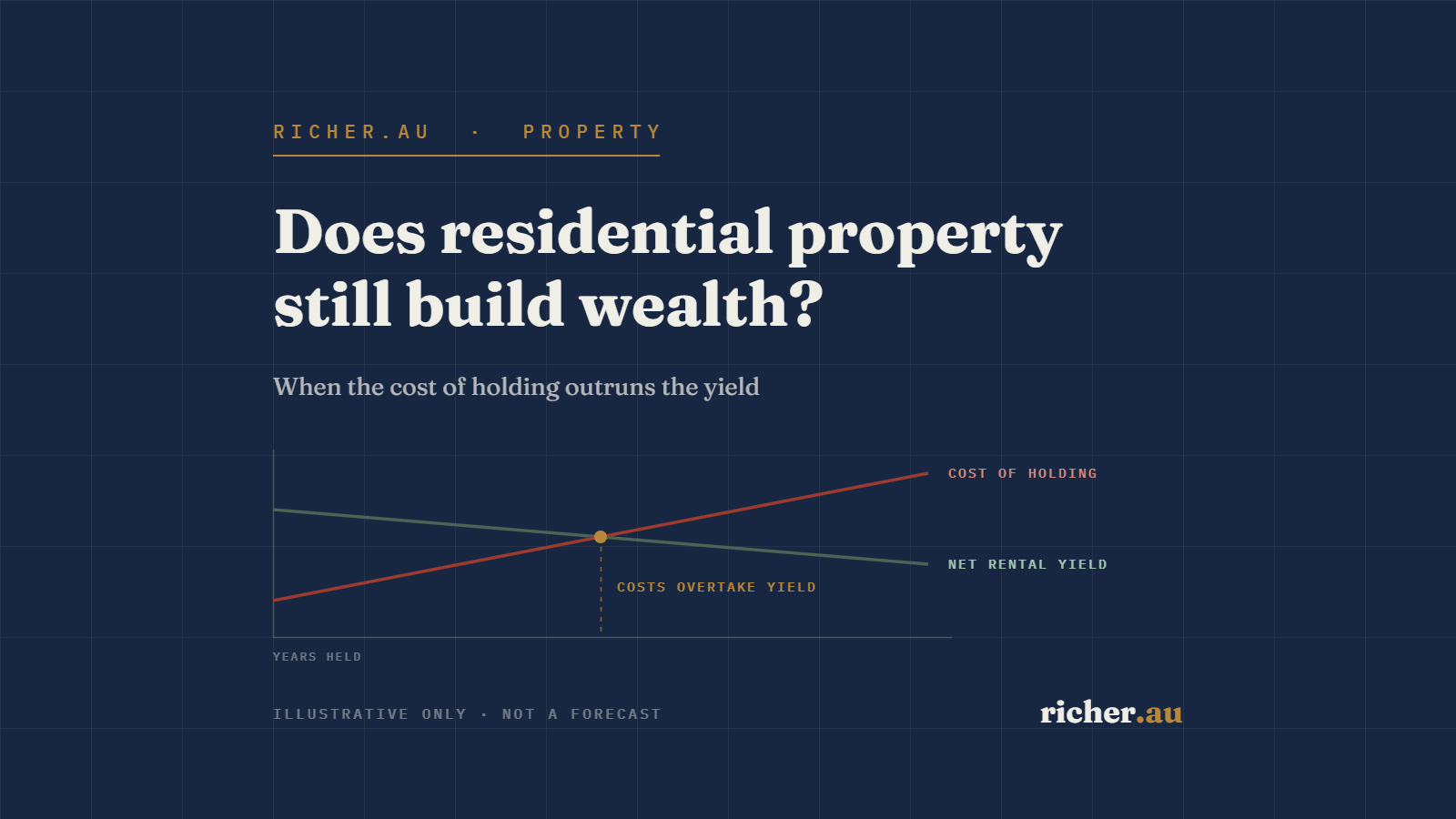
The playbook that stopped working
For many decades, residential property has been one of Australia's favourite ways to build wealth. The traditional playbook was simple: buy a property, use negative gearing to reduce tax, then wait for population growth and inflation to push prices higher.
It worked for a long time. But investing means looking forward, not backwards — and today's market looks quite different: higher prices, changing tax rules, thinner rental yields, rising construction costs and affordability pressure all mean the old formula deserves a second look.
“Price is what you pay. Value is what you get.” — Warren Buffett
Sometimes the smartest move isn't rushing to buy. Patience, saving, and earning a reasonable return while you wait can be the better strategy.
Why established properties are becoming less attractive
Established houses and apartments performed well for decades on the back of strong population growth, falling interest rates, easy credit and steadily rising incomes. Several of those tailwinds have weakened.
1. Low rental yields
Many established properties in Australia's major cities produce relatively little income compared with their purchase price.
| Example · $1,000,000 established property | Figure |
|---|---|
| Annual rent (before expenses) | $40,000–50,000 |
| Interest, rates, strata, insurance, maintenance | Often higher |
| Gross yield | ~4–5% |
| Typical cash-flow position | Negative |
Illustrative example only — actual yields vary significantly by location and property type. Capital growth then has to do the heavy lifting to justify holding the asset.
That matters because of what the same money earns sitting still. A gross yield of four to five per cent is measured before a single expense is paid; a savings account rate is not. On a like-for-like basis, cash is currently competitive with an asset that also carries interest-rate, vacancy and market risk.
2. Higher holding costs
Ownership costs keep climbing: interest repayments, insurance, maintenance, government charges, and the risk of further tax changes. An investment should ideally strengthen over time — not rely purely on the next buyer paying more.
3. Tax benefits shouldn't be the main reason to invest
A common mistake is buying a mediocre property purely for the tax deduction. Saving tax is useful; building wealth is the actual goal. Losing a dollar to save a portion of it in tax doesn't make anyone richer.
“The tax tail should not wag the investment dog.” — Warren Buffett
Are new house and land packages the answer?
New builds can look appealing — depreciation benefits, lower initial maintenance, modern design, and, as covered in our negative gearing update, a real structural tax advantage now that established properties face new restrictions. But a tax benefit alone doesn't make something a good investment.
| Established property | New build / off-the-plan | |
|---|---|---|
| Purchase price | Often a lower premium vs. new stock | Price often includes developer margin, marketing and sales commissions |
| Location | Usually proven, not speculative | Frequently in newer, less-established areas |
| Negative gearing | New restrictions apply if bought after 12 May 2026 | Retains negative gearing and CGT discount access |
| Maintenance | Higher as the building ages | Lower in the early years |
| Resale | Already established — the buyer knows what they are getting | Becomes “established” the moment you settle |
| Supply risk | Limited by existing stock | Oversupply risk if many similar homes are being built nearby |
The moment you settle on a new property, it becomes “established” in the eyes of the next buyer — and the incentives that attracted you may not apply to them, which can make resale harder. Scarcity still matters: a unique property in a tightly held location tends to behave very differently from one of a thousand near-identical units.
When good opportunities are scarce, cash is also a position
Many investors feel pressure to always be buying something. But patience is a strategy too — not investing is also a decision. When asset prices are expensive and opportunities are thin, holding cash offers flexibility, safety and future buying power. With interest rates where they are, term deposits and other lower-risk options can pay you reasonably well while you wait.
“The big money is not in the buying and the selling, but in the waiting.” — Charlie Munger
Where the cash can sit while you wait
If you decide to stay patient, your savings do not have to sit idle. Australia's major banks are currently paying bonus savings rates of around 5% p.a., and the strongest offers a little more. The figures below are the maximum ongoing (or introductory) rates advertised as of 24 August 2026, and most require conditions such as a minimum monthly deposit, a growing balance and no withdrawals.
| High-interest savings · major & popular banks | Maximum rate |
|---|---|
| ING — Savings Maximiser | up to 5.50% p.a. |
| Macquarie — Savings Account | 5.35% for 4 months, then 5.00% |
| ANZ Plus — Growth Saver | up to 5.10% p.a. |
| CommBank — GoalSaver | up to 5.00% p.a. |
| Westpac — Life | up to 5.00% p.a. |
| NAB — Reward Saver | up to 5.00% p.a. |
Maximum advertised variable rates, 24 August 2026. Bonus rates are conditional (for example a minimum monthly deposit, a growing balance and no withdrawals) and can change at any time. ING and Macquarie are shown alongside the big four as widely used alternatives. Always confirm the current rate and conditions directly with the provider before opening an account.
If you already have a mortgage, parking spare cash in a 100% offset account can be even more powerful than a savings account. Every dollar sitting in the offset reduces the balance your home-loan interest is charged on — effectively earning you the loan rate (often 6% or more), and, unlike savings-account interest, that saving is not taxed.
It also keeps your money liquid and ready to move the moment the right property, or another opportunity, appears.
Passive income beyond residential property
Building wealth isn't only about buying houses. Worth considering alongside — or instead of — direct property:
- Dividend-paying shares — income plus franking credits, but with market volatility.
- Diversified ETFs — broad exposure at low cost; see our seven-ETF portfolio.
- Commercial property — longer leases and higher yields, thinner buyer pool.
- Bonds & fixed income — defensive ballast, sensitive to rate moves.
- Businesses — the highest returns and the highest demands on your time.
- Intellectual property — royalties and licensing, hard to value and to sell.
Every option carries its own risk. The key question is always the same: what do you own, why do you own it, and does the expected return justify the risk?
The forgotten wealth strategy: spend less than you earn
Many people focus entirely on finding the next investment, but the real foundation is simpler: increase income, control expenses, invest the difference. Saving $10,000 has the same effect on your net worth as earning $10,000 after tax — and lifestyle inflation is what quietly stops many high earners from ever getting properly wealthy.
“A penny saved is a penny earned.” — Benjamin Franklin
Always search for value
None of this means avoiding property forever — great opportunities still exist. Successful investors are constantly looking for situations where value exceeds price: a site with redevelopment potential, an undervalued business, quality shares during a downturn, or an asset with improving future income. That is exactly the logic behind our look at what is happening outside the capitals.
“It's far better to buy a wonderful company at a fair price than a fair company at a wonderful price.” — Warren Buffett
Final thoughts: becoming richer requires patience
Australian residential property has created enormous wealth over the decades. But yesterday's winning strategy isn't automatically tomorrow's best opportunity. Smart investors adapt — they don't chase tax deductions, buy because everyone else is buying, or confuse activity with progress.
The cash-flow gap. Work out the shortfall after interest, rates, strata, insurance, maintenance and vacancy — not the gross yield — and be honest about how many years you can fund it.
The tax rules that apply to you. Whether the property is established or a new build, and whether it settles before or after 12 May 2026, changes the deductions available.
Entry and exit costs. Stamp duty, legals, buyer's agent and selling costs can consume several years of growth on their own.
Concentration. One leveraged property in one suburb is not a diversified portfolio, however good the story sounds.
Spend less than you earn, invest wisely, buy value for less than it's worth, and stay patient.
Frequently asked questions
Is residential investment property still worth it in Australia in 2026?
It can be, but the old formula no longer works on its own. Gross rental yields on established capital-city property are around 4–5% before expenses, holding costs have risen, and negative gearing on established property bought after 12 May 2026 is restricted. Property can still build wealth — it now has to be bought well rather than bought early.
What rental yield does a typical established property produce?
On an illustrative $1,000,000 established capital-city property, annual rent before expenses is roughly $40,000–50,000, or a gross yield of about 4–5%. After interest, rates, strata, insurance and maintenance the cash-flow position is typically negative, so capital growth has to justify holding the asset.
Did the 2026 Budget change negative gearing on established property?
Yes. Established residential property bought after 7:30pm AEST on 12 May 2026 has its rental losses quarantined from 1 July 2027 — they can be offset against rental income and rental capital gains rather than salary. Holdings bought before the cut-off, and eligible new builds, are not affected.
Is a new house and land package a better investment than an established home?
Not automatically. New builds keep access to negative gearing and offer depreciation and lower early maintenance, but the price often includes developer margin, marketing and sales commissions, the property becomes “established” the moment you settle, and nearby construction can create oversupply. A tax benefit alone does not make an investment good.
Is it better to keep spare cash in a savings account or an offset account?
If you have a mortgage, a 100% offset account is usually stronger. Every dollar in the offset reduces the balance your home-loan interest is charged on, effectively earning the loan rate — often 6% or more — and that saving is not taxed, unlike savings-account interest. The money also stays liquid.
What are Australian savings accounts paying right now?
As at 24 August 2026 the major and popular banks advertise maximum rates of about 5.00% p.a., with ING's Savings Maximiser up to 5.50% and Macquarie at 5.35% for four months then 5.00%. Bonus rates are conditional and can change at any time.
Data sources
- CommBank, Westpac, NAB, ANZ Plus, Macquarie and ING published savings rate cards, accessed 24 August 2026 — maximum advertised ongoing and introductory rates and their bonus conditions.
- Canstar savings account comparison tables, August 2026 — cross-check on the rates above.
- Australian Government 2026–27 Budget measures and subsequent ATO guidance — the 12 May 2026 negative gearing cut-off, the 1 July 2027 quarantining start date, and the new-build carve-out.
- richer.au, Negative gearing in Australia, 2026: what actually changed — the mechanics of the reform, including the separate CGT treatment.
- Illustrative $1,000,000 established-property example — richer.au, based on typical capital-city rents and holding costs; not drawn from a single listing.
Keep reading
James Zhang is an Australian investor and business owner, and the founder of richer.au. He holds a Bachelor of Economics from the University of Sydney and an MBA majoring in Finance from the University of Technology Sydney, and has spent over twenty years investing in more than twenty properties across six Australian states and territories, alongside shares, ETFs, commodities and private businesses. More about James.
About these figures. Rates and tax rules were current as at 24 August 2026 and can change without notice. The $1,000,000 property example is illustrative only — actual yields, costs and outcomes vary significantly by location and property type.