2500 · International shares
Australia is home. Your portfolio doesn't have to be.
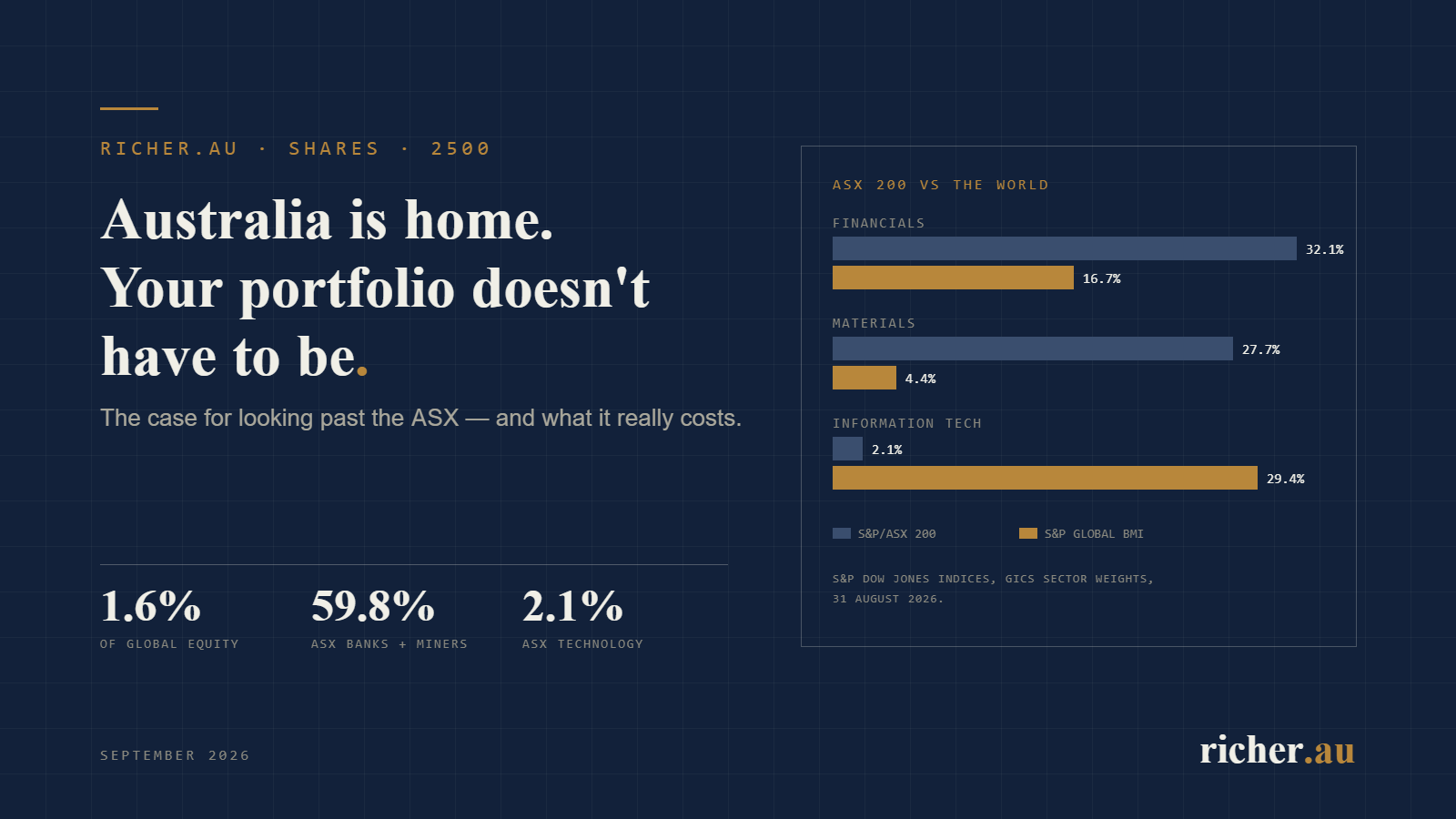
Australia is 1.6 per cent of the world's listed equity, and the ASX 200 keeps almost 60 per cent of its weight in banks and miners. The case for sending part of the share portfolio offshore — what it costs, and where it breaks down.
You can own thirty companies and still own one country
Picture an Australian who has done everything right. She earns a good salary in Sydney. She owns a $2 million home and a couple of investment properties. Her super is in a default fund. And she has built a $500,000 share portfolio of thirty carefully chosen ASX names — banks, miners, a supermarket, a health-care giant, a couple of small caps.
Ask her whether she is diversified and she will say yes, obviously. Thirty companies across eight sectors.
She is diversified across companies. She is not diversified at all across countries, currencies or economies. Her salary, her house, her rental income, most of her super and every share she owns are claims on the same economy, priced in the same currency, exposed to the same interest rate and the same housing cycle. If Australia has a bad decade, all of it has a bad decade together.
Owning thirty Australian companies is company diversification. It is not geographical diversification, and it is not economic diversification.
This article is not an argument that American shares are better than Australian shares. Nobody knows that, and anyone who tells you they do is describing the past. The argument is narrower and much harder to dispute: Australia is a small, unusually lopsided slice of the world's listed businesses, most Australians are already heavily exposed to it before they buy a single share, and the share portfolio is often the only part of the balance sheet they can easily point somewhere else.
- The home-bias problem, in dollars
- What the ASX 200 actually owns
- Has investing overseas actually produced better returns?
- The size of what you are leaving out
- Direct shares or ETFs
- What it actually costs: the platforms compared
- The fee you notice and the fee you don't
- Is moomoo safe for Australian investors?
- Currency: the second bet you did not think you placed
- Tax, in outline
- What can go wrong
- Where this argument could be wrong
- Think globally, allocate deliberately
Data updated 3 September 2026. Sources: S&P Dow Jones Indices (S&P/ASX 200, S&P 500 and S&P Global BMI, 31 August 2026); RBA daily exchange rates (AUD/USD 0.7143, 2 September 2026); broker pricing pages and Financial Services Guides as dated in the tables below. Full source list at the end of this article.
The home-bias problem, in dollars
Economists call the tendency to over-own your own market "home bias", which makes it sound like a mild preference. Put it on a balance sheet and it looks more serious.
Take the investor from the opening. Her assets are a $2 million home, $3 million of investment property, $500,000 in superannuation and a $500,000 ASX share portfolio. Six million dollars, and every dollar of it is a claim on Australia. Her salary is too, which means the income that services the mortgages is correlated with the assets the mortgages are secured against.
Now watch what happens if she moves the entire share portfolio offshore. Not part of it — all of it.
Two conclusions fall out of that picture, and they point in the same direction.
The first is that for a property-heavy Australian, the share portfolio is a small lever. Even spending all of it on international equities leaves the balance sheet more than 90 per cent domestic. The second follows immediately: because the lever is small, there is very little diversification benefit left on the table if you also spend it on Australia. The share portfolio is the one part of the balance sheet that can easily hold something else, and an investor who fills it with ASX names has chosen to buy more of what they already own in size.
The reverse case is just as important. A 26-year-old renter with $40,000 in super, no property, and a job that is not tied to the domestic economy has a much weaker home-bias argument. Their exposure to Australia is mostly their future salary. The strength of the case for overseas shares depends on the rest of your balance sheet, not on a view about which market is better.
What the ASX 200 actually owns
The second half of the argument is about what is inside the Australian index. It is not a small version of the world market. It is a very different animal.
At 31 August 2026, financials were 32.1 per cent of the S&P/ASX 200 and materials another 27.7 per cent. Banks and miners together were 59.8 per cent of the index. Information technology was 2.1 per cent.
Because S&P Dow Jones Indices publishes both the ASX 200 and its global index on the same GICS sector definitions at the same date, the comparison below is genuinely like-for-like rather than two providers measuring different things.
| Sector | S&P/ASX 200 | S&P Global BMI | Difference |
|---|---|---|---|
| Financials | 32.1% | 16.7% | +15.4 |
| Materials | 27.7% | 4.4% | +23.3 |
| Information technology | 2.1% | 29.4% | −27.3 |
| Industrials | 6.6% | 11.7% | −5.1 |
| Health care | 6.5% | 8.7% | −2.2 |
| Consumer discretionary | 6.5% | 9.0% | −2.5 |
| Communication services | 3.3% | 7.1% | −3.8 |
| Real estate | 5.4% | 2.2% | +3.2 |
| Consumer staples | 3.7% | 4.6% | −0.9 |
| Energy | 4.6% | 4.0% | +0.6 |
| Utilities | 1.4% | 2.3% | −0.9 |
The concentration goes further than sectors. The ten largest companies in the ASX 200 are 48.8 per cent of it. The ten largest in the global index are 21.2 per cent. An Australian index fund is close to a levered bet on four banks and two miners with a health-care company attached.
What sits in the 29.4 per cent the ASX does not have is not an abstraction. It is semiconductors, cloud infrastructure, enterprise software, global payments networks, search and advertising platforms, medical devices, large-scale pharmaceuticals, aerospace, industrial automation, cybersecurity, luxury goods and global logistics. Microsoft, Nvidia, Alphabet, Amazon, Meta, Apple, Broadcom, Visa, Mastercard and Berkshire Hathaway are simply examples of business models with no meaningful Australian equivalent.
Naming those companies is not a view that any of them is good value today. Several trade on valuations that assume a great deal. The point is about access to industries, not about which shares to buy. An Australian investor who never looks outside the ASX has ruled out most of the world's semiconductor, software and payments industries before doing any analysis at all — and would have done so at any price.
Has investing overseas actually produced better returns?
Over the last decade, yes — by a wide margin. That fact is worth stating plainly, and then handling carefully, because it is the weakest part of the case for overseas shares even though it looks like the strongest.
All the figures below are total returns with dividends reinvested, annualised. The S&P rows are to 31 August 2026 and the MSCI row to 31 July 2026, its latest published factsheet. Comparing a price index with a total-return index is the most common way this comparison gets rigged, usually in Australia's favour, because Australian dividend yields are high.
| Index (total return) | Currency | 3 yr p.a. | 5 yr p.a. | 10 yr p.a. |
|---|---|---|---|---|
| S&P/ASX 200 | AUD | 11.24% | 7.81% | 9.36% |
| S&P 500 | AUD | 17.03% | 13.23% | 15.92% |
| S&P 500 | USD | 21.04% | 12.79% | 15.37% |
| MSCI World ex Australia | AUD | 17.14% | 12.79% | 14.29% |
The row that matters most to an Australian is the second one, not the third. You spend Australian dollars. The 15.92 per cent is what an unhedged Australian holder of the S&P 500 actually experienced; the 15.37 per cent is what an American experienced. The MSCI row is arguably the most realistic of all, because a diversified investor is far more likely to buy the whole developed world than the United States alone.
The dollar gap is large enough to be uncomfortable: about $193,000 on a $100,000 starting balance. Now here is why that chart is a bad reason to send everything overseas tomorrow.
Six reasons not to read Fig. 3 as a forecast
Starting valuations differ. The decade of US outperformance ended with US shares priced far more richly than Australian shares. Buying the same index at a higher multiple of earnings is not the same investment, and a good deal of that 15.92 per cent came from investors agreeing to pay more per dollar of profit rather than from profits themselves.
Currency did some of the work, and can undo it. Over ten years the falling Australian dollar added roughly half a percentage point a year to US returns for Australians. Over the last twelve months it did the reverse, and violently — see the currency section below.
Australia has a dividend and franking advantage this table cannot show. Total-return indices reinvest dividends but do not add franking credits. For an Australian investor on a low marginal rate, or a fund in pension phase, franking materially improves the after-tax Australian return relative to what Fig. 3 shows.
Australia has beaten the US before, for long stretches. The 2000s were an Australian decade: a resources boom, a rising currency and a US market recovering from the dot-com collapse. Anyone who globalised their portfolio in 1999 on ten-year backward-looking numbers had a difficult decade.
The last decade was unusually narrow. A handful of American mega-cap technology companies produced a disproportionate share of that return. That is a real economic phenomenon, not a statistical illusion — but it is one specific thing that happened, not a law.
And recency bias is the whole trap. The most common way investors destroy returns is buying the thing that already went up, at the moment its outperformance is most obvious.
Historical outperformance is a reason not to ignore overseas shares. Diversification is a much better reason than chasing whichever market won the last decade.
The size of what you are leaving out
Set returns aside entirely and just count. The S&P Global BMI, the broadest standard measure of listed equity, held 15,332 companies at 31 August 2026. Australia accounted for 330 of them and 1.6 per cent of the value.
This is the part of the argument that does not depend on any forecast. You do not have to believe the United States will keep winning, or that Japan is cheap, or that India will compound for twenty years. You only have to accept that you cannot know in advance where the best businesses of the next two decades will be domiciled.
If the best business of the next twenty years is headquartered in Seattle, Copenhagen, Taipei or Paris, an Australia-only investor excluded it before reading a single annual report.
A single diversified international fund buys exposure to somewhere between a thousand and several thousand companies in one transaction. The MSCI World ex Australia index holds 1,235 companies across developed markets; MSCI ACWI holds 2,460 across 23 developed and 24 emerging markets and covers roughly 85 per cent of the global investable opportunity set. Neither requires you to pick a country.
Direct shares or ETFs
There are two ways to do this, and they suit different people.
Buying overseas shares directly
You open an account that can trade US or other foreign markets and buy individual companies — Microsoft, Alphabet, Berkshire Hathaway, Novo Nordisk, Toyota. You control exactly what you own, you pay no ongoing management fee, and if you are genuinely good at analysing businesses you can concentrate on the ones you think are exceptional.
The costs are real. You carry single-company risk. You have to do the research in a market where you are further from the news flow and the culture. You have foreign-currency records to keep for every parcel. You will hold shares whose price moves overnight while you sleep, which is a genuine behavioural hazard — an app that pings you at 3am is not a neutral tool.
Buying an international ETF
The alternative is one fund that holds the index. This is where most Australians should probably start, and there is a structural point worth understanding before choosing between the two available routes.
| ASX-listed international ETF | US-listed ETF bought directly | |
|---|---|---|
| Traded on | ASX, in AUD, in Australian hours | US exchange, in USD, overnight |
| Currency conversion | None to buy or sell | Required both ways |
| W-8BEN | Handled by the fund, if Australian-domiciled | You must lodge one, renewed every three years |
| US estate tax exposure | Generally avoided via Australian domicile | Directly held US securities are US-situs assets |
| Tax reporting | Australian AMIT statement | You reconstruct it from US statements |
| Management cost | Often slightly higher | Often the cheapest available |
| Choice | Growing but limited | Very large |
Broad global exposure is available on the ASX through funds tracking the S&P 500, the Nasdaq 100, MSCI World ex Australia and MSCI ACWI, in hedged and unhedged versions. The practical consequence is that an Australian does not need an international brokerage account at all to own the world. You can buy it on the ASX, in Australian dollars, through any ordinary Australian broker, and never convert a cent.
We are not naming specific funds as recommendations. Compare the management cost, the index, the domicile, whether it is hedged, and the size and spread of the fund in the PDS before deciding. Our companion piece on seven ETFs that cover the entire market works through how the pieces fit together.
What it actually costs: the platforms compared
If you do decide to buy overseas shares directly rather than through an ASX-listed fund, the platform you choose matters more than most people expect — and not for the reason the advertising suggests.
Every figure in this section was checked against each provider's own pricing page or Financial Services Guide on 3 September 2026. Broker pricing changes often. Check it again yourself before you act on it.
| Platform | US brokerage | Currency conversion | Markets | Fractional | Structure for US shares |
|---|---|---|---|---|---|
| CommSec | Greater of US$5.00 or 0.12% | 0.55% per conversion | 13 | No | Custodial |
| moomoo | US$0 commission + US$0.99 platform fee per order | Spread of 50 pips (0.005 AUD/USD) — about 0.70% | 3 | Yes | Futu Clearing Inc |
| Stake | US$3.00, or 0.01% above US$30,000 | 0.55% on funding | 2 | Yes | Custodial |
| CMC Invest | $0 on US, UK, Japan, Canada | 0.60% spread at execution | 15 | Not advertised | Custodial |
| Interactive Brokers | US$0.005/share, min US$1.00 (fixed tier) | 0.20 basis points, min US$2.00 | 150+ | Yes | IBKR as US broker |
Sources: CommSec international rates and fees; Moomoo Securities Australia Financial Services Guide dated 1 September 2026; Stake pricing; CMC Invest pricing and international shares pages; Interactive Brokers Australia commissions pages. All checked 3 September 2026. IBKR rates are quoted exclusive of GST and a lower tiered commission schedule is also available. moomoo's US pass-through fees (settlement, SEC and FINRA charges) are additional and small. Selfwealth has changed ownership since 2025 and is excluded; check its current pricing directly.
Now convert that into money. The table below is the cost of putting a single lump sum into a US share, counting the currency conversion and the brokerage together. It assumes AUD/USD of 0.7143, the RBA rate on 2 September 2026, and a US$150 share price where the brokerage depends on share count.
| Amount invested | IBKR | CMC Invest | Stake | CommSec | moomoo |
|---|---|---|---|---|---|
| A$1,000 | $4.20 | $6.00 | $9.70 | $12.50 | $8.39 |
| A$10,000 | $4.20 | $60.00 | $59.20 | $67.00 | $71.39 |
| A$50,000 | $4.47 | $300.00 | $280.00 | $335.00 | $351.39 |
| A$100,000 | $6.13 | $600.00 | $560.00 | $670.00 | $701.39 |
| As % of A$100,000 | 0.006% | 0.60% | 0.56% | 0.67% | 0.70% |
Read the bottom two rows again. On a A$100,000 investment the cheapest advertised brokerage in the table belongs to moomoo, at US$0.99 — and moomoo is the most expensive platform on the list. The gap between the cheapest and dearest is not a few dollars. It is roughly A$695 on a single transaction.
The fee you notice and the fee you don't
This is the single most useful practical lesson in the article, so it gets its own section.
Brokerage is the number platforms compete on because it is the number investors compare. It is also, for anyone investing more than a few thousand dollars at a time, the smaller of the two costs by an order of magnitude.
A 0.55 per cent conversion charge on A$100,000 is $550. When you eventually bring the money home, you convert again, and on today's rates that is roughly another $550 — before any change in the exchange rate itself. Call it $1,100 to take a round trip through the US dollar. The brokerage on the same journey might be $2 or it might be $240, but it is not what decided the outcome.
Conversion on funding. Stake and moomoo convert Australian dollars into a US dollar balance when you fund the account. You then trade in US dollars and pay nothing further on currency until you convert back. Fewer conversions, so the cost is a function of how often you move money in and out — not how often you trade.
Conversion at execution. CMC Invest converts as part of each international order, at the exchange rate at the time of execution plus its spread. There is no US dollar balance to hold. That is simpler, but it means every buy and every sell carries the FX cost, so an active investor pays it repeatedly.
Why it matters. Under the first model, ten trades from one funding event cost you one conversion. Under the second, ten trades cost ten. Two platforms quoting a similar percentage can produce very different annual bills depending on how you actually invest.
CommSec sits between the two: its 0.55 per cent applies per conversion, and the international service allows foreign currency to be held. Interactive Brokers is different again — you place an explicit currency order on its FX venue and hold the balance, which is precisely why its cost is so low and why it is harder to use.
CommSec: paying for the bank
CommSec is the most expensive mainstream option in the table on brokerage, and mid-range on currency. It is also, by a wide margin, the one Australians actually use, and the reasons are not irrational.
It is owned by the Commonwealth Bank. It settles into a CBA account you already have. It gives access to 13 international markets from the same login as your Australian holdings, with no account-opening fee, no custody fee and no inactivity fee on the standard international service. For someone who wants one tax statement, one login and a large Australian bank behind it, the premium buys something real.
The arithmetic still has to be faced. On A$10,000 the brokerage is about A$12; on A$100,000 it is about A$120, because the 0.12 per cent has no cap. Add 0.55 per cent of currency conversion and a A$100,000 purchase costs around A$670 against roughly A$6 at the cheapest end of the market. Whether that is worth paying is a personal judgement — but it should be a judgement, not an accident.
Interactive Brokers: cheapest, and hardest
It would be easy to write this section as "moomoo is the cheap one". The numbers do not support it.
Interactive Brokers charges 0.20 basis points on currency conversion — 0.002 per cent — with a US$2.00 minimum per order. On A$100,000 that is the US$2 minimum, about A$2.80. The equivalent charge at CMC Invest is A$600. The same transaction, roughly 200 times the cost.
US share commission on the fixed tier is US$0.005 a share with a US$1.00 minimum and a 1 per cent cap; the tiered schedule starts lower again. IBKR gives access to more than 150 markets, supports fractional shares, and is the natural home for a large or genuinely global portfolio.
The trade-offs are real and they are not about safety. The platform is built for professionals: you place an explicit currency order rather than having conversion happen invisibly, the interface assumes you know what you are doing, market-data subscriptions are a separate decision, and the quoted commissions are exclusive of GST. A first-time investor putting $500 a month into one ETF will find Stake, moomoo or CommSec markedly easier, and at that size the dollar difference is small. An investor moving A$100,000 offshore and leaving it there is in a completely different position.
The cheapest platform on brokerage and the cheapest platform overall are not the same platform, and the gap between them is not small.
Is moomoo safe for Australian investors?
This question comes up constantly, usually in the form: how can a broker charge US$0.99 and be legitimate? It deserves a proper answer rather than either reassurance or suspicion, so here is the structure, from the primary documents.
The Australian layer
Moomoo Securities Australia Ltd holds Australian Financial Services Licence 224663 and is regulated by ASIC. Australian client money must be held in designated client money accounts, separate from the firm's own funds, under the Corporations Act. Australian shares bought through moomoo are CHESS-sponsored under your own Holder Identification Number and registered in your name — since April 2024, new accounts receive individual HINs. ASX execution and settlement runs through FinClear Execution Ltd.
The US layer, which is different
CHESS does not extend beyond ASX-listed securities. There is no Australian registry for US shares, so every Australian broker offering US equities — CommSec, Stake, CMC, moomoo, IBKR — holds them through a custodian or nominee. This is normal market structure, not a warning sign, but it does mean you hold a beneficial interest recorded in the broker's books rather than being on the US share register yourself.
In moomoo's case the custodian is Futu Clearing Inc., in moomoo's own words "a U.S. broker-dealer and clearing firm regulated by the SEC and FINRA, and a fully owned subsidiary of our parent company, Futu Holdings (NASDAQ: FUTU)". The public record supports the description: Futu Clearing Inc. is registered with the SEC (file number 8-70215), has been a FINRA member since 28 May 2019 under CRD 298769, and appears on SIPC's list of members.
SIPC protection applies if a member brokerage fails and customer assets are missing. The limit is US$500,000 per customer, including a US$250,000 sub-limit for cash. It is not an insurance policy on your investments.
In SIPC's own words: "SIPC does not protect against the decline in value of your securities." It does not cover bad investment decisions, unsuitable advice, currency losses, or foreign exchange trades. Saying "your investment is insured for US$500,000" is simply wrong, and you will see it written.
The same logic applies at the Australian end. ASIC licenses and supervises conduct. It does not guarantee your returns, and an AFSL is not a compensation scheme.
Two things worth knowing that the marketing does not mention
First, Futu Clearing is a related party. It is wholly owned by the same parent as the Australian licensee, so the custody arrangement is intra-group rather than independent. That is common in this industry — Interactive Brokers clears through its own US entity too — but it is a different structure from a broker using an unaffiliated third-party custodian, and it is worth understanding rather than glossing over.
Second, FINRA's BrokerCheck record for Futu Clearing shows no disclosure events against the firm itself, but three against affiliates within the Futu group: a suspension order from Japan's financial regulator in June 2026 against Moomoo Securities Japan over ETF and ETN representations and compliance controls; a US$100,000 settlement with the US National Futures Association in February 2025 by Futu Futures Inc. for late financial reporting and supervisory failures; and a pending China Securities Regulatory Commission investigation opened in May 2026 into Futu Securities International (Hong Kong) regarding unlicensed activity directed at mainland investors.
None of that is a finding against the Australian licensee or the US clearing entity, and none of it means client assets are at risk. It is context a reader is entitled to have before deciding how much of their portfolio to place with any single group — the same question you should ask of any broker, including the big ones.
Why can moomoo be so cheap?
Because brokerage is not the only thing it sells. moomoo's own answer to the question is unusually direct: it says it "earns through various channels including brokerage commissions, foreign exchange (FX) spreads, and interest income".
Unpack that and the model is clear enough. A technology-led broker with no branch network automates onboarding, execution and reporting at very low marginal cost, and spreads the fixed cost of the platform across a large user base. On top of the US$0.99 platform fee it earns the currency spread — which, as Fig. 5 shows, is where the real money is. It earns interest on cash balances within the limits its licence allows. It sells premium data and other services. And it collects small regulatory pass-through charges on behalf of US market operators.
Cheap does not mean free
This is a general principle, not a criticism of one platform. Interactive Brokers puts it on its own commissions page: "Zero commission isn't the same as free." Every platform that advertises $0 brokerage is being paid somewhere, and the honest question is not whether they are making money but where. On the evidence in this article, for Australian investors buying US shares, the answer is nearly always the currency conversion.
Which platform suits whom
| Investor | What should drive the decision |
|---|---|
| Beginner, small regular amounts | Fractional shares, a simple interface and a low brokerage minimum. At A$1,000 a trade the whole cost range is roughly $4 to $13 — not worth agonising over |
| Existing CBA customer | Integration, one login and one tax statement have genuine value. Price the premium and decide deliberately |
| Cost-focused US investor | Compare currency conversion first, brokerage second. That ordering flips most published rankings |
| A$100,000+ going offshore | Currency conversion dominates everything else. A single conversion decision is worth several hundred dollars |
| Frequent trader | Whether FX is charged on funding or at execution matters more than the headline rate |
| Buy and hold, rarely trades | Custody, reporting quality and the cost of eventually converting back matter more than saving a dollar per trade |
| Multi-market or advanced | IBKR-style access to 150+ markets and cheap FX, accepting a steeper learning curve |
| Wants none of this | An ASX-listed international ETF, in Australian dollars, with no conversion at all |
There is no universal winner in that table, and any article that names one is not really comparing.
Currency: the second bet you did not think you placed
Buy a US share and you have made two decisions, whether or not you intended to. You have taken a view on the company, and you have taken a position in the US dollar against the Australian dollar.
The best illustration is the same index measured two ways. Over the year to 31 August 2026 the S&P 500 returned 20.38 per cent in US dollars. For an unhedged Australian holder it returned 9.94 per cent, because the Australian dollar strengthened. Currency took roughly half the return.
Look at the ten-year pair and the effect reverses: 15.37 per cent in US dollars became 15.92 per cent in Australian dollars, because the Australian dollar fell over that period. Nobody predicted either move.
There is a genuine diversification argument buried in this. The Australian dollar tends to weaken when global markets are under stress, which means unhedged overseas assets often rise in Australian-dollar terms exactly when domestic assets are falling. That cushioning is real and it is one of the better reasons to own foreign currency exposure. It is also not guaranteed, and it works against you in a strong-AUD year like the one just past.
Hedged or unhedged? Currency-hedged international funds strip the exchange-rate movement out at a cost, and remove the cushioning effect along with the risk. Unhedged funds keep both. Neither is correct in the abstract: hedging suits an investor whose spending and liabilities are entirely in Australian dollars over a short horizon, while a long-horizon investor is often better served keeping some genuine currency diversification. Many people split the difference and hold both.
Tax, in outline
This is a summary of how the system works, not advice about your situation. Structures held through companies, trusts and SMSFs, and anyone who is not an Australian tax resident, face materially more complexity than what follows.
Australian residents are taxed on worldwide income. The ATO requires you to declare foreign dividends, foreign interest and capital gains on overseas assets, converted to Australian dollars.
US dividends are withheld at source. The default rate for a non-resident is 30 per cent. Lodging a W-8BEN with your broker claims the reduced 15 per cent rate available to Australian residents under the Australia–US tax treaty. The form lasts three calendar years, or until your details change. Most brokers prompt you at account opening; if you skip it you are giving away 15 per cent of every dividend.
Foreign tax you paid can usually be credited. The foreign income tax offset lets you reduce Australian tax by foreign tax actually paid on income included in your Australian assessable income, subject to an offset limit.
Capital gains follow the normal Australian rules, calculated in Australian dollars, which means the exchange rate on the day you bought and the day you sold both affect the gain — you can make a US-dollar loss and an Australian-dollar gain.
Keep your cost base in Australian dollars. This is the record-keeping trap. Every parcel needs its AUD cost recorded at the time, not reconstructed years later.
Estate planning deserves a thought. Directly held US securities are generally US-situs assets and can create US estate tax filing obligations for non-residents above a low threshold, though the Australia–US estate tax treaty may substantially improve the outcome. An Australian-domiciled ETF holding the same shares generally avoids the issue. Get advice if the amounts are large.
Two structural conveniences are worth noting. An Australian-domiciled ETF handles the W-8BEN at fund level, so you never lodge one. And it gives you a single Australian tax statement instead of a pile of US paperwork.
What can go wrong
Diversifying overseas removes one concentration and introduces several new exposures. Honest accounting means listing them.
Valuation risk. Global equities, and US equities in particular, have at times traded at materially higher earnings multiples than Australian equities. Paying more for the same dollar of profit lowers your expected return whatever the quality of the business.
You may be swapping one concentration for another. This is the sharpest objection to the whole argument. Information technology is 29.4 per cent of the global index and the United States is 61.1 per cent of it. An investor who leaves an ASX portfolio that is 60 per cent banks and miners for a global index fund that is 30 per cent technology has diversified, but has not arrived at neutrality. They have chosen a different bet.
Currency risk, in both directions, as Fig. 6 shows.
Custodian and counterparty risk. Beneficial ownership through a nominee is standard, but it is not the same as being on the register. Understand who holds your assets, how they are segregated, and what protection actually applies if the firm fails.
Foreign regulatory and political risk. Rules on listings, disclosure, taxation and foreign ownership are set by other governments and can change without reference to you.
Tax complexity. More forms, more records, more ways to get it wrong, and higher accounting fees.
Time zones and behaviour. US markets trade while Australia sleeps. Apps with overnight price alerts are engineered to be checked. The most likely damage from international investing is not a market crash; it is an investor who trades more because the market is always open somewhere.
Different shareholder protections. Class action regimes, disclosure obligations, franking and takeover rules differ. Australian investors sometimes overestimate how transferable their rights are.
Chasing what already worked. The largest risk in this whole article is that somebody reads Fig. 3, sells their ASX portfolio at the top of a US bull market, and buys the index that produced that chart.
Overseas diversification is sensible. Chasing whichever overseas market just had the strongest five years is a different activity wearing the same clothes.
Where this argument could be wrong
Every argument in this article has a serious counter-case, and some investors should quite reasonably hold more Australia, not less.
Franking credits are a genuine Australian advantage
Total-return indices do not capture them. For a retiree in pension phase or an investor on a low marginal rate, fully franked Australian dividends can be worth meaningfully more after tax than the headline yield suggests, and there is no international equivalent. Fig. 3 understates Australian after-tax returns for those investors, in some cases substantially.
If your liabilities are in Australian dollars, so should some of your assets be
A retiree drawing an income in Sydney has costs in Australian dollars for the rest of their life. Matching a portion of the portfolio to the currency you will actually spend is not home bias; it is sensible asset-liability matching. Currency diversification is a benefit to someone accumulating over thirty years and a risk to someone drawing down over five.
The dividing line between "Australian" and "global" is blurry
BHP and Rio sell iron ore into China at prices set in US dollars. CSL earns the large majority of its revenue outside Australia. Macquarie is a global business with an ASX listing. An investor who owns those companies already has substantial foreign-currency and foreign-economy exposure through an Australian ticker, and the ASX 200's own country breakdown shows nearly 4 per cent of the index is companies domiciled elsewhere. The home-bias problem is real, but it is smaller than a naive reading of "100 per cent Australian shares" implies.
Australian valuations and yields may simply be better at some point
Nothing in this article says buy global regardless of price. If Australian shares are cheap relative to global shares on sensible measures, that is a real argument for tilting home, and the same reasoning that warns against chasing US outperformance warns against ignoring Australian value.
Familiarity is worth something, within limits
You bank with these companies, shop at them, and read about them in your own language and legal system. That is a genuine informational edge for an investor who analyses individual businesses — although it is also exactly the bias that produces home bias in the first place, so treat the argument with suspicion.
And costs are not zero
Conversion charges, wider spreads, tax complexity and an extra layer of custody all subtract from whatever diversification benefit you are buying. On a small portfolio traded frequently through an expensive platform, the costs could plausibly exceed the benefit.
Think globally, allocate deliberately
There is no correct percentage. What follows is a way of thinking about the question, not a recommendation for any individual.
| Illustrative setting | Australian shares | International | The investor this might describe |
|---|---|---|---|
| Australia-heavy | 70% | 30% | Income-focused, franking matters, spends in AUD, few other Australian assets |
| Balanced | 50% | 50% | Accumulating, some property, wants franking and global exposure both |
| Global-heavy | 25% | 75% | Long horizon, heavy Australian property and salary exposure elsewhere on the balance sheet |
Illustrations only. These are not recommended allocations, they are not derived from any optimisation, and they are not advice. For reference, a portfolio holding global shares strictly at market weight would be roughly 98 per cent international.
The variables that should move you along that scale are mostly about the rest of your life, not about markets:
How much Australian property do you own? Heavy property exposure is the strongest single argument for a global tilt in the share portfolio. What does your super hold? Check the actual allocation — many default options hold a large Australian equity weight, and it may already be doing some of this job. Where does your income come from? A mining engineer in the Pilbara and a locum doctor have different exposures to the same economy. Do you own a business? Almost certainly an Australian one. What is your horizon, and do you need income now? Franking and currency matching both favour home as the drawdown date approaches.
Our companion article on money management makes the broader version of this point: the objective is a balance sheet that does not require you to be right about any one thing.
The point of all of it
Australia is a good place to live, work, own property and invest. None of that requires every investment dollar to carry an Australian postcode.
The case for overseas shares was never that Wall Street will beat the ASX over the next twenty years. Nobody knows that, this article does not claim it, and the decade in Fig. 3 is history rather than evidence. The case is that Australia is 1.6 per cent of the world's listed value and an unusually concentrated 1.6 per cent at that; that most Australians already own the domestic economy several times over through their salary, their house and their super; and that the share portfolio is usually the only part of the balance sheet that can easily hold something else.
Diversification is what you do when you accept that you do not know which country, currency, industry or company will create the most wealth between now and 2046 — and build a portfolio that does not need you to know. Think Richer, and the question stops being "which market wins" and becomes "what am I already exposed to, and what have I left out".
Frequently asked questions
Should Australians invest in overseas shares?
It depends on what else you own. The strongest version of the argument is not that foreign markets perform better, but that Australia is about 1.6 per cent of global listed equity value, the ASX 200 holds close to 60 per cent of its weight in banks and miners, and most Australians already carry heavy domestic exposure through their salary, home, investment properties and superannuation. If that describes you, the share portfolio may be the only part of your balance sheet that can easily point somewhere else. If you rent, have little super and work in a globally traded industry, the case is weaker.
How do I buy US shares in Australia?
Two routes. You can open an account with a broker offering US markets — CommSec, moomoo, Stake, CMC Invest and Interactive Brokers all do — convert Australian dollars to US dollars and buy directly, lodging a W-8BEN to reduce US dividend withholding from 30 per cent to 15 per cent. Or you can buy an ASX-listed international ETF in Australian dollars through any ordinary Australian broker, with no currency conversion and no W-8BEN, because the fund handles it.
What is the best broker for US shares in Australia?
There isn't one answer, and the ranking changes depending on how much you invest. On costs checked at 3 September 2026, Interactive Brokers was by far the cheapest overall on a A$100,000 purchase at roughly A$6, against about A$560 for Stake, A$600 for CMC Invest, A$670 for CommSec and A$700 for moomoo — because currency conversion, not brokerage, dominates at that size. At A$1,000 the entire range is about $4 to $13 and ease of use matters more. IBKR is also the hardest to learn.
Is moomoo safe for Australian investors?
Moomoo Securities Australia Ltd holds AFSL 224663 and is regulated by ASIC, client money must be held in designated client money accounts, and Australian shares are CHESS-sponsored under your own HIN. US shares are held under a custodian arrangement with Futu Clearing Inc., which is SEC-registered, a FINRA member since 2019 and on SIPC's member list. Two caveats worth knowing: Futu Clearing is a wholly owned affiliate rather than an independent custodian, and FINRA's BrokerCheck record lists regulatory matters against other companies in the Futu group in Japan, the US futures market and Hong Kong. None of that is a finding against the Australian or US entities, but it is context.
Does SIPC insure my US shares?
No, not in the way the word "insure" suggests. SIPC can restore missing customer securities and cash up to US$500,000, including a US$250,000 cash sub-limit, if a member brokerage fails. SIPC states plainly that it "does not protect against the decline in value of your securities". It does not cover investment losses, bad decisions, currency movements or foreign exchange trades.
Why are currency conversion fees more important than brokerage?
Because they scale with the amount and brokerage usually does not. A 0.55 per cent conversion on A$100,000 is $550, and converting back later costs roughly the same again. The brokerage on that trade might be US$0.99. Platforms advertise the number that looks smallest, which is why several "zero brokerage" offers are among the more expensive ways to invest a large sum.
Do I need a W-8BEN form?
If you hold US shares directly, yes. Without one, US dividend withholding is 30 per cent; with one, Australian residents get the 15 per cent treaty rate. It lasts three calendar years or until your details change. If you own US exposure through an Australian-domiciled ETF, the fund lodges it and you do not.
What allocation to international shares should I have?
That is a question for you and, if the sums are meaningful, a licensed adviser. The framework in this article is deliberately not a number: work out how much Australian exposure you already have through property, salary, business and super, then decide how much of the remaining lever you want to point offshore. A global market-weight portfolio would be roughly 98 per cent international, which almost nobody holds; most sensible answers sit a long way below that and well above zero.
Data sources
- S&P Dow Jones Indices, S&P/ASX 200 — sector breakdown, country breakdown, top-10 weight and total returns in AUD, as at 31 August 2026.
- S&P Dow Jones Indices, S&P 500 — total returns in both USD and AUD, as at 31 August 2026.
- S&P Dow Jones Indices, S&P Global BMI — 15,332 constituents, sector and country breakdown including Australia at 1.6%, as at 31 August 2026.
- MSCI, MSCI World ex Australia Index (AUD) factsheet, 31 July 2026 — 1,235 constituents, sector weights and annualised gross returns.
- MSCI, MSCI ACWI Index (AUD) factsheet, 31 July 2026 — 2,460 constituents across 23 developed and 24 emerging markets, approximately 85% of the global investable opportunity set.
- Reserve Bank of Australia, exchange rates — AUD/USD 0.7143, 2 September 2026.
- CommSec, rates and fees — international brokerage of the greater of US$5.00 or 0.12%, 0.55% foreign exchange fee, no custody or inactivity fee. Checked 3 September 2026.
- Moomoo Securities Australia Ltd, pricing and Financial Services Guide dated 1 September 2026 — AFSL 224663, US$0 commission plus US$0.99 platform fee, 50-pip AUD/USD spread, pass-through fees, FinClear execution and CHESS sponsorship for ASX products.
- Stake, pricing — US$3 per trade or 0.01% above US$30,000, 55 basis points on funding. Checked 3 September 2026.
- CMC Markets, stockbroking pricing and international shares — $0 brokerage on US, UK, Japanese and Canadian listings, 0.60% FX spread at execution, 15 markets. Checked 3 September 2026.
- Interactive Brokers Australia, stock commissions and spot currency commissions — US$0.005 per share fixed with a US$1.00 minimum, 0.20 basis points on currency with a US$2.00 minimum, exclusive of GST. Checked 3 September 2026.
- FINRA, BrokerCheck report for Futu Clearing Inc. — CRD 298769, SEC file 8-70215, FINRA member since 28 May 2019, and affiliate disclosure events.
- Securities Investor Protection Corporation, what SIPC protects and list of members — US$500,000 limit including US$250,000 for cash, and the statement that SIPC does not protect against a decline in the value of securities.
- Australian Taxation Office, foreign and worldwide income and claiming a foreign income tax offset.
- Internal Revenue Service, tax treaty tables — Form W-8BEN as the means of claiming treaty benefits; and Betashares, W-8BEN forms explained — 30% default withholding, 15% treaty rate, three-year validity and fund-level lodgement by Australian-domiciled ETFs.
Keep reading
James Zhang is an Australian investor and business owner, and the founder of richer.au. He holds a Bachelor of Economics from the University of Sydney and an MBA majoring in Finance from the University of Technology Sydney, and has spent over twenty years investing in more than twenty properties across six Australian states and territories, alongside shares, ETFs, commodities and private businesses. More about James.
General information only. This article is general information and does not take your objectives, financial situation or needs into account. It is not personal financial, tax or investment advice, and nothing in it is a recommendation to buy or sell any share, fund or platform mentioned, or to hold any particular allocation. The illustrative 70/30, 50/50 and 25/75 allocations are examples used to explain a way of thinking, not recommended portfolios. Past returns are not a guide to future returns, and the historical figures in this article do not predict what any market will do next. Broker fees, index weights, exchange rates and tax rules stated were current on the dates shown and change frequently — verify them yourself before acting. Richer Online Pty Ltd does not hold an AFSL, has no commercial, referral or affiliate relationship with any broker, platform or fund named in this article, and received no payment or consideration from any of them. Speak to a licensed financial adviser and a registered tax agent about your own circumstances.
Get richer, one decision at a time
New articles as they land.
Property, shares, commodities and tax strategy — worked examples with real Australian figures and no product spruiking. One email when something new goes live.
No spam · unsubscribe any time