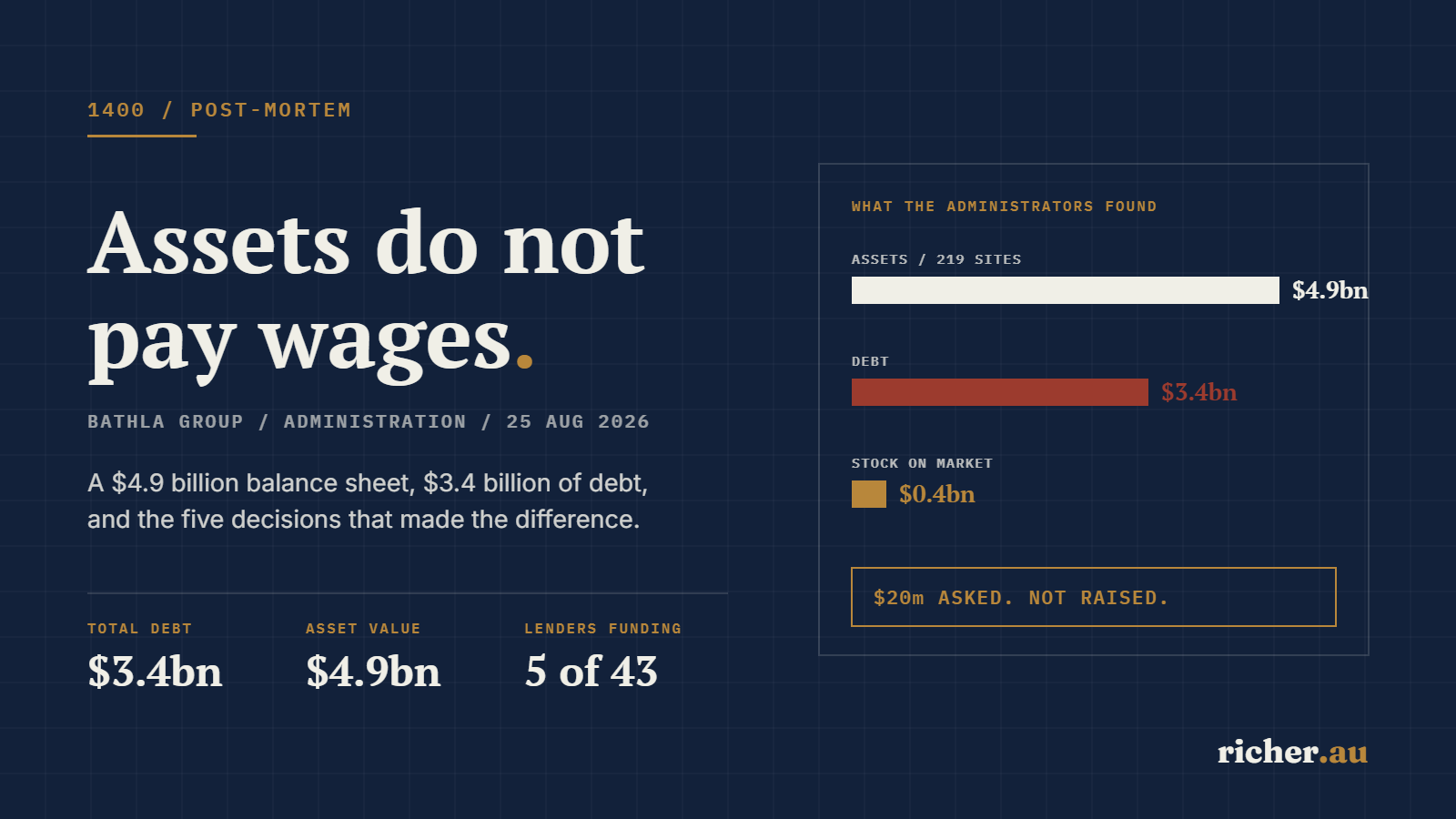
A $4.9 billion balance sheet that could not find $20 million
On 25 August 2026, Teneo was appointed voluntary administrator of the Bathla Group and 542 associated companies. Two days later the administrators sat down with 43 separate lenders and asked them for $20 million — enough to keep the cranes turning for five weeks. Five lenders eventually put up between $3 million and $5 million, enough for a fortnight, on the condition it was spent only on their own projects. Fourteen of 45 active building sites kept working. The other 31 stopped.
That is the whole story in one paragraph. A group with a preliminary asset value of $4.9 billion across 219 sites, owing $3.4 billion, was brought down by a working-capital gap of roughly $1.3 million a week. On any solvency test that runs off the balance sheet, Bathla looked fine. On the only test that matters — can you pay what falls due this Friday — it had already failed.
What actually happened, in order
Bathla was not a boutique. It was one of the largest suppliers of affordable housing in New South Wales, with a pipeline of about 14,000 dwellings — on the ABC's reckoning, close to a fifth of the new housing the state was targeting for the year. Its product was the Western Sydney growth corridor: Schofields, Marsden Park, Tallawong, Kellyville, Blacktown. Houses and townhouses for first-home buyers, and mid-rise apartments for investors.
The sequence of the collapse matters, because almost every warning sign arrived in public before the administration did.
Two things in that timeline are worth pausing on. The first is 14 August: Centuria Bass, one of Bathla's own lenders, paused redemptions across two credit funds — eleven days before the administration. Investors in those funds found out that their money was illiquid before the borrower found out it was insolvent. The second is 31 August: Woodbridge Capital put FTI Consulting in as receiver over 65 completed townhouses at Kellyville. Finished stock, no construction risk, and the first thing a lender did was move to sell it.
“Private construction of affordable housing, with private credit, subject to private inspections of quality and safety. What could possibly go wrong?” Alan Kohler, ABC News, 7 September 2026
The numbers the creditors were given
At the first meeting of creditors on 4 September, Teneo put figures on the table. They are worth reading as a structure, not just a total.
| What the administrators reported | Amount | What it tells you |
|---|---|---|
| Preliminary value, 219 sites | $4.9bn | Asset cover of about 1.4 times the debt — on paper |
| Secured lender debt | $3.08bn | Spread across 43 lenders, project by project |
| ATO and land tax | $187m | Tax used as working capital — a late-stage distress signal |
| Property listed or under contract | $400m | No cash expected from it in the near term |
| Cost of keeping sites going | $1.0–1.3m per week | The number that actually decided the outcome |
| Funding requested from lenders | $20m for 5 weeks | 0.4% of the asset value could not be raised against it |
The five reasons it failed
The company's own explanation, given by managing director Bhart Bhushan on 24 August, was a “perfect storm”: softening sales, the May Budget, falling confidence, construction cost increases it had absorbed, and pressure in the lending market. Every one of those is real. None of them is an accident that happened to Bathla. Each was a risk the group had chosen to carry at full size.
1. Forty-three lenders, and not one of them in charge
Bathla did not borrow from a bank. It borrowed from about 40 private credit funds, project by project, entity by entity, across 542 companies. Disclosed exposures ran from $1.5 million to $340 million. That structure is genuinely useful while things are going well: each single-purpose vehicle carries its own security, a problem at one site does not contaminate the others, and a developer in a hurry can start a new project the week a fund says yes.
It is close to unworkable in a crisis. When the administrators needed $20 million to keep 45 sites moving, there was no agent bank to call, no syndicate to bind, no intercreditor deed to hold the group together while a rescue was negotiated. There were 43 separate commercial decisions, each rational on its own and collectively fatal. Five lenders said yes — and the money they advanced could only be spent on their projects.
There is a second cost to that structure, and it lands on the lenders rather than the developer. Because Bathla's security sits in the same handful of corridors — Blacktown, The Hills, Marsden Park, Schofields — a receiver selling one lender's stock sets the comparable sale price for everybody else's. Olvera Advisors made this point after the first receivership: enforce simultaneously in a concentrated market and you revalue each other's collateral downwards. Forty-three lenders who could not agree to fund $20 million are now individually incentivised to sell first.
2. It was financed, day to day, with other people's money
Inside the $3.4 billion sit three numbers that are not really borrowings at all. $145 million owed to the ATO. $42 million of unpaid land tax. And customer deposits that, on the administrators' own account, were spread across multiple law-firm trust accounts and were not all held in trust — some contracts permitted the deposit to be used to fund the project.
Unpaid tax is the cheapest and most dangerous working capital in Australian business. It is unsecured, it requires no application, and it is the single clearest tell that a business has run out of other options. A developer that has stopped remitting to the ATO has usually stopped being a going concern some months earlier — it simply has not been told yet. Spending buyers' deposits belongs in the same category, with the added feature that the lender is a family with a mortgage pre-approval and no way to withdraw it.
Are the tax obligations current? Not “is there a payment plan” — current. A business funding itself from PAYG withholding, GST or land tax has already exhausted its commercial credit; the arrears are the symptom of a decision made long before the insolvency.
3. It kept buying land while its market turned
At the appointment, Bathla held 219 sites and a pipeline of roughly 14,000 dwellings, of which about 2,000 were physically under construction. That is an enormous option on future Sydney house prices, and options cost money to hold: interest on the site debt, council rates, holding costs, and the $42 million of land tax that went unpaid.
A pipeline is an asset in a rising market and a liability in a falling one, because the carry is fixed and the exit is not. The $400 million of completed or contracted stock the administrators found sitting on the market is the same problem in its final form: real product, real cost, and no cash from it in the near term. The group was long land, long construction and short cash at precisely the point in the cycle when that combination stops being rewarded.
4. Demand broke on 12 May 2026, and the rate cycle broke with it
The 2026–27 Federal Budget quarantined negative gearing on established residential property bought after 7:30pm on 12 May 2026, effective from 1 July 2027, and replaced the 50% CGT discount from the same date with cost-base indexation plus a 30% minimum tax. New builds were deliberately carved out — which, on paper, should have favoured a developer selling new stock.
It did not work that way. The CGT change applies to CGT assets generally, not only established housing, so the investor who was weighing an off-the-plan apartment against an ETF saw both sides of the trade reprice at once. Add three 25 basis point rate rises in February, March and May 2026, taking the cash rate to 4.35%, and the marginal buyer of a $700,000 house-and-land package in Marsden Park simply stopped turning up.
By August, 93% of capital city suburbs were recording value falls, against 45.8% in autumn. Listings were 24% higher than a year earlier and quarterly sales 15.5% lower. For a business whose entire model was to convert land into settled contracts at volume, that is not a soft patch. It is the machine running backwards.
5. Costs and compliance stepped up at the worst possible moment
Construction costs are about 51% higher than before COVID, and the fixed-price contract — still the norm for house-and-land and off-the-plan sales — hands that risk to the builder. Bathla said explicitly that it had absorbed cost increases. That is an admirable-sounding sentence which, on a 14,000-dwelling pipeline sold at fixed prices, describes an unhedged short position in the price of concrete, labour and finance.
On top of that came quality. Building Commission NSW carried out more than 40 inspections of Bathla sites, buyers complained of defects and poor finishes, and a private certifier was alleged to have falsified approval documents at four Bathla sites. In the same month, New South Wales became the first Australian jurisdiction to require decennial liability insurance — ten-year, first-resort cover for structural, waterproofing and fire-safety defects in new strata apartment buildings above three storeys — as a condition of an occupation certificate. That regime commenced days before the administration.
The point is not that the insurance caused the failure. It is that an insurer pricing your defect history is functionally the same as a lender pricing your business, and Bathla had spent years giving both of them reasons to charge more. Quality was never only an ethical question; it was a cost-of-capital question that arrived with a due date.
3,472 construction companies failed in 2025–26, a quarter of all company insolvencies in Australia, with about two-thirds of them small builders. Australia is not expected to reach its 1.2 million new homes target until December 2030, and NSW may miss its own five-year target by three years. Good builders are migrating to infrastructure and commercial work, where the terms are better and the price risk is shared — which makes the housing shortage worse, not better.
What Bathla should have done instead
Hindsight is cheap, so the test here is not “should it have foreseen the May Budget”. It is narrower and fairer: which of these decisions were available to the group before the market turned, at a cost it could afford at the time? On that test, most of them were.
| Decision | What Bathla did | What would have prevented this |
|---|---|---|
| Funding structure | ~40 private lenders across 542 entities, no lead bank | A syndicated facility with an agent and an intercreditor deed, so one conversation can save the group |
| Debt tenor | Short project facilities requiring continual refinance | Term debt matched to the build-and-settle cycle, plus committed undrawn working capital |
| Liquidity | Reliant on next settlement and next drawdown | Twelve months of interest, overheads and site costs held in cash, untouchable |
| Pipeline | 219 sites, 14,000 dwellings, still acquiring | Stop buying land above a set gearing level; finish and settle before adding |
| Price risk | Fixed-price contracts with absorbed cost increases | Rise-and-fall clauses, shorter price-lock windows, contingency priced into every contract |
| Tax and deposits | $145m ATO, $42m land tax, deposits partly used for project funding | Tax current at all times; every deposit in trust, full stop |
| Quality | 40+ regulator inspections, defect complaints, certifier allegations | Defect spend treated as a financing cost, because that is what it becomes |
| Group structure | 542 companies, no single consolidated view for lenders | One audited consolidated balance sheet and one treasury, whatever the SPV map looks like |
Match the money to the asset, and keep one lender in charge
The cheapest capital is rarely the best capital. Project-by-project private credit was faster and more flexible than a bank facility, and in a growth phase that flexibility is worth paying for. But a developer with 219 sites is a corporate borrower pretending to be 219 small ones. A group-level syndicated facility, with a lead lender, cross-collateralisation on agreed terms and a standstill mechanism, costs more in normal times and is the only thing that buys a company a fortnight when it needs one.
Hold the buffer you hope you will never justify
Twelve months of interest, corporate overhead and committed site costs, in cash, would have been somewhere between $80 million and $120 million for a group this size. It would have looked like lazy capital for years. It would also have turned a $20 million funding request into a management decision rather than a negotiation with 43 counterparties who had just read about you in the paper.
Solvency is an opinion about tomorrow. Cash is a fact about Friday. The whole art of staying Richer is never having to find out which one your lender believes.
Read the early warning, not the late one
The market told Bathla what was coming well before August. Alceon exited an exposure of around $670 million in January 2026 — seven months before the administration. When a sophisticated lender takes the trouble to get out of your largest relationship, that is not a portfolio decision; it is a credit opinion about you, delivered in the only language lenders use. The correct response to a lender leaving is to shrink until the remaining lenders are comfortable, not to replace the money and continue.
Stress test to the downside that actually happened
None of the 2026 shocks required clairvoyance. A competent stress test in 2025 would have run: prices down 10%, rates up 75 basis points, settlements six months late, one major lender declining to roll. That is not a pessimistic scenario — it is a normal Australian property cycle, and it is close to exactly what occurred. A group that survives that test on paper does not need a rescue; a group that fails it should be selling sites into strength, which in 2025 was available.
Stop selling tomorrow's houses at today's prices
Fixed-price contracts transfer inflation risk from the buyer to the builder for the duration of the build. With costs up 51% since 2019 that transfer has bankrupted a large slice of the industry. The fixes are unglamorous and legal: shorter price-lock periods, rise-and-fall or escalation clauses within consumer-law limits, staged pricing, and simply refusing volume that only works if input costs behave. Growth bought by underpricing risk is not growth.
Sell the stock, not the story
By the time the administrators arrived there was $400 million of finished or contracted product on the market and no near-term cash coming from it. Stock that will not sell at the asking price is not worth the asking price. Clearing completed inventory at a discount in early 2026 — while buyers still existed — would have been painful, visible and survivable. Waiting for the market to come back is the most expensive form of optimism in property.
Make the group legible
Five hundred and forty-two companies is not fraud and it is not unusual; it is how Australian development finance is structured. But an SPV map that no one can consolidate quickly means no lender can see the group's true liquidity, and neither can the board. Legibility is what makes a rescue possible: administrators, lenders and a government considering assistance all need one set of numbers within days, not weeks.
What investors can learn from it
Most readers of this page will never build a townhouse. Rather more of them are on the other side of this story, because the money that funded Bathla came from retail and wholesale investors chasing 8–12% yields in property credit funds.
If you hold a private credit or mortgage fund
Roughly half of Australia's estimated $200 billion private credit market is property, and Bathla is the first genuinely large test of it. Look at what happened to the funds, not just the borrower.
| Lender | Disclosed Bathla exposure | What it did |
|---|---|---|
| PAG Asia Capital | $300m+ | Among the five funding continued work |
| CVS Lane (two funds, $2.1bn FUM) | 9 loans | Suspended applications and redemptions 28 Aug, to reassess by end October |
| Centuria Bass | Not disclosed | Paused redemptions in two funds on 14 Aug, before the administration |
| La Trobe Financial | $38.1m | Four residential loans plus one development loan around 95% complete |
| Trilogy Funds | $29.79m | Two of 131 current loans |
| MA Financial | Not disclosed | Capped monthly redemptions at 1% of funds under management |
| Woodbridge Capital | Not disclosed | Appointed FTI as receiver over 65 completed homes, 31 Aug |
| Alceon | ~$670m (exited) | Left the exposure in January 2026 |
Four lessons fall out of that table, and they generalise well beyond this one borrower.
A redemption gate is the product working as designed. When a fund lends money for three years and offers you monthly liquidity, the liquidity is a convenience, not a right. Freezing redemptions is what a responsible manager does when one borrower's fate would otherwise let early exiters leave at a valuation the late ones will have to fund. It is still a reason to understand, before you invest, what fraction of the fund could be locked and for how long.
Single-borrower concentration is the risk that actually bites. Trilogy held two loans out of 131 to this borrower; CVS Lane held nine across two funds. Those are very different positions in the same event. Ask the manager the only question that matters: what is our largest single-borrower exposure, as a percentage, including related entities? Forty-three lenders to one group means someone's diversification was a fiction.
Valuations in development lending are opinions about the future. Loans are commonly written against an “as if complete” valuation. If the project stalls, that valuation describes a building that does not exist, on a site that now needs someone else's money to finish it. ASIC chair Sarah Court has called Bathla “the first real test for private credit” and told a parliamentary committee there is “currently a lack of information and insight into wholesale private credit funds”. The regulator published ten principles for the sector in November 2025; until they bite, the disclosure gap is the investor's problem.
Yield is compensation for being last to know. The investors in those funds learned about Bathla's position from a redemption freeze. The subcontractors learned about it when their invoices stopped. One firm alone, Delta Foundations, is owed about $400,000 for work already performed across several Bathla sites. If a 9% return is available in a market where banks will lend at 6%, the extra 3% is buying somebody else's risk — usually the risk of being informed late.
If you invest in shares, the same tells apply
Bathla was private, but the warning signs are the ones that show up in listed companies too, and they are all in the public record before the event: tax arrears disclosed as a “payment arrangement”; a proliferation of subsidiaries with no consolidated cash view; a major financier exiting; revenue concentrated in one geography and one product; and a fixed-price order book celebrated as a pipeline when it is really an unhedged short position in input costs. Every collapse in this sector has read from the same page. Forced selling is what turns all of it from a bad year into a permanent loss.
If you are one of the buyers
Up to 1,000 deposits are caught in this, and around 2,500 apartments are unfinished. Nothing here is legal advice — get your own — but the order of operations matters.
1. Which entity is on your contract. With 542 companies in administration, your counterparty is one specific numbered vehicle, and its position may be very different from the group's. 2. Whether your deposit is in trust. The administrators are reconciling deposits across multiple law-firm trust accounts, and not all deposits were held in trust — some contracts permitted their use in funding the project. Your solicitor can confirm which applies to you. 3. What your sunset clause says, and what the current completion date is. 4. Whether home building compensation cover exists for your property. 5. Get an independent cost-to-complete assessment before agreeing to anything that involves more of your money. 6. Keep every record — contract, variations, progress claims, payments, correspondence, photographs.
On point four, there is a trap worth knowing about. NSW home building compensation cover is compulsory for residential building work over $20,000, and it is what stands behind an incomplete house or townhouse. It is not required for new buildings with a rise in storeys of more than three containing multiple units. So the buyer of a Bathla townhouse in Schofields and the buyer of a Bathla apartment on level 14 are in structurally different positions, through no choice of their own. The new ten-year decennial insurance is designed to close part of that gap for apartments — but it applies to buildings coming through the system now, not to the ones already half-built.
An administrator's job is to get the best outcome for creditors as a whole, which is not the same as the best outcome for you. A request to vary your contract, pay a higher price to fund completion, or settle on a property with outstanding defects is a commercial proposal, not an instruction. Take it to your own solicitor and your lender, and price it against the alternative of terminating and recovering what you can.
What happens from here
Voluntary administration is a short statutory window, not a restructure. The administrators must report to creditors and convene a second meeting — at which creditors choose between a deed of company arrangement, liquidation, or handing the companies back to their directors — within roughly 25 business days of appointment unless a court extends that period. With 542 companies, 43 secured lenders and 219 sites to value, an extension is close to inevitable, and secured lenders are not bound by the outcome in any case: each can appoint its own receiver over its own security, as Woodbridge already has.
That is the practical shape of the next few months. Projects with a supportive lender and a short path to completion get finished. Projects where the cost to complete exceeds the value on completion get sold as land, and whoever buys them will not be honouring anyone's 2024 contract price. Sites in the same corridors will be marketed at the same time, which is the mechanism that turns one developer's failure into a suburb's comparable sales.
“Significant work remains to secure the funding required to progress and ultimately complete all projects currently under construction.” Stephen Longley, Teneo, 7 September 2026
For the rest of us, the useful conclusion is not about Bathla at all. Every element of this failure — short debt against long assets, no cash buffer, price risk given away for volume, tax arrears as working capital, a lender leaving early, and a market that turned on a single Tuesday night in May — is available to anyone who gears into property or lends to someone who does. The difference between a bad year and a terminal one is almost never the quality of the asset. It is whether you can hold it without permission. Think Richer, and liquidity stops being the boring part of the plan.
Frequently asked questions
Why did Bathla Group go into administration?
Because it ran out of cash, not because it ran out of assets. The group could not fund about $1.0–1.3 million a week of construction costs against $3.4 billion of debt spread across roughly 40 private credit lenders and 542 companies. The immediate triggers were a collapse in sales after the May 2026 Budget changes to negative gearing and capital gains tax, three interest rate rises in 2026, falling house prices, and construction costs about 51% above pre-COVID levels which the group had absorbed under fixed-price contracts. Teneo was appointed voluntary administrator on 25 August 2026.
How much does Bathla owe, and to whom?
Creditors were told on 4 September 2026 that total debt is about $3.4 billion: $3.08 billion to secured lenders, $145 million to the ATO, $42 million of land tax, about $130 million to other unsecured creditors and roughly $4 million of employee wages and superannuation. Preliminary asset value across 219 sites was put at $4.9 billion.
If assets were $4.9 billion and debt $3.4 billion, how was it insolvent?
Insolvency in Australia is a cash-flow test, not a balance-sheet test: a company is insolvent if it cannot pay its debts as and when they fall due. Development sites, half-built apartments and unsold stock cannot be converted to cash quickly, particularly in a falling market, and $400 million of listed or contracted property was expected to produce no near-term cash. Only 5 of 43 lenders would fund continued construction, so the group could not meet weekly obligations despite showing asset cover of about 1.4 times.
What happens to buyers' deposits?
It depends on the individual contract. The administrators are reconciling deposits held across multiple law-firm trust accounts, and have said not all deposits were held in trust — some contracts permitted the deposit to be used to fund the project. A deposit properly held in a solicitor's or agent's trust account is generally not available to creditors; a deposit released to the developer becomes an unsecured claim. Buyers should identify the exact contracting entity, ask their solicitor to confirm where the deposit sits, and check the sunset date.
Are Bathla buyers covered by home warranty insurance?
Some are and some are not. NSW home building compensation cover is required for residential building work over $20,000 and is what supports an incomplete house or townhouse where the builder has become insolvent. It is not required for new buildings with a rise in storeys of more than three containing multiple home units, so buyers in the taller apartment projects generally do not have it. NSW introduced ten-year decennial liability insurance for new apartment buildings above three storeys in August 2026, but it attaches to buildings entering the system under the new regime.
Is my private credit fund at risk because of Bathla?
Around 40 private credit funds had exposure, from about $1.5 million to $340 million each, and several have restricted withdrawals: Centuria Bass paused redemptions in two funds on 14 August 2026, CVS Lane suspended applications and redemptions on two funds on 28 August, and MA Financial capped monthly redemptions at 1% of funds under management. Whether your own fund is materially affected depends on its single-borrower concentration, whether its loans are first mortgages, the loan-to-value basis used, and how much of the fund is illiquid. Ask the manager for its largest single-borrower exposure including related entities.
What could Bathla have done differently?
The available decisions, in rough order of impact: hold a real cash buffer of around twelve months of interest and site costs; use a syndicated group facility with a lead lender rather than 40-odd project lenders; stop acquiring land above a set gearing level and clear completed stock in early 2026 while buyers still existed; price cost inflation into contracts instead of absorbing it; keep tax obligations current and every deposit in trust; and treat a major lender exiting — Alceon left an exposure of about $670 million in January 2026 — as a credit verdict requiring the business to shrink.
Does the Bathla collapse mean Australian house prices keep falling?
It is a symptom of the downturn rather than a cause of the next leg. Cotality's national index fell 0.9% in August 2026, a fifth consecutive monthly fall, leaving it 3.6% below the March peak, with Sydney 7.1% below its February peak and 93% of capital city suburbs falling. The Bathla-specific effect is local and mechanical: receiver sales concentrated in a handful of Western Sydney corridors set comparable prices there. The longer-term effect runs the other way — 3,472 construction insolvencies in 2025–26 and builders moving to infrastructure work reduce future supply.
Sources
All figures are as reported to 11 September 2026 and will change as the administration proceeds.
- Bathla Group, “Bathla Update August 2026” — statement of managing director Bhart Bhushan, 24 August 2026.
- Teneo Australia, notice of appointment as voluntary administrator of the Bathla Group and subsidiaries, 25 August 2026 (Stephen Longley, Rebecca Gill, Daniel Walley, Adam Colley, Andy Scott).
- ABC News, “Major NSW property developer Bathla Group enters administration”, 25 August 2026.
- ABC News, “Bathla Group needs $20 million to keep construction going as buyers and contractors wait”, 27 August 2026.
- ABC News, “Bathla Group reveals $3.4b debt as administrators warn some work could halt”, 4 September 2026.
- ABC News, “Financially distressed developer Bathla Group suspends 60 per cent of workforce”, 7 September 2026.
- ABC News, “Bathla's collapse exposes many issues in Australia's housing industry”, 7 September 2026 (Building Commission NSW inspections; Alan Kohler comment).
- ABC News, “Australia has a housing shortage. So why are Bathla and other home builders collapsing?”, 8 September 2026 (construction insolvencies, cost inflation, housing targets).
- The Urban Developer, “Urgent talks under way as overextended Bathla Group collapses”, August 2026 (lender list; Alceon exit).
- ABC News, “Major private credit fund suspends investor redemptions”, 28 August 2026 (CVS Lane, MA Financial, La Trobe and Trilogy exposures).
- Financial Newswire and Financial Standard, Centuria Bass redemption pause, 14 August 2026.
- Cotality Home Value Index, August 2026 release (national, capital city and peak-to-trough figures; listings and sales volumes).
- Reserve Bank of Australia, cash rate decisions February, March and May 2026.
- Commonwealth of Australia, 2026–27 Federal Budget, and Treasury Laws Amendment (Tax Reform No. 1) Act 2026 — negative gearing quarantine and CGT indexation measures.
- ASIC, evidence of chair Sarah Court to the Parliamentary Joint Committee on Corporations and Financial Services, September 2026; ASIC's ten principles for private credit, November 2025.
- Bloomberg via Insurance Journal, “Sydney developer in distress sounds alarm for private credit”, 31 August 2026 (lender exposures; size and composition of the Australian private credit market).
- Olvera Advisors analysis of the first Bathla receivership, via The Broker Times, September 2026 (Woodbridge Capital, FTI Consulting, 65 Kellyville townhouses; comparable-price contagion).
- NSW Government, Building Commission NSW — “Ten-year defect insurance for apartment buildings”; Fair Trading and Building Amendment Act 2026.
- State Insurance Regulatory Authority (NSW), exemptions from the home building compensation scheme — multi-storey and $20,000 thresholds; Home Building Regulation 2014 reg 56.
- Duo Tax, guidance on cost-to-complete assessments for affected Bathla purchasers, September 2026.
- Corporations Act 2001 (Cth), Part 5.3A — voluntary administration, convening period and second meeting of creditors.
- Productivity Commission, report on impediments to housing construction, cited in ABC News, 8 September 2026.
Keep reading
James Zhang is an Australian investor and company director, with interests spanning residential and commercial property, shares, ETFs, commodities and private businesses. More about James.
About these figures. Every number on this page comes from the sources listed above and reflects the position reported up to 11 September 2026. An administration of this size changes weekly, and preliminary asset values are estimates, not sale prices. This is general information, not legal, financial or investment advice, and it does not take your circumstances into account.