1400 · Post-mortem
188 years. Undone by the rent.
Australia’s oldest department store collapsed on 5 November after it stopped paying Westfield. Why it failed, what it means for Myer and the landlords, how risky commercial property really is, and what centres do with an empty department store.
A 188-year-old business did not fail in a week
David Jones survived two world wars, the Depression, the arrival of Kmart and the rise of online shopping. On Thursday 5 November 2026 its directors appointed McGrathNicol as voluntary administrators, and its secured lender, Hilco, appointed FTI Consulting as receivers and managers on the same day. The stores are still open. The business is now being run for the people it owes money to.
The trigger was rent. David Jones paid its Westfield landlord, Scentre Group, up to 30 September and then stopped. Scentre says it offered a deal that would have kept the stores trading; the private equity owner, Anchorage Capital Partners, turned it down. Two days after the Reserve Bank lifted the cash rate to 4.85%, the highest since 2008, the board called in the administrators.
But rent was the trigger, not the cause. This article traces the causes, then works through the questions an investor should be asking: what it means for Myer, for Westfield and the other landlords, for retail, and for anyone who owns or is thinking of buying commercial property. The short version is that this was a balance-sheet failure dressed up as a rent dispute, and the lesson is older than the store.
- What happened, in order
- Why David Jones failed: five reasons
- What happens now
- What it means for Myer
- What it means for Westfield and the other landlords
- What it means for retail
- Is commercial property a risky investment?
- What this case proves
- If no department store moves in: what centres can do
- The bottom line
- Frequently asked questions
What happened, in order
The collapse took twelve years to build and about five days to arrive. The timeline below sets the long decline beside the final week.
| Date | Event |
|---|---|
| 2014 | South Africa's Woolworths Holdings buys the listed David Jones for $2.1 billion |
| 2016 | The Market Street menswear building in Sydney is sold to Scentre and Cbus Property for $360 million |
| 2020 | The Bourke Street menswear store in Melbourne sells for $121 million; in December the Elizabeth Street flagship sells to a Charter Hall consortium for $510 million on a 20-year leaseback |
| 2022–23 | Woolworths sells the business, excluding some property and Country Road, to Anchorage Capital Partners for a reported price of about $100 million. Scentre requires bank guarantees as a condition of approving the deal |
| FY24, FY25 | Reported losses of $74.1 million and then $95.5 million |
| 2026 | Brands leave the floor, suppliers report late payments, the 2026 accounts are not lodged on time, and Anchorage tries to shrink the chain to between 12 and 20 stores |
| 30 Sep | The last rent payment to Scentre |
| Late Oct | Hilco advances about $10 million above its agreed facility so the stores can buy Christmas stock |
| 3 Nov | RBA lifts the cash rate to 4.85% |
| 4 Nov | Scentre tells the ASX that David Jones is in breach and that its offer has been rejected |
| 5 Nov | McGrathNicol appointed administrators; FTI Consulting appointed receivers and managers. Vicinity and Charter Hall disclose their exposure |
Why David Jones failed: five reasons
Every failed retailer blames the economy, and the economy was genuinely bad in 2026. But Myer, Kmart and Uniqlo traded through the same economy. What follows are the five things that made David Jones, specifically, unable to survive it.
1. Customers left the department store model
A modern department store is mostly a landlord in its own right. Much of the floor is run as concessions: brands pay the store a share of their sales for the space and staff it themselves. That only works while the store brings shoppers the brands could not reach alone. Brands now sell direct online, open their own stores in the same centres, and sell through marketplaces. Each brand that leaves makes the store less worth visiting, which makes the next brand more likely to leave.
The numbers show the category shrinking, not just this retailer. Vicinity Centres reported department store sales down 6.5% across its portfolio in the September 2026 quarter, the fourth consecutive quarterly fall. In the March quarter, while department stores went backwards, Vicinity's discount department stores grew 5.1%. Shoppers had not stopped spending. They were spending at Kmart, at specialists and online, and the middle got squeezed.
2. It sold its buildings and kept the rent
This is the part of the story most relevant to property investors. Under Woolworths Holdings, David Jones sold its three great city buildings: Market Street in Sydney for $360 million in 2016, the Bourke Street menswear store in Melbourne for $121 million in 2020, and the Elizabeth Street flagship for $510 million in December 2020. The Elizabeth Street sale was a sale-and-leaseback: David Jones signed a 20-year triple-net lease, paying all outgoings, at an initial net rent of $25.5 million a year, rising at least 2.5% every year, plus a turnover rent.
Selling the buildings raised cash. It also turned a business that owned its most important stores into a tenant with a fixed, rising bill. Rent goes up whether sales do or not.
Run the arithmetic. Six annual increases of 2.5% from the December 2020 starting point take that net rent to about $29.6 million in 2026, before any turnover rent. Scentre says its share of gross rent from all 17 David Jones stores in Westfield centres is $45 million in 2026. One building's rent is roughly two-thirds of the rent on seventeen stores.
Selling the building turned an asset into a bill. The cheque arrived once. The rent arrives every month, and it rises every year.
3. Too many stores in the wrong places
David Jones still had 38 stores, many of them large boxes in outer-suburban centres whose shoppers were drifting to discount and specialty retailers. Its own plan was to retreat to between 12 and 20 premium stores. Five Westfield stores — Carousel in Perth, Parramatta, Hornsby, Woden in Canberra and Southland in Melbourne — were reported as the first targets because they were losing money. The trouble with a long lease is that you cannot simply hand the keys back. Closing a store early means negotiating with the landlord, and that negotiation is what failed.
4. An owner without deep pockets, funded by a distressed lender
Anchorage paid a reported $100 million for a business with tens of millions of dollars of annual losses and hundreds of millions of dollars of lease commitments. Its main financier was Hilco, a specialist asset-backed lender whose loans are secured over stock and other assets. In 2026 suppliers reported late payments, some brands withdrew stock, the company did not lodge its accounts with ASIC on time, and in late October Hilco put in about $10 million above its agreed facility so the stores could stock up for Christmas.
One retail analyst summed it up on the morning of the collapse: the problem was not merchandise or marketing but undercapitalisation. A retailer with a strong parent can lose money for two or three years while it restructures. A retailer living on a borrowing base cannot, because every week of losses shrinks the stock it can borrow against.
5. The worst possible economic timing
The RBA raised the cash rate five times in 2026 — February, March, May, September and November — from 3.60% to 4.85%. Fuel prices rose with the conflict in the Middle East. Myer described a material fall in consumer sentiment and spending in June and July. Discretionary spending on clothes, cosmetics and homewares is the first thing households cut. A healthy retailer feels that as a bad year. A retailer already losing money and behind on its bills feels it as the end.
The trigger: the rent negotiation
According to reports, David Jones asked its landlords for steep relief, including no rent in December, and for the right to close stores before their leases ended. Scentre says it made a generous offer that would have kept the business trading; the reported terms included deferred rent and allowing some Westfield stores to close over the next 12 months. Anchorage rejected it. A day later, administration.
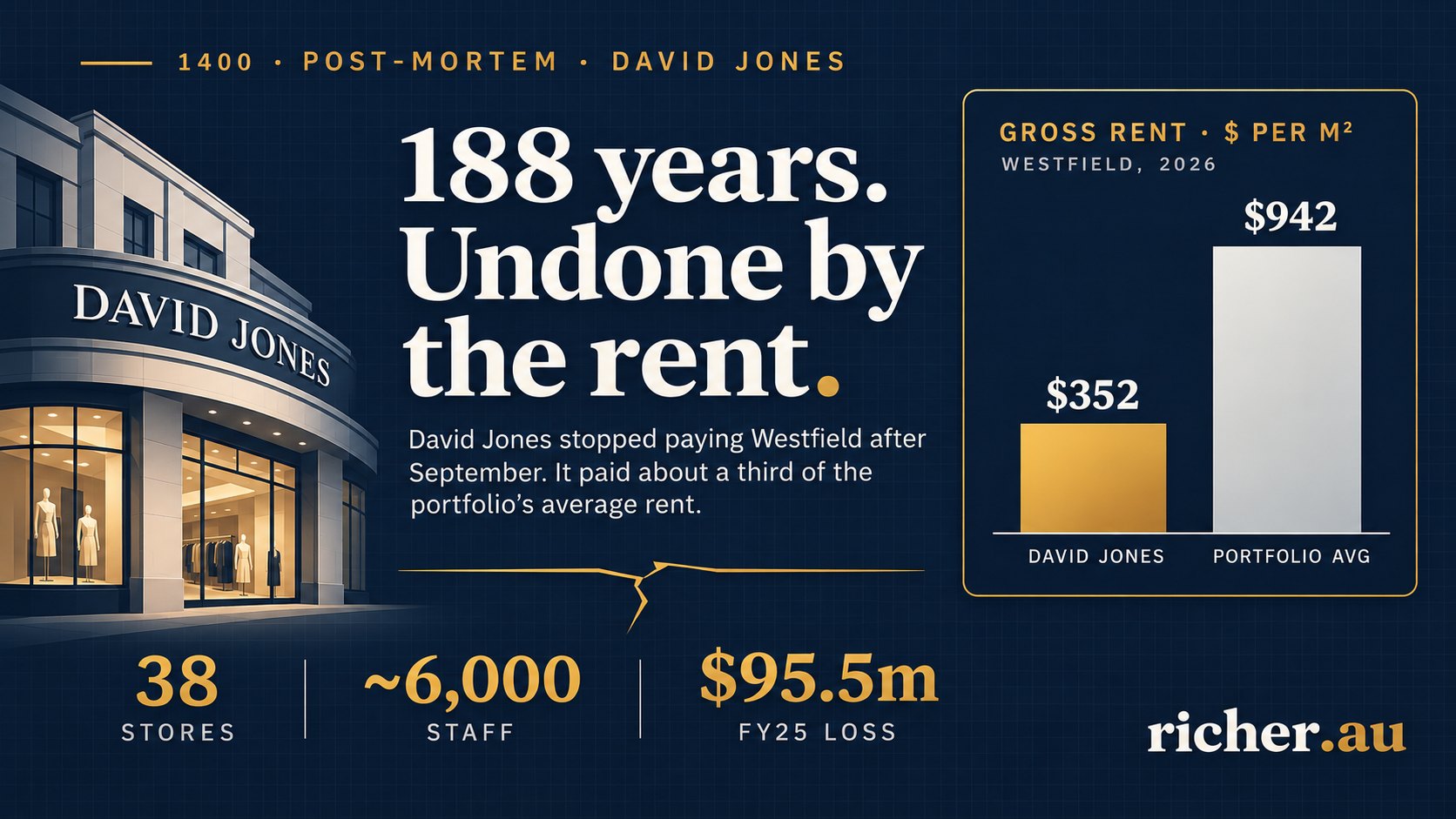
From the landlord's side, the refusal is easier to understand once you see the rent. Scentre was already charging David Jones $352 a square metre against a portfolio average of $942. It held bank guarantees worth about eight months of rent. Its chief executive had said back in April that older department store leases produced far less rent per square metre than the tenants who replace them. A landlord in that position has less to lose from a closure than the tenant assumes.
What happens now
There are two separate appointments, and they have different jobs. The administrators, McGrathNicol, control the company, investigate its affairs, report to creditors and run a sale process seeking either a recapitalisation or a buyer for the business as a going concern. The receivers, FTI Consulting, act for Hilco: they control the assets Hilco's loan is secured over and are trading the stores while they review them. In practice the secured lender has the strongest hand, because it is paid first from the assets it is secured over.
The most likely outcome is a much smaller David Jones, if a buyer can be found, concentrated in city flagships and affluent centres, with the outer-suburban stores closed. Creditors will vote on the future at a second meeting once the administrators report. Until then, employees, brands that supplied stock on concession or credit, and landlords wait. Gift card holders are unsecured creditors; consumer groups have advised spending cards sooner rather than later, and whether they keep being honoured is a decision for the people running the business.
Administrators are appointed by directors (or sometimes creditors) to give an insolvent company breathing space and work out the best result for creditors as a whole. Receivers are appointed by a secured lender to recover that lender's money. They can operate side by side, as they are here.
What it means for Myer
Myer is the obvious beneficiary, and the market priced it in quickly. Its shares rose more than 27% between Monday, when concerns about David Jones intensified, and Thursday's appointments. The case is straightforward: it is the only national department store left, and David Jones' customers, brands and best leases are all now in play. One estimate reported by Proactive Investors put the sales opportunity at around $180 million.
The case against is just as strong. Myer is in the same declining category, facing the same shoppers and the same landlords.
| Measure | Myer (FY26, to 25 July 2026) | David Jones |
|---|---|---|
| Ownership | Listed on the ASX (MYR) | Private, Anchorage Capital Partners |
| Total sales | $4.09bn | Not published for FY26 |
| Statutory result | −$276.5m | −$95.5m (FY25, pre-tax) |
| Underlying profit | $42.5m NPAT | Loss-making |
| Balance sheet | Net cash $100.1m | Dependent on an asset-backed lender |
| Early FY27 trading | Comparable sales broadly flat | In administration |
Myer's statutory loss was mostly a $279.6 million non-cash impairment — a write-down of goodwill, brands and stores. That write-down is itself a signal: the board marked down what its own stores are worth. The underlying business still made money and has net cash, which is precisely the difference between Myer and David Jones. Myer can afford to wait. David Jones could not.
How it plays out in the short term:
- The downside comes first. Closing stores tend to clear stock at heavy discounts. That pulls Christmas sales away from Myer in the same centres just as it needs a strong season.
- The upside comes later. Shoppers, brands and loyalty members will need a new home once stores close. Myer could also pick up selected leases, though industry sources talk about a handful, not a chain.
- Landlords will remember. Every centre owner now knows exactly how little department stores pay and how much they can earn by replacing one. Myer's own lease renewals just got harder, not easier.
Our read: Myer is the relative winner in a shrinking category. Less competition buys it time and some sales, but it does not fix the model. The shares had fallen more than 50% in 2026 before this week's rally, which tells you how the market saw the business before its rival failed.
What it means for Westfield and the other landlords
Here is the counter-intuitive part. The landlord that broke off the talks is the one least hurt by the collapse.
| Landlord | David Jones stores | Share of income | Security held |
|---|---|---|---|
| Scentre Group (SCG), Westfield | 17 stores, ~200,000 m² | $45m, 1.8% of gross rent, ~3.6% of FFO | ~$30m of bank guarantees, about 8 months' rent |
| Vicinity Centres (VCX) | 4 stores | $34m, 2.4% of gross rental income | None. About $2.2m unpaid at 31 Oct; leases expire 2029–2041 |
| Charter Hall Long WALE REIT (CLW) | 50% of the Elizabeth St flagship | About 4% of net property income | Bank guarantee of about 12 months' rent; lease to 2040 |
| GPT Group (GPT) | 2 centres direct, 1 through its wholesale fund | About $4m of rent in 2026 | Not disclosed |
For Scentre, the David Jones rent is a rounding error. It reaffirmed its 2026 guidance the day before the collapse, with Westfield occupancy at 99.8% and visits up 3.2% for the year. Its shares barely moved, and property trusts rallied on 5 November as bond yields fell. More importantly, it is replacing a tenant paying $352 a square metre in a portfolio averaging $942.
Anchors were never priced for their own rent. They paid low rates because they drew shoppers past higher-paying specialty shops, and shopping centre leases often carry co-tenancy expectations built around them. The real risk for a landlord is not the lost rent; it is the empty, dark box in the middle of the mall, the cost of refitting it, and a year or two of downtime before new tenants open.
Ranked by how exposed they really are, the order is the reverse of their size:
- Charter Hall Long WALE REIT owns half of a single, specialised CBD building leased to one tenant. A 12-month guarantee is helpful, but if David Jones leaves, the lease that made the building look like a bond — 20 years, triple net, fixed increases — is worth only what a receiver decides to keep.
- Vicinity holds no guarantees, has unpaid rent already, and its stores include some of David Jones' best, at Chadstone, Chatswood Chase and QueensPlaza. Those are also the stores most likely to survive a restructure, which cuts both ways.
- Scentre has the smallest proportional exposure, the most security and the biggest upside from re-letting at higher rents.
Look past the headline percentage of rent. Ask how much security the landlord holds, whether the lease is with the operating company or a parent that can pay, how long the space would sit empty, what refitting will cost, and whether the replacement tenants would pay more. We compare the big ASX property trusts in Listed property is on sale. Is it cheap?
What it means for retail
David Jones is the biggest name to fall, but not the first. Barbeques Galore, Betts, Stateside Sports, Glue Store and a string of smaller fashion brands have gone into administration or closed stores in 2026. Reuters described David Jones as one of a number of Australian businesses restructuring under high fuel costs and a slowing economy.
Three things are worth separating:
- The cycle. Five rate rises and higher fuel prices are squeezing discretionary spending. The RBA has signalled it may now pause, but households on variable mortgages are still adjusting to the last increase. For our view on where rates go next, see our interest rate forecast, and on the wider economy, whether Australia is heading for recession.
- The structure. Spending is splitting towards value (Kmart, Uniqlo, discount department stores, outlets) and towards genuine luxury, while the middle shrinks. Department stores sit in that middle.
- The knock-on. Small brands that sold through David Jones on concession or on credit are now unsecured creditors, and some are scrambling to recover stock. Expect a few supplier failures to follow.
None of this means shopping centres are dying. Scentre's own figures show visits rising. It means the space inside them is being reallocated from big, low-rent anchors to many smaller, higher-rent tenants — which is good for the best centres and hard on the weakest.
Is commercial property a risky investment?
Yes — but the risk is different from residential, not simply larger. The David Jones case shows both sides of it.
A commercial lease can look like a bond. The Elizabeth Street building came with a 20-year, triple-net lease to a household name, rent rising every year, on a 5% initial yield. For six years it behaved exactly as promised. The risk was never in the lease document; it was in the tenant's ability to keep paying.
| Factor | Residential investment | Commercial investment |
|---|---|---|
| Lease length | Usually 6–12 months | Often 3–10 years; anchors 15–25 years |
| Outgoings | Paid by the owner | Often paid by the tenant (net or triple-net leases) |
| Typical yield | Lower | Higher, to compensate for the risks below |
| Vacancy | Short and frequent; many possible tenants | Rare but long; few tenants fit a specialised building |
| Re-letting cost | Small | Can include incentives, fit-out and months of free rent |
| Tenant concentration | Low | Often one tenant is all the income |
| Value driver | Land and the owner-occupier market | The income stream and the tenant's covenant |
| Lending | Higher loan-to-value, longer terms | Lower LVR, shorter terms, covenants on income |
So commercial property trades frequent small problems for rare large ones. A residential landlord loses a few weeks' rent every couple of years. A commercial landlord can collect every dollar for a decade and then lose the income, the tenant and a chunk of the value in a month. Neither is safer in the abstract. The question is whether you are being paid enough for the risk you are holding, and whether you can survive the vacancy if it comes.
The checks that matter, all visible in this case:
- Tenant strength, not tenant fame. A famous brand owned by a thinly capitalised company is a weak covenant. Know which entity signed the lease and whether a parent guarantees it.
- Rent against sales. If the rent is rising 2.5% a year and the tenant's sales are falling, the lease is getting riskier every year even though it looks better on paper. Ask for the occupancy cost — rent as a share of sales — wherever you can.
- Passing rent against market rent. A property rented above what a new tenant would pay is over-rented. Its value depends on the current tenant surviving.
- Security. Eight months of guarantees, twelve months, or none: Scentre, Charter Hall and Vicinity sat at three different points on that scale, and their exposure differs accordingly.
- Alternative use. How quickly, and at what cost, could the space be re-let to someone else? A flexible floor plate in a strong location is the real safety net.
- Your own gearing. A vacancy is survivable if your debt is modest and your cash buffer covers the downtime. It is fatal if the lender needs the rent to stay within its loan covenants.
If you want commercial exposure without single-tenant risk, a diversified listed REIT spreads it across hundreds of leases, at the price of share-market volatility. Direct ownership gives control and, often, a higher yield, but concentrates the risk in one tenant.
What this case proves
- A brand is not a balance sheet. 188 years of goodwill did not pay a single month's rent. Customers liked David Jones; that was never the problem.
- Sale-and-leaseback swaps an asset for a liability. Selling the buildings raised hundreds of millions of dollars and left a rent bill that rose every year whatever happened to sales. It is the test from our assets-versus-liabilities article: an asset puts money in your pocket; a liability takes it out.
- Fixed costs decide who survives a downturn. When sales fall 5%, a business with high fixed costs can see its profit fall far more. Leases are the largest fixed cost a retailer has.
- Time is bought with cash. Myer and David Jones faced the same shoppers. One had net cash and an underlying profit; the other had an asset-backed lender and late bills. We saw the same pattern with Bathla: solvency on paper is not the same as cash in the bank.
- Cheap rent can still be too much rent. David Jones paid about a third of the Westfield average and still could not afford it. A low rent is not a safe rent if the business behind it is shrinking.
- Landlords hold more power than tenants assume. When the tenant pays well below what the space could earn, the landlord can afford to say no.
Own the asset, not the obligation. The investors who end up Richer are the ones who can keep paying their bills in the worst year, not just the average one.
If no department store moves in: what centres can do
Australia has no third national department store chain. Myer may take a few sites, but most closing David Jones stores will not be replaced like-for-like. The good news for landlords is that they have been doing this for years — Myer, Target and David Jones itself have all handed back floors — and the playbook is well tested.
The options, roughly in the order landlords reach for them:
| Option | What it involves | Australian examples |
|---|---|---|
| Split into mini-majors | Divide floors into 1,000–3,000 m² shops for sport, fashion and electronics chains | Westfield Tuggerah: former David Jones space, $20m works, JD Sports and Rebel open and Timezone due in 2027. Westfield Hurstville: former Myer became Woolworths, JB Hi-Fi, Big W and Cotton On |
| Discount department store or supermarket | Re-let a whole level to Kmart, Big W or a supermarket | Westfield Carindale and Westfield Tuggerah: Kmart took former David Jones upper floors |
| Leisure and entertainment | Gyms, trampoline parks, arcades, bowling, cinemas | Bayside, Frankston: former Myer now Revo Fitness, BounceInc, Uniqlo, TK Maxx, Rebel and Foot Locker |
| Health, childcare and services | Medical centres, imaging, dental, childcare, government services | A growing share of new tenancies in suburban centres |
| Offices and coworking | Upper floors converted to workspace | Emporium Melbourne: former Myer space for a coworking operator. Bayside: offices with Hub Australia |
| Swap the anchor | Bring in the other department store | Myer replaced David Jones at Westfield Eastgardens and Bankstown |
| Redevelop, including housing | Demolish and rebuild as mixed use, apartments or build-to-rent above retail | Market Street, Sydney: the old David Jones menswear store became luxury retail with apartments above. Vicinity's Bankstown and Chadstone mixed-use plans |
| Logistics | Click-and-collect or last-mile fulfilment in back-of-house space | Used for parts of floors with poor shopper access |
The economics are what decide it. At Tuggerah, Scentre reported visits up 6.2% in the eight weeks after the new retailers opened. That is the real return: not only the rent from the new tenants, but more shoppers walking past everyone else. The cost is significant. At a 6% hurdle rate, which is our assumption, $20 million of works needs roughly $1.2 million a year of extra rent, or extra sales across the centre, to pay for itself. In a strong centre that is achievable. In a weak one it may not be, which is why some boxes will sit empty for a long time, or be bulldozed for car parks, open-air dining or housing.
Expect a split. Prime centres with high foot traffic will re-let former David Jones floors quickly and at higher rents. Weaker outer-suburban and regional centres face longer vacancies and more pressure on value. If you are buying a shopping centre stake, directly or through a fund, the quality of the centre matters more than ever.
The bottom line
David Jones did not fail because Australians stopped liking it. It failed because a shrinking business carried fixed costs it had locked in during better years, owned too little of its own property, and had an owner without the capital to wait out a downturn. The rent dispute with Westfield was simply the moment the numbers stopped working.
For Myer, it is a reprieve rather than a rescue. For Scentre, it is a manageable loss and probably a long-run gain. For Vicinity and Charter Hall, it is a test of how much a long lease is really worth. For investors, the lesson applies well beyond retail: judge a property by the tenant's ability to pay, the security you hold and what happens if the space goes empty — not by the length of the lease or the fame of the name on the door. Think Richer, and you buy income that survives the bad year.
Frequently asked questions
Why did David Jones go into administration?
Years of losses ($74.1 million in FY24 and $95.5 million in FY25), a shrinking department store market, rising rent on buildings it had sold and leased back, too many unprofitable stores and a thinly capitalised owner. The trigger was a breakdown in rent talks with Westfield owner Scentre Group: David Jones stopped paying rent after 30 September and its owner rejected Scentre's offer.
Is David Jones closing all its stores?
Not immediately. As at 6 November 2026 the stores and website are trading under the control of the receivers while the administrators look for a buyer or a recapitalisation. Some stores, particularly loss-making outer-suburban ones, are widely expected to close.
Can I still use my David Jones gift card?
Gift card holders are unsecured creditors, so whether cards keep being honoured is a decision for the administrators and receivers. Consumer groups have advised using them sooner rather than later. Check David Jones' website and the administrators' updates for the current position.
Who owns David Jones?
Private equity firm Anchorage Capital Partners, which bought it from South Africa's Woolworths Holdings for a reported $100 million. Control now sits with the administrators, McGrathNicol, and the receivers, FTI Consulting, appointed by lender Hilco.
Is this good news for Myer shares?
It is good news for Myer's competitive position, and the shares rose sharply this week. But Myer is in the same declining category, reported a $276.5 million statutory loss for FY26 and faces short-term clearance discounting from closing David Jones stores. This is general information, not a recommendation.
Is Westfield in trouble because of David Jones?
No. David Jones is about 1.8% of Scentre's gross rent, Scentre holds about eight months' rent in bank guarantees, and the space was let at about a third of the Westfield average rate, so re-letting it may eventually raise income. The main costs are refitting the space and the downtime.
Is commercial property riskier than residential property?
It is differently risky. Commercial property offers longer leases, higher yields and tenants who pay outgoings, but vacancies are rarer, longer and more expensive, and one tenant can be the whole income. The tenant's financial strength, the security held and the space's alternative uses matter more than the lease term.
What happens to empty department store space?
Landlords usually split it into smaller shops, re-let a level to a discount department store or supermarket, add gyms, entertainment, dining and health services, convert upper floors to offices, or redevelop the site, sometimes with housing above. At Westfield Tuggerah, former David Jones space now holds JD Sports and Rebel, with Timezone to follow.
Sources
All figures as at 6 November 2026 unless stated. The Elizabeth Street rent estimate and the capital-works hurdle are richer.au calculations from the cited inputs.
- McGrathNicol and FTI Consulting, appointment statement via Retail World Magazine, "Voluntary administrators appointed for David Jones", 5 Nov 2026. retailworldmagazine.com.au
- ABC News, "David Jones calls in administrators, leaving retailer's future in doubt", 5 Nov 2026. abc.net.au
- ABC News, business live blog, 5 Nov 2026 (Hilco, Charter Hall, analyst comments). abc.net.au
- Reuters via Daily Maverick, "Australia's 188-year-old retailer David Jones enters administration, faces sale", 5 Nov 2026. dailymaverick.co.za
- Commercial Real Estate, "David Jones calls in administrators as Scentre deal falls over", 5 Nov 2026. commercialrealestate.com.au
- Ragtrader, "Westfield puts a number on David Jones exposure", 4 Nov 2026. ragtrader.com.au
- BusinessDesk, "David Jones enters voluntary administration as lender appoints receivers", 5 Nov 2026. businessdesk.co.nz
- Ragtrader, "David Jones owes $2.2m to Vicinity Centres", 5 Nov 2026. ragtrader.com.au
- Finance News Network, "Vicinity Centres addresses David Jones administration impact", 5 Nov 2026. finnewsnetwork.com.au
- Financial Standard, "Mall owners count cost as David Jones enters administration", 5 Nov 2026. financialstandard.com.au
- Real Estate Source, "Charter Hall assesses David Jones flagship exposure after retailer collapse", 5 Nov 2026. realestatesource.com.au
- Charter Hall, "$510 million acquisition of David Jones flagship Sydney CBD store", 21 Dec 2020. charterhall.com.au
- The Urban Developer, "David Jones downfall puts cloud over 390,000 sq m of retail space", 5 Nov 2026. theurbandeveloper.com
- The Conversation, "David Jones falls into administration – and its outdated business model explains why", Nov 2026. theconversation.com
- SBS News, "What David Jones' administration means for shoppers, stores and gift cards", 5 Nov 2026. sbs.com.au
- Canberra Times, "David Jones faces store closures after Scentre rent breach", Nov 2026. canberratimes.com.au
- Proactive Investors, "Myer shares jump as David Jones collapse opens A$180 million sales opportunity", Nov 2026. proactiveinvestors.com
- Smallcaps, "Myer Holdings sales edge higher as continued economic headwinds slow profit", 23 Sep 2026 (Myer FY26 results). smallcaps.com.au
- Mi-3, "Myer posts $276m loss, warns volatile trading conditions", 24 Sep 2026. mi-3.com.au
- The Adviser, "RBA tightens the reins on cash rate", 3 Nov 2026. theadviser.com.au
- Kalkine, "ASX Stock in Focus: Scentre Group reaffirms guidance and addresses David Jones rent", 4 Nov 2026. kalkine.com.au
- Property Council of Australia, "Repurposing retail space as department stores downsize" (JLL research). propertycouncil.com.au
- Ragtrader, "Department store sales struggle across Vicinity Centres", May 2026. ragtrader.com.au
Keep reading
James Zhang writes richer.au's Property, Shares, Commodities and Wealth coverage. He has invested through more than two decades of Australian market cycles — including the 2008 crisis, the 2011–15 commodities bust, the 2020 recession and the 2022–23 hiking cycle — across residential, commercial and development property and listed markets.
General information only. This article is general information, not personal financial, investment, taxation or legal advice, and doesn't account for your objectives, financial situation or needs. Rent estimates and illustrations are the author's calculations from published figures, not forecasts. Forecasts quoted are those organisations' opinions at the dates shown and change without notice. Mention of a company or fund is not a recommendation to buy or sell it. Figures are sourced and dated as shown and can change. Past performance is not a reliable indicator of future performance. Richer Online Pty Ltd (ABN 62 159 604 949) does not hold an Australian Financial Services Licence and has no commercial relationship with any company or fund mentioned. Read the Terms of Use or get in touch.
Get richer, one decision at a time
New articles as they land.
Property, shares, commodities and tax strategy — worked examples with real Australian figures and no product spruiking. One email when something new goes live.
No spam · unsubscribe any time