1200 · Strategy
Buy what 2036 will want.
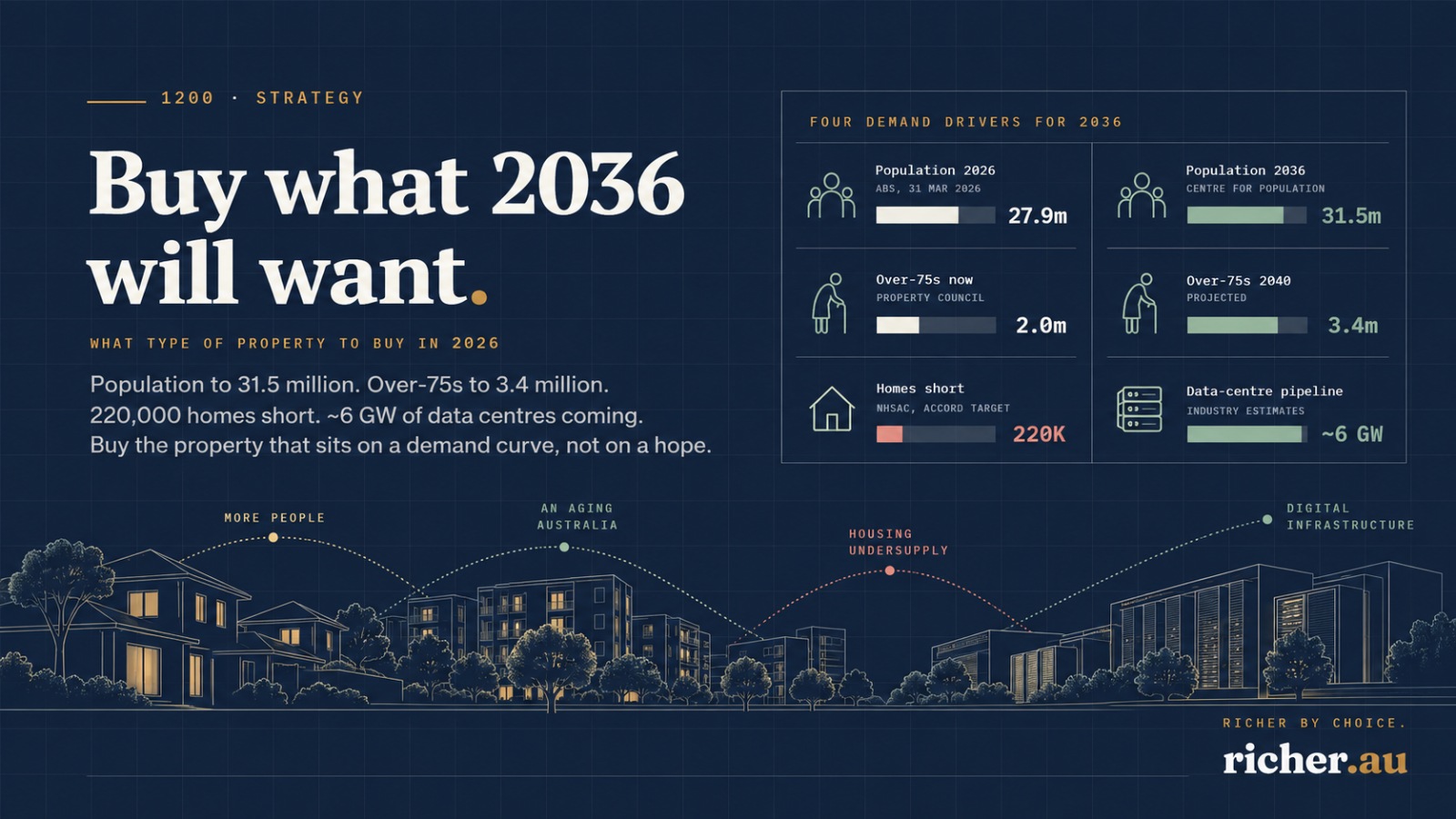
What type of property to buy in 2026 is the wrong question. The right one is what type of property more people will want in 2036 — and whether anyone can build another one. A four-part test, run on the population, ageing, supply and infrastructure figures as they stand today.
Sources: ABS, Centre for Population, Property Council, NHSAC, CommBank
The only question that matters is what a buyer will pay in 2036
Ask what type of property to buy in 2026 and you will get a hundred answers about interest rates, auction clearance rates and which suburb "did 12% last year." None of that is the question. A property is a claim on future demand: what you get back depends almost entirely on how many people will want that exact thing, in that exact place, in ten years' time, and how many more of them will have been built by then. Last year's growth tells you what buyers wanted last year. It tells you nothing about whether they will still want it in a decade.
So this article is not a list of hot suburbs. It is a four-part test — will demand be greater in a decade, what will drive it, what will supply do, and which themes have a decade of demand already visible — with the 2026 figures that let you run it on any property you are looking at. The conclusion is one idea, and it is the whole strategy: buy the properties that will grow greater in demand over time, and let everything else follow.
- The decade test: will more people want this in 2036?
- What drives demand: population, demographics, income and industry
- The residential checklist: schools, safety, shops, walk score, transport
- Supply and demand: is this type scarce, or being built exponentially?
- Four investment themes with a decade of demand already visible
- The one idea: buy what grows greater in demand
The decade test: will more people want this in 2036?
Every property decision on richer.au starts with cash flow — an asset pays you, a liability doesn't. This article is about the second question, the one that decides how much it will pay you later: will this specific type of property, in this specific place, be in greater demand in ten years than it is today?
That is a different question from "will it go up." Almost everything went up between 2020 and 2026 because money was cheap and then because there weren't enough homes. A rising tide is not evidence of demand for your particular boat. The decade test asks you to name the people who will want to rent or buy this property in 2036 — how old they are, what they do for a living, why they are in that suburb and not the next one — and then to check whether there will be more of those people or fewer. If you can't name them, you don't have an investment thesis; you have a hope that someone else will pay more.
Who is the 2036 tenant or buyer? Is that group growing where this property is? Is anything about the property itself going to be obsolete (the layout, the energy rating, the car park nobody needs)? And how many more of these will exist by then? If the answers are "a growing group, nothing obsolete, and not many more," you are looking at the right type of property. If any answer is a shrug, keep looking.
What drives demand: population, demographics, income and industry
Four forces set the size of the 2036 buyer pool, and all four are measurable today.
Population growth — and where it actually lands
Australia had 27.9 million people at 31 March 2026, 392,700 more than a year earlier. Three-quarters of that growth was net overseas migration, 292,100 people, and it is not spread evenly: Western Australia grew 2.1%, Victoria 1.6%, Tasmania 0.6% (ABS, 17 September 2026). The Centre for Population projects 31.5 million by 2035–36 — 3.6 million more people in a decade — and, crucially, that capital cities will grow nearly twice as fast as the rest of each state, with WA the fastest state (2025 Population Statement, 9 January 2026). Migrants land in capitals, near jobs and universities. That is the single most reliable source of new demand in the country, and it points at the big cities, not away from them.
Changing demographics — the demand curve you can see 40 years out
The Intergenerational Report projects that the number of Australians aged 65 and over will more than double, and the number aged 85 and over will more than triple, by 2062–63, in a population of 40.5 million (Treasury, August 2023). The Property Council puts the number of Australians over 75 rising from two million to 3.4 million by 2040 (11 April 2024). No other demand curve in property is this predictable. Older Australians need single-level homes, homes near hospitals and GPs, retirement and land-lease communities, and — as they age further — residential aged care. Younger households, meanwhile, are having fewer children (the fertility rate is projected to hit a record low of 1.42) which shifts demand from four-bedroom houses on the fringe towards well-located two- and three-bedroom homes.
Income potential, industries and the local economy
People follow work. A suburb's rent ceiling is set by what its tenants earn, and what its tenants earn is set by which industries are hiring there. WA's population lead is a resources story; Toowoomba recorded the strongest year-on-year growth in net inflows from capital cities of any local government area in Australia, up 236%, on the back of a regional economy that is diversifying beyond agriculture (Regional Movers Index, March 2026 quarter). When you assess a location, look at the employers, not the cafés: a hospital precinct, a university, a port, a new rail line or a data-centre cluster is a decade of wage growth in the ground. A suburb whose only employer is the property market itself is a suburb whose rents can only rise as fast as the next buyer's borrowing capacity.
The residential checklist: schools, safety, shops, walk score, transport
For a house or apartment, "greater demand in a decade" comes down to six things that families and tenants pay for, year in and year out, regardless of the interest-rate cycle. None of them is glamorous. All of them are checkable before you inspect.
| Factor | Why it holds demand for a decade | How to check it in 2026 |
|---|---|---|
| Good schools | Families pay a premium to be in-zone for a strong public school, and the premium survives every downturn because the school doesn't move. | My School (myschool.edu.au) for results; the state education department's catchment maps for the exact boundary — buy inside it, not near it. |
| Safe neighbourhood | Perceived safety decides whether a family stays ten years or leaves in two; turnover is the enemy of rent growth. | State crime statistics agencies publish offences by suburb (BOCSAR in NSW, Crime Statistics Agency in Victoria); compare the trend, not one year. |
| Shopping centre | A major centre anchors employment, transport and the daily errands that make a suburb self-contained. | Distance to the nearest full-line supermarket and regional centre; check for approved centre expansions in the council's DA register. |
| Walk score | Walkability is what younger tenants and older downsizers both want; it is the one factor that suits both ends of the demographic curve. | walkscore.com for the address; anything above 70 is genuinely walkable, below 50 means a car for everything. |
| Transportation | A train station or rapid-bus stop within walking distance extends the property's catchment to every job in the city. | Ten-minute walk to a station is the test. Check the state transport agency's committed projects — funded and under construction, not "proposed." |
| Amenities | Parks, hospitals, sport, a main street: the reasons people choose a suburb over the identical one next door. | Walk it at 6pm on a weekday and 10am on Saturday. Empty streets both times is the answer. |
Judgement, not data: the checklist is how richer.au screens residential property, not a guarantee of returns. The tools named are public and free at the time of writing.
The properties that pass all six are rarely the cheapest in the area, and that is the point. A cheap house in a suburb with no school, no station and a shrinking employer base is cheap because the 2036 buyer is not coming. A dearer house in the right catchment is dearer because the 2036 buyer is already visible in the 2026 price.
Supply and demand: is this type scarce, or being built exponentially?
Demand is only half of it. The most common way to lose money in Australian property is to buy the right demand story and the wrong supply story — a one-bedroom apartment in a precinct where 4,000 more one-bedroom apartments are approved. So the third test: is this type of property limited in number, or is it being built as fast as buyers will take it?
At the national level, supply is losing. The National Housing Supply and Affordability Council projects 980,000 new homes over the National Housing Accord period against a target of 1.2 million — a shortfall of 220,000 (State of the Housing System 2026, 30 April 2026). The rental market shows the same thing in real time: SQM Research's national vacancy rate was 1.3% in July 2026, with Perth, Adelaide, Hobart and Darwin all at 0.6% or below and only Sydney, Melbourne and Canberra above 1.5% (13 August 2026). That is a tight market almost everywhere, and it is why anything with a tenant in it has held up.
But "tight nationally" hides exactly the trap you need to avoid. The types of property that can be built quickly and at scale — high-rise apartments on rezoned corridors, fringe house-and-land packages, generic industrial sheds — will be built quickly and at scale the moment prices justify it, and their scarcity evaporates. The types that can't be replicated hold their scarcity for decades: a house on land in an established suburb inside a school catchment, a shop on the main street, a consulting suite beside the hospital, a coastal block with the view that can't be built out. The supply question is really a replication question: how easily can someone build another one of these? If the answer is "easily," your capital growth is capped at the cost of building the next one.
Count the cranes, then count the approvals. Your state's planning portal and the council's DA register list every approved dwelling in a precinct. If approved supply exceeds a few years of the suburb's absorption, the 2036 buyer will have plenty of choice — and choice is what stops rents and prices rising. Scarcity is a property of the type and the location together, never of the postcode alone.
Four investment themes with a decade of demand already visible
Put the three tests together — growing demand, a named driver, constrained supply — and a handful of themes stand out for 2026 because their demand is already written into the demographic and infrastructure data. None is a free lunch; each has its own supply risk, noted below.
1. Medical assets for an ageing population
Australia spent $270.5 billion on health in 2023–24, 10.1% of GDP and $10,037 per person (AIHW, 29 October 2025), and the population that consumes most of it — the over-65s — is set to more than double. GP clinics, allied-health suites, day surgeries, pathology and imaging premises near hospitals are the physical footprint of that spending. They tend to come with long leases, tenants who fit out at their own cost and are reluctant to move, and demand that rises with age rather than the economic cycle. The supply check: medical zoning near a major hospital is genuinely limited; a "medical centre" in a strip of shops with no hospital nearby is just a shop.
2. Retirement living and land-lease communities
The Property Council estimates the retirement living sector needs 67,000 new units by 2030, with the over-75 population rising from two million to 3.4 million by 2040 (11 April 2024). Retirement villages, land-lease communities and the well-designed single-level homes that downsizers actually buy sit right on top of the most predictable demand curve in the country. For a direct investor that can mean the downsizer product itself — the single-level home or ground-floor apartment near shops and a medical precinct — or exposure through the listed operators. The supply check: villages take years to approve and build, which is exactly why the shortfall exists.
3. Sea-change and tree-change destinations
Capital-city residents moving to the regions outnumbered those moving the other way by 29.7% in the March 2026 quarter, and the Regional Movers Index hit a record, up 20.1% on the December quarter (23 June 2026). The Sunshine Coast took 8.8% of the net flow, Greater Geelong 5.3%, with Fraser Coast, Moorabool and Lake Macquarie next. These are places with hospitals, universities and airports, not just beaches. The supply check is the sharpest of the four: coastal land with a view is finite, but the flat paddocks behind the town are not, and much of the regional boom will be met by house-and-land estates that carry no scarcity at all.
4. AI infrastructure and the land around it
CommBank estimates around $150 billion of data-centre investment in Australia by 2030, with roughly 1.5 gigawatts operating at the end of 2025 and about six gigawatts in the pipeline — about half of it in NSW and a quarter in Victoria (6 August 2026). Almost nobody reading this will buy a data centre. But every gigawatt needs industrial-zoned land with power and fibre, contractors and engineers who need somewhere to live, and the substations, cooling and logistics that cluster around it. The property play is the serviced industrial land and the workforce housing in those corridors, plus the listed owners of the centres themselves. The supply check: industrial land with committed power is scarce in exactly the places the pipeline wants it; industrial land without power is just a paddock with a zoning.
| Property type, 2026 | Demand in a decade | Supply response | The decade-test call |
|---|---|---|---|
| House on land in an established suburb, inside a good school catchment, near a station | Rising — migration lands in capitals, families pay for zones | Fixed — can't build more land in the catchment | Passes |
| Medical suite beside a major hospital | Rising — ageing, health spend at 10.1% of GDP | Limited — medical zoning is scarce | Passes |
| Single-level downsizer home near shops and GPs | Rising — over-75s to 3.4m by 2040 | Limited — few built, slow to approve | Passes |
| Coastal home with a protected view in a regional city with a hospital | Rising — record regional migration | Fixed — the view can't be replicated | Passes, priced accordingly |
| Serviced industrial land in a data-centre corridor | Rising — 6 GW pipeline | Limited by power and fibre | Passes for those who can hold it |
| Generic one-bedroom apartment in a rezoned high-rise precinct | Flat — same tenant pool, more competition | Exponential — thousands more approved | Fails on supply |
| House-and-land package on the fringe with no station or employer | Uncertain — depends on the next estate | Exponential — flat land is not scarce | Fails on supply |
| Vacant land held for growth, no tenant | Maybe — but it pays nothing while you wait | Varies | Fails the cash-flow test first |
The calls are richer.au's judgement applied to the three tests, not predictions for any individual property. A property in a "passes" category can still be a bad buy at the wrong price, and a "fails" category can hold exceptions.
The one idea: buy what grows greater in demand
Strip away the suburb tips and the rate forecasts and the strategy for 2026 is a single sentence: find the properties that will grow greater in demand over time. Everything else in this article is a way of checking that sentence against the evidence. Population is growing by 390,000 a year and landing in the capitals. The over-75s go from two million to 3.4 million within 14 years. The country is 220,000 homes behind its own target and vacancy is 1.3%. Health spending is a tenth of GDP and rising. Six gigawatts of data centres are coming and each one needs land, power and people. Those are not opinions; they are the demand curves of the next decade, published, dated and sitting in the Sources below.
The property that sits on one of those curves, in a location where the driver is visible and the supply can't be replicated, will be worth more in 2036 because more people will want it — not because someone took a bigger loan. That is the difference between investing and hoping, and it is the only version of property that has ever made anyone Richer for the long term.
Name the 2036 buyer. Confirm the driver in the data, not the brochure. Count the approvals. Check the cash flow — a property that pays nothing while you wait is a liability, however good the demand story. And decide the ownership structure before the contract, not after; the 2026 changes to negative gearing and the CGT discount make that choice more expensive to get wrong than it was.
Frequently asked questions
What type of property should I buy in 2026?
The type that more people will want in 2036 and that can't easily be replicated: a house on land in an established suburb inside a good school catchment and near transport; a medical suite beside a hospital; a single-level downsizer home near shops and GPs; a coastal home with a protected view in a regional city that has a hospital and an airport; or serviced industrial land where the data-centre pipeline needs power. Run every candidate through the three tests in this article — future demand, the driver behind it, and the supply response.
Is population growth slowing, and does that hurt property?
Growth is slowing from its post-pandemic peak — 1.4% in the year to March 2026, projected at 1.3% for 2025–26 — but it is still 390,000 more people a year, and the Centre for Population projects 31.5 million by 2035–36. What matters more than the national rate is where it lands: capital cities are projected to grow nearly twice as fast as regional areas, and Western Australia fastest of all.
Should I buy in the regions given the sea-change trend?
The migration is real — a record Regional Movers Index in the March 2026 quarter, with capital-to-regional movers outnumbering the reverse by 29.7% — but be precise about the type. Coastal or view land in a regional city with a hospital, university and airport passes the supply test; a house-and-land package on flat land behind the town does not, because that supply is close to unlimited.
Are apartments a bad investment in 2026?
Not as a category. A well-located, larger apartment in a low-rise building in an established suburb can pass every test. What fails is the generic one-bedroom in a rezoned high-rise precinct with thousands more approved, because the 2036 tenant will have endless choice. The question is never "house or apartment" but "how many more of these can be built here."
How do I invest in themes like medical, retirement living or data centres without buying a whole building?
Directly, through the smaller physical footprints of each theme — a consulting suite, a downsizer home, serviced industrial land — or indirectly through ASX-listed owners and operators of healthcare property, retirement communities and data centres. The listed route gives the same demand curve with liquidity and diversification; the direct route gives control and leverage. Both need the same tests.
What about vacant land or off-the-plan purchases?
Vacant land fails the cash-flow test before it reaches the demand test: it pays nothing while you hold it and costs rates, land tax and interest every year, as my own 18-year example shows. Off-the-plan is a supply-test question — you are buying into the exact precinct where the most new stock is landing, so the approvals count matters more than the display suite.
Sources
Figures are point-in-time and dated individually below. They will move — check the primary source before relying on any of them.
- Australian Bureau of Statistics, "Australia's population grows 1.4% in March 2026" — 27.9 million at 31 March 2026, up 392,700; net overseas migration 292,100; WA 2.1%, Victoria 1.6%, Tasmania 0.6%; released 17 September 2026 — abs.gov.au
- Centre for Population, "2025 Population Statement" — 31.5 million projected by 2035–36; capitals to grow nearly twice as fast as rest-of-state areas; WA fastest; fertility to 1.42; published 9 January 2026 — population.gov.au
- The Treasury, "Intergenerational Report 2023 at a glance" — Australians aged 65+ to more than double and 85+ to more than triple by 2062–63; population 40.5 million; August 2023 — treasury.gov.au
- Property Council of Australia, "Retirement living construction activity forecast to grow while nation ages" — 67,000 units needed by 2030; over-75s from two million to 3.4 million by 2040; 11 April 2024 — propertycouncil.com.au
- National Housing Supply and Affordability Council, "State of the Housing System 2026" — 980,000 new homes projected against the 1.2 million Accord target, a 220,000 shortfall; 30 April 2026 — nhsac.gov.au
- SQM Research, national residential vacancy rates — 1.3% nationally in July 2026, 40,771 vacancies; Darwin 0.3%, Perth, Adelaide and Hobart 0.6%, Brisbane 0.9%, Sydney and Melbourne 1.7%, Canberra 1.8%; released 13 August 2026 — sqmresearch.com.au
- Commonwealth Bank / Regional Australia Institute, "Regional Movers Index, March 2026 quarter" — index up 20.1% on the December quarter and 4.7% year on year; capital-to-regional movers outnumber the reverse by 29.7%; Sunshine Coast 8.8%, Greater Geelong 5.3%; Toowoomba up 236%; 23 June 2026 — commbank.com.au
- Commonwealth Bank, "Australia's data centre boom: a $150 billion investment opportunity" — ~1.5 GW operating at end-2025, ~6 GW pipeline, ~50% NSW and ~25% Victoria; 6 August 2026 — commbank.com.au
- Australian Institute of Health and Welfare, "Australia's health expenditure hits $270.5 billion in 2023–24, 10% of GDP" — $10,037 per person, 10.1% of GDP; 29 October 2025 — aihw.gov.au
Keep reading
James Zhang writes richer.au’s Property and Wealth coverage. He has bought, held and sold residential, commercial and development property over two decades, including the 18-year Western Sydney block that taught him the cash-flow test the hard way.
General information only. This article is general information, not personal financial, investment, taxation or legal advice, and doesn't account for your objectives, financial situation or needs. The "decade test" calls are the author's judgement, not forecasts for any property. Figures are sourced and dated as shown and can change. Richer Online Pty Ltd (ABN 62 159 604 949) does not hold an Australian Financial Services Licence. Consider seeking advice from a licensed financial adviser, accountant or lawyer before acting. See our Terms of Use or get in touch.
Get richer, one decision at a time
New articles as they land.
Property, shares, commodities and tax strategy — worked examples with real Australian figures and no product spruiking. One email when something new goes live.
No spam · unsubscribe any time